




Read
Are We Being Fed Fake Food?
Lab-grown meat, egg whites made by yeast, and blueberries that were never blueberries. We checked what's actually on American shelves, what's legal, who's banning what, and whether any of it is growing. The truth is less sci-fi than the internet says, and more sneaky.
Every dispatch is also a podcast. Follow on Spotify ↗
Are We Being Fed Fake Food?
Lab meat, yeast-made eggs, and blueberries that never grew on a bush. What's real, what's rumor, and how to tell the difference.
A friend brought this up over coffee, and I'll admit it caught me flat-footed. His worry was fake food, specifically fake meat, fake eggs, and fake fruit. Blueberries came up more than once. He'd been seeing posts all summer saying the FDA had "approved lab-grown eggs," that you could eat them without knowing, and that lab meat was quietly creeping into the grocery store.
I raise cattle. If somebody is growing steak in a steel tank and slipping it into the meat case, I want to know. So we dug in.
The short answer: there's real stuff here, but mostly not where people are looking. Lab-grown meat is nearly impossible to buy. Plant-based meat is shrinking. The fake food you've most likely eaten this year is a blueberry muffin, and that trick is older than the iPhone.
Here's the long answer.
The three kinds of "fake"
People use "fake food" for things that have almost nothing in common. It helps to split them apart:
- Cultivated meat (the industry name) or lab-grown meat (what everyone else calls it). Real animal cells, taken from a live animal and grown in a steel tank called a bioreactor. No slaughter involved. It is actual chicken or pork tissue, just not raised on an animal.
- Plant-based meat. Beyond, Impossible, and the like. Made from soy, peas, oils, and flavorings to act like meat. No animal cells at all.
- Precision fermentation. Yeast or other microbes programmed to produce one specific protein, like the main protein in egg white or in milk whey. The protein comes out the same as the animal version; the rest of the egg or the milk doesn't exist.
And then there's a fourth kind that isn't high-tech at all:
- Plain old imitation. Sugar, starch, oil, and dye shaped into something that looks like fruit.
Each of these has a different story, so let's take them one at a time, starting with the one that isn't sci-fi.
The blueberries: yes, many of them are fake
This is the most likely one to have ended up in your kitchen.
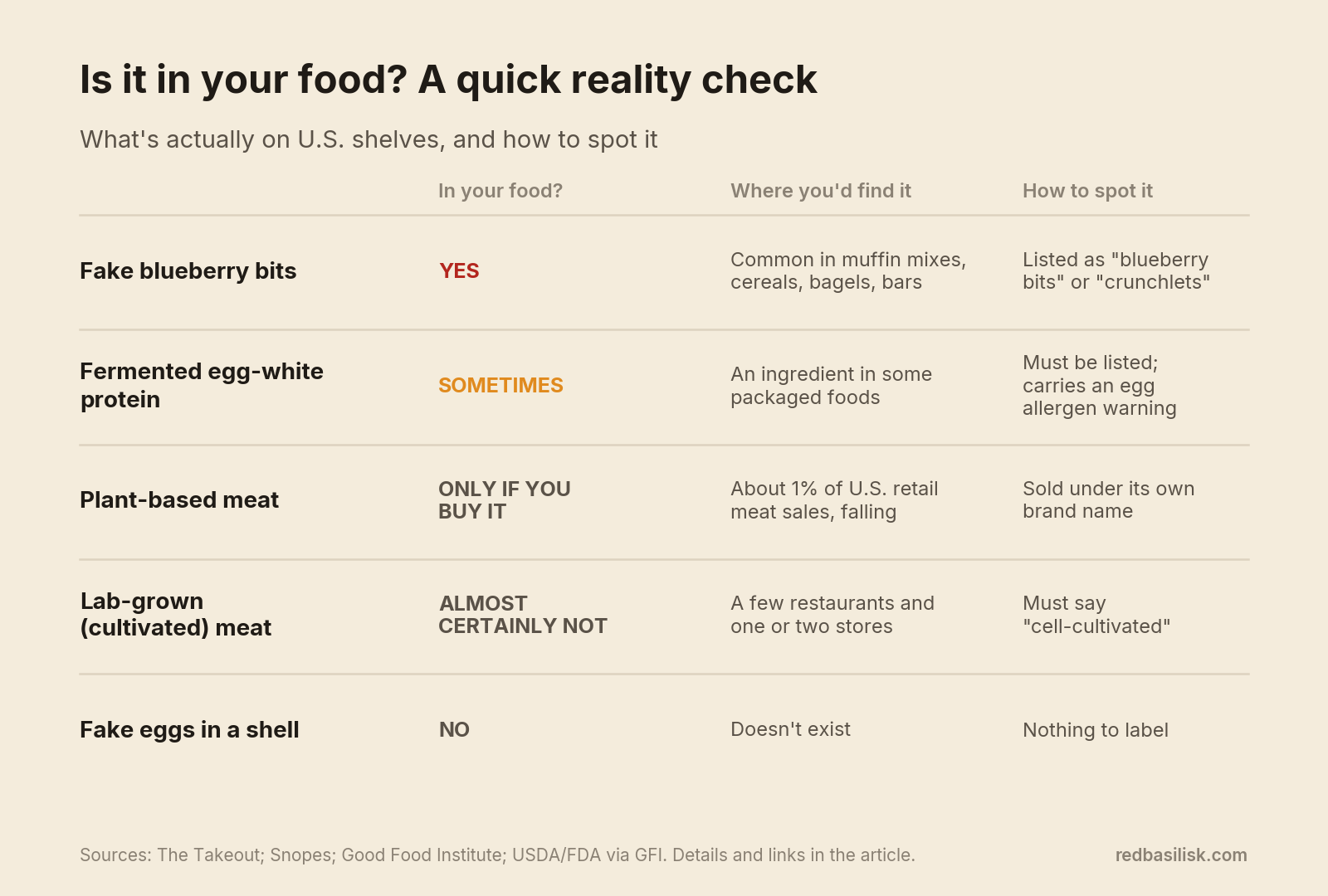
A lot of boxed "blueberry" products contain no blueberries at all. What they have instead are little blue nuggets made of sugars, starches, and oils, colored with blue and red dyes and flavored with artificial blueberry flavor. You'll find them in cereals, breads, granola bars, bagels, yogurts, and baking mixes.
Even the same brand can go both ways. Betty Crocker sells a Wild Blueberry Muffin mix made with real canned berries, and some pouches of its regular Blueberry Muffin Mix use artificial nuggets instead. Chain bagels have used "blueberry-flavored bits" too. None of this is new; newspapers were exposing it back in 2011.
Is it legal? Yes, as long as the ingredient list tells the truth. That's the catch: the front of the box shows berries, and the back tells you what's really inside.
How to spot it: flip the box over. If the ingredients say "blueberries," even canned or dried, you're getting fruit. If they say "blueberry bits," "blueberry flavored crunchlets," or "imitation blueberries" and list dyes like Blue 1 and Red 40, you're eating blue candy. Fresh berries in the produce section are real berries. Nobody is faking those.
Nutritionally, a muffin is a muffin either way. The real complaint here is paying berry prices for sugar and dye, and being misled by the picture on the front.
The eggs: what the FDA "ruling" actually was
This is what set a lot of people off this summer. In August, posts spread claiming the FDA had "approved lab-grown eggs," that they were now in stores, and that companies didn't have to put them on the label. Snopes looked into it and rated it a mix of true, false, and undetermined. Here is how it sorts out.
What's true: A company called The EVERY Company makes an egg-white protein called OvoPro. It's produced through precision fermentation using a yeast, Komagataella phaffii, that's been programmed to make egg-white protein. EVERY says OvoPro is now in products sold through Walmart and Target, and that its orders in the first four months of 2026 already equaled 550% of all of 2025. Around the same time, ADM announced it would make EVERY's egg protein at its corn processing complex in Iowa. That's the moment this moved from a startup to big ag.
What's false:
- "The FDA just approved it." There was no new ruling. Back in October 2023, EVERY told the FDA its protein was "generally recognized as safe," and the FDA answered with a "no questions" letter. The 2026 news was the rollout, not a new federal decision.
- "They don't have to label it." Snopes found no evidence of that. Federal law decides what goes on an ingredient list. And because it is the same protein as egg white, it is also an egg allergen, which has to be declared.
- "It's lab-grown egg." No chicken cells are involved. It's a single protein made by yeast, closer to how insulin or rennet for cheese has been made for decades than to lab-grown meat.
And the most important clarification: nobody is selling a fake egg in a shell. That doesn't exist. Whole eggs in the carton came from hens. OvoPro is a protein powder that goes into processed foods like baked goods, protein bars, and drinks. Plant-based substitutes like Just Egg (made from mung beans) are sold openly under their own brand. You'd have to buy one on purpose.
So the practical point is narrow but real: in packaged food, "egg" on the label no longer guarantees it came from a chicken. If that matters to you, look for wording like "animal-free egg protein."
The loophole that actually deserves the anger
The rumor was wrong, but the thing underneath it is real, and it's a better story than the rumor.
It's called GRAS, short for "generally recognized as safe." Under the current rules, a company that decides its own ingredient is GRAS can sell it in the U.S. with no FDA involvement at all. Telling the FDA is voluntary. The system dates back to 1958.
EVERY did notify the FDA. Plenty of companies don't. That's the actual gap: not a secret approval, but no requirement to ask in the first place.
It's worth noting that Washington moved on this a few weeks ago. On August 10, 2026, HHS Secretary Robert F. Kennedy Jr. announced a proposed FDA rule that would make GRAS notification mandatory. It still wouldn't require approval before sale, since companies could keep selling while the paperwork is reviewed, but it would end the "decide it yourself and tell no one" route. Public comments are open through December 9, 2026, so a final rule won't come before 2027.
A court case likely added to the confusion. In Natural Grocers v. USDA, a federal appeals court struck down a loophole that let "highly refined" GMO ingredients skip the "bioengineered" label. The plaintiffs said that exemption covered roughly 70% of GMO foods. Then in early August, a federal court ordered USDA to revise the standard by 2028, so labels won't change overnight.
Put those together and you can see how people ended up where they did: two real stories about what the government does and doesn't check, blended with a viral post about eggs.
Lab-grown meat: approved, but almost impossible to buy
Now the headline scare. Here's where things actually stand.
Federally, it's legal. Cultivated chicken from UPSIDE Foods and GOOD Meat cleared the FDA and USDA in 2023. Since then, Mission Barns (pork fat) and Wildtype (salmon) have been cleared as well. The FDA reviews the cell-growing process, and the USDA inspects production and approves every label. Packages have to say "cell-cultured" or "cell-cultivated."
In practice, you've almost certainly never eaten it. It has shown up in a handful of restaurants, like Bar Crenn in San Francisco and a restaurant in Washington, D.C. In 2025, Sprouts started selling it at a single Oakland store, and Mission Barns' pork meatballs went into Berkeley Bowl. That's about the extent of it. No cultivated meat product has reached mainstream grocery shelves nationally.
And the biggest bet in the industry just went bust. Believer Meats, an Israeli company, built a 200,000-square-foot plant in Wilson, North Carolina, billed as the largest cultivated meat facility in the world, with claimed capacity of about 12,000 metric tons (26 million pounds) of chicken a year. It won FDA clearance in July 2025 and USDA approval in November 2025. About a month later, it shut down.
Believer had raised roughly $390 million. Its builder sued over $34 million in unpaid bills. The finished plant sat empty for months, and this summer UPSIDE Foods put in a $50 million opening bid for it in the receivership sale, a fraction of the $125–150 million the plant was reported to cost. It had every piece a company needs: federal approval, USDA inspection, and a full-size plant. It still couldn't make it work.
That's the reality behind the headlines: the barrier isn't regulators. It's cost. Growing animal cells in a sterile tank, fed on pharmaceutical-grade growth media, is still far more expensive than raising an animal on grass and grain.
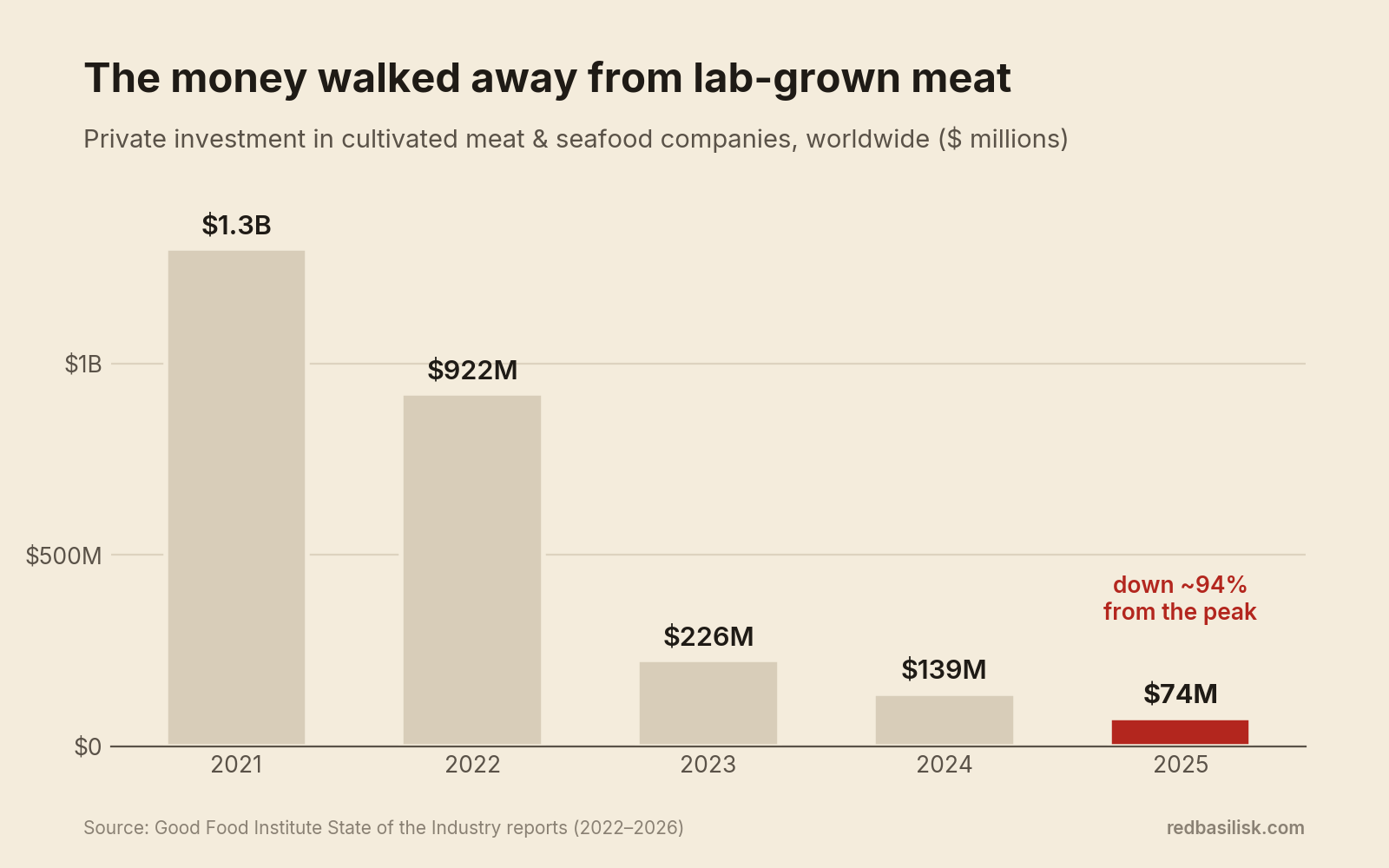
Investors have noticed. Private money into cultivated meat peaked around $1.3 billion in 2021, fell to $226 million in 2023 and $139 million in 2024, and was about $74 million in 2025. That's down roughly 94% from the peak. Since September 2024, more than 70 alternative-protein companies have merged, been bought, gone insolvent, or shut down.
The states drew a line
While Washington approved it, a lot of state capitols said no.
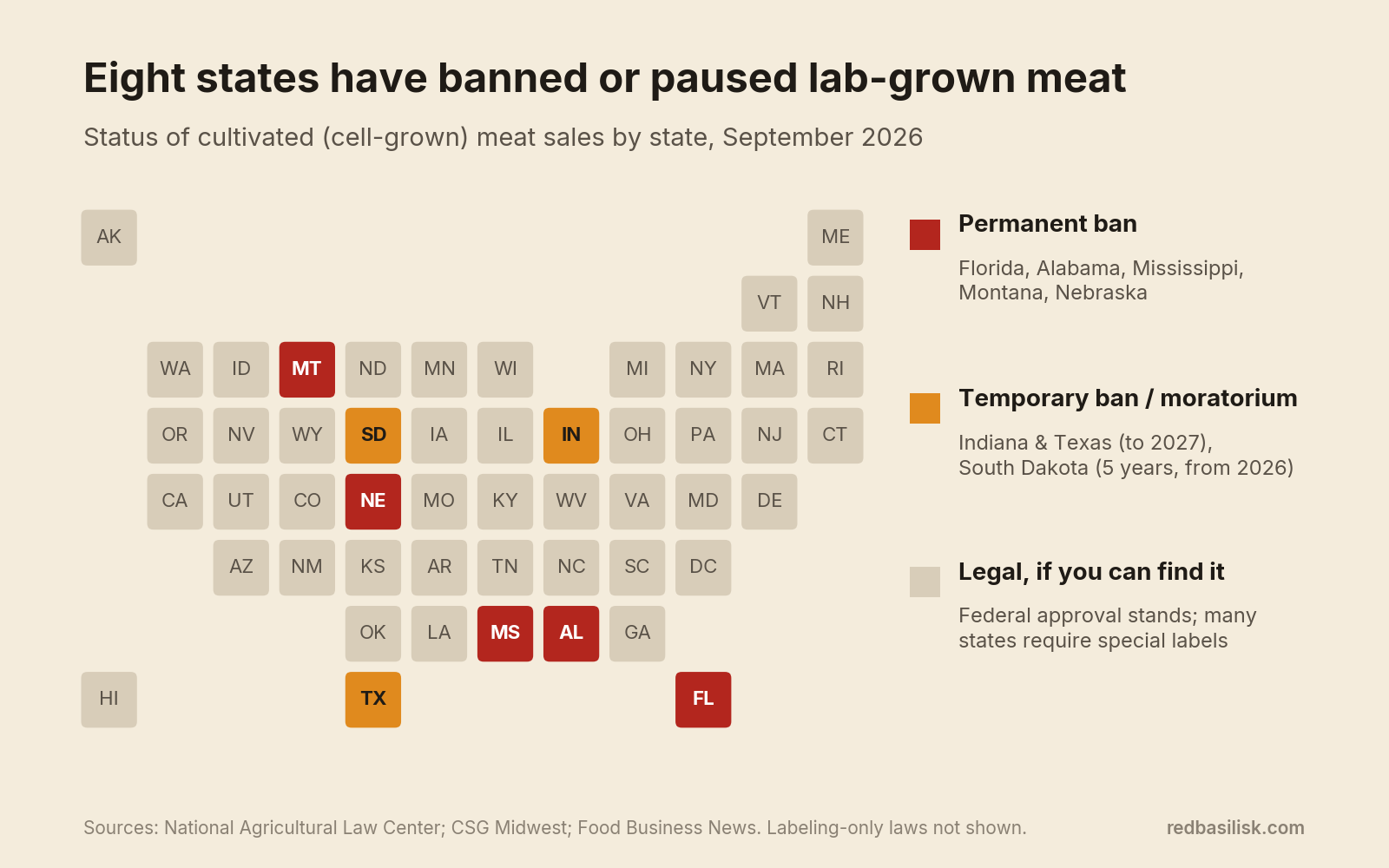
Florida went first in 2024, making it illegal to make, sell, or distribute cultivated meat in the state. Alabama, Mississippi, Montana, and Nebraska followed with their own bans. Indiana and Texas passed temporary bans that run into 2027. This year South Dakota added a five-year prohibition. (Its governor also vetoed a separate, harsher bill that would have labeled cultivated protein "adulterated.")
Others went the labeling route instead of banning. By one 2026 count, 21 states had labeling rules for cell-cultivated products as of late 2025. Some, like Ohio and Iowa, keep it out of school cafeterias. Idaho bans cut names like "steak" or "brisket" on lab-grown products. Mississippi became the first state to ban lab-grown dairy this year.
The companies fought back in court and have mostly lost so far. UPSIDE argued that Florida's ban conflicts with federal approval. In March 2026, a federal appeals court upheld Florida's ban, drawing a line between telling a federally inspected plant how to operate (which federal law controls) and simply banning a product from being sold (which a state can do). Challenges to Texas's ban are still in court.
Meanwhile, Washington has cooled on the industry too. Federal research money for cultivated meat has been cut, and the Health and Human Services website lists the state bans as examples of Secretary Kennedy's agenda.
Was this forced on us against public opinion?
For lab-grown meat, it's the other way around. Public opinion is mostly on the side of the bans.
- In a 2024 poll from the Center for the Environment and Welfare, an industry-aligned group, 58% of Americans supported laws restricting the sale of lab-grown meat, including majorities of Republicans (62%), independents (55%), and Democrats (56%). Asked whether they'd eat it themselves, 75% of Republicans, 67% of independents, and 60% of Democrats said no. The sponsor has a stake in the outcome, but other polling points in the same direction.
- Democrats are warmer to it than Republicans, especially on environmental grounds. A Morning Consult poll found a much higher share of Democrats believed cultivated meat is good for the environment.
- It's not strictly partisan. Democratic Senators John Fetterman and Jon Tester sided with the bans. Fetterman said he'd "never serve that slop" to his kids. On the other side, a group of House Republicans has warned about the U.S. falling behind on the technology.
- Most people barely know it exists. Fewer than half of consumers are aware of cultivated meat, and only a small share say they'd try it.
Where industry lobbying really has worked against what shoppers say they want is in the quieter rules: loose ingredient self-certification under GRAS and GMO labeling loopholes. Those are the fights worth watching, and in 2026 both are finally being challenged.
Plant-based meat: a fad that's fading
Beyond and Impossible were supposed to be the future. The numbers say otherwise.
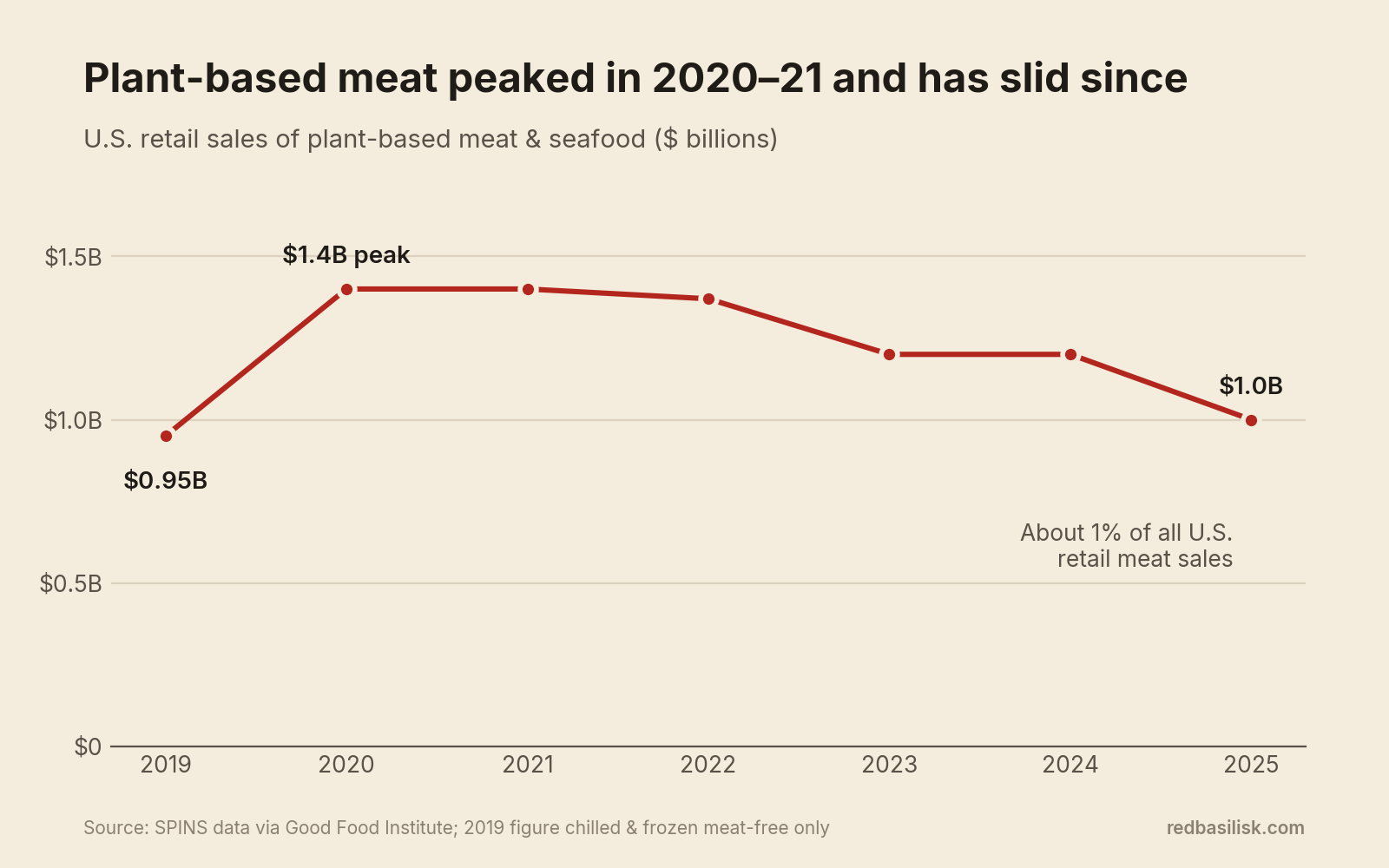
U.S. retail sales of plant-based meat and seafood hit about $1.4 billion in 2020 and 2021, then slid to about $1.0 billion in 2025. Last year alone, dollar sales fell 10% and the number of packages sold fell 11%. Over the same period, regular meat sales grew. Plant-based meat now makes up about 1% of U.S. retail meat sales.
Shoppers have said why: taste, price, and a growing wariness of ultra-processed food, which these products are. Stores responded by giving them less shelf space, and sales slid further.
There are bright spots. Plant-based milk still holds around 13% of the milk market. Foodservice sales of egg substitutes jumped 28% in 2024 as bird flu drove up egg prices, though from a small starting point. But the "fake meat takes over" story isn't happening, at least not in America.
So is it rising, or flatlining?
In the U.S., it's shrinking.
- Cultivated meat: investment down about 94% from its peak, the flagship plant sits idle, and it's banned in eight states.
- Plant-based meat: down two years in a row and falling.
- Overall U.S. plant-based food sales: down 4% in 2024 and another 2% in 2025, to $7.9 billion.
The exception is precision fermentation. The egg-protein orders and the ADM deal show that one is gaining ground, because it's a cheaper, simpler ingredient that can quietly slide into processed food without asking shoppers to choose it.
The picture overseas is different. Global plant-based sales still grew 3% last year. Australia now has the world's largest operating cultivated meat facility, in Sydney. And in May 2025, a Chinese state investment fund put about $555 million into biomanufacturing, with "new proteins" as a focus. The U.S. is expected to lose its spot as the top funder of this research to China in 2026.
The bottom line
Are we being fed fake food? A little, and mostly not the way the posts claim.
- Lab steak in the meat case: not happening. It's barely sold anywhere, it's banned in eight states, and the money has fled.
- Fake eggs in a shell: doesn't exist.
- Yeast-made egg protein in packaged food: real and growing. It's labeled, but it's easy to miss.
- Fake blueberries: real, common, legal, and decades old.
The common thread isn't a lab. It's the processed-food aisle. Almost everything here is avoided the same way: read the back of the box, and buy food you can recognize.
My take
As a cattleman, I went into this expecting to be angry at lab meat. I came out more annoyed at the cereal aisle. The lab-grown steak everyone's scared of can't even keep its own factory open, while blue-dyed sugar has been sold as fruit for twenty years and nobody marched on anything.
Where I land: I don't need the government to ban a product nobody can afford. I do want to know what's in my food, and I want companies to have to tell the FDA what they're putting in it before it hits the shelf. The labeling fights and the GRAS rule matter more to my family's table than any state ban.
The part I'll keep an eye on is overseas. If China figures out how to make cheap protein in a tank, that's a trade question for American ranchers, not a food-safety one. That's a fight worth being ready for.
How we dug into this
We started with a conversation, not a thesis: a friend's concerns about fake meat, eggs, and blueberries. We used AI to search industry reports (the Good Food Institute's annual data, SPINS sales numbers), legal trackers (the National Agricultural Law Center, CSG Midwest), federal announcements (HHS, FDA), trade press, and fact-checkers.
A few things changed our minds along the way. We first listed Believer Meats' North Carolina plant as the industry's big win, until a follow-up search turned up that the company had collapsed a month after approval. The "FDA approved lab eggs" story looked like new federal action at first; the real FDA letter was from 2023. And the first public-opinion numbers we found came from a pro-livestock group, so we flagged the sponsor and checked them against independent polling.
Where sources disagreed, we used the most conservative number. Funding figures vary by tracker (GFI and AgFunder count differently), so the chart uses GFI's numbers throughout.
Sources
- [The Takeout: What's really in imitation blueberries](
- [Tasting Table: How to tell if the blueberries in your muffins are fake](
- [HuffPost: Your blueberries may be entirely fake](
- [Snopes: Rumors about "lab-grown" eggs sold in the US](
- [Dallas Express: The egg without a chicken](
- [Vegan-News/Vegconomist: FDA moves to make GRAS notifications mandatory](
- [HHS: Fact sheet on the proposed GRAS rule](
- [Holland & Knight: From voluntary to mandatory, FDA's proposed GRAS rule](
- [FlavorSum: 2026 regulatory news (Natural Grocers v. USDA)](
- [Congressional Research Service: Cell-cultivated meat overview](
- [Good Food Institute: Cultivated meat regulatory pathway](
- [National Hog Farmer: Fifth cultivated meat company gains FDA approval](
- [Fast Company: Inside the collapse of Believer Meats](
- [AgFunderNews: Believer Meats sued for $34M in unpaid bills](
- [Meatingplace: Believer's $150M plant remains vacant](
- [Cultivated X: UPSIDE Foods bids $50M for Believer's plant](
- [Scrunchy Living: Lab-grown meat at Sprouts](
- [Meat+Poultry: Cultivated meat industry shrinks](
- [Food Business News: Headwinds impede cultivated meat](
- [AgFunderNews: GFI on cultivated meat funding gaps](
- [Green Queen: GFI 2026 State of the Industry](
- [GFI: Cultivated meat State of the Industry](
- [National Agricultural Law Center: Food law in the states, 2026](
- [CSG Midwest: Cell-cultured meat legislation](
- [Daily Health Post: Seven states have banned lab-grown meat](
- [LegalClarity: Eleventh Circuit upholds Florida ban](
- [Daily Wire: Iowa labeling law and 21-state count](
- [U.S. News: States try to snuff out lab-grown meat](
- [Pork Business: Poll on restricting lab-grown meat](
- [Genetic Literacy Project: Politics of lab-grown meat (Morning Consult)](
- [E&E News: Fights in Congress over cultivated meat](
- [GFI: Analyzing plant-based meat & seafood sales](
- [GFI: Plant-based retail market overview](
- [Just Food: US plant-based meat volumes fell in 2022](
- [Food Business News: Plant-based sales continue to slide](
- [AgFunderNews: Plant-based meat by the numbers](
- [Food Engineering: Cultured meat faces old and new obstacles](