




Read
Brazilian Beef: Did Trump Betray the American Cattleman?
Trump opened the door to 300,000 tons of tariff-free foreign beef, and Brazil is first in line. We look at what's actually coming, which animals it competes with, what the futures did, and why the bigger threats to a calf check aren't in Brazil at all
Every dispatch is also a podcast. Follow on Spotify ↗
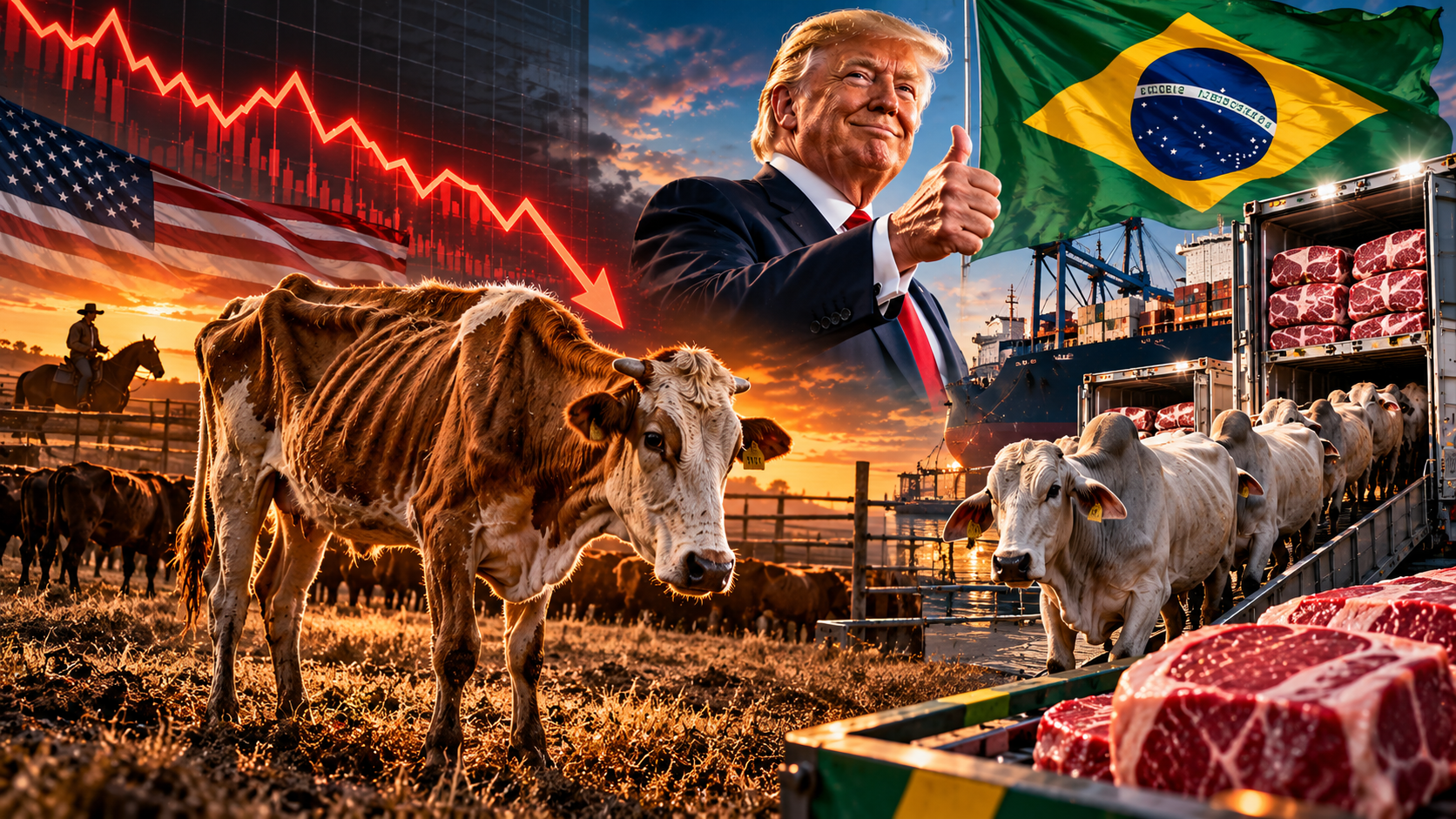
It isn't cattle, it isn't steak, and it isn't the biggest thing moving the market. But it isn't nothing.
When Trump said he was bringing in beef "from Brazil," I got some looks. Several of my friends are America First, don't-meddle-overseas types, and I raise cattle, so I was asked.
Honestly, my first reaction was to shrug. I raise good animals. Most of what comes off our place ends up in restaurants, delis, and butcher shops. I figured whatever was coming up from South America was competing with a different product, closer to worn-out dairy cows and Holstein steers than to anything I sell.
That hunch turned out to be mostly right. But "mostly right" isn't right, and it isn't the whole story. So we dug in while it's still happening, to get a baseline before anyone knows how it ends.
What's actually coming
First, the cattle are coming. Not live animals, of course. This is frozen boxed beef.
Here's the deal as written:
- What: Lean beef trimmings. That's the very lean meat (usually around 90% lean) that gets ground together with fattier American trim to make hamburger.
- How much: Up to 300,000 metric tons, about 661 million pounds.
- When: 90 days, starting September 1, 2026, released in three 100,000-ton tranches: September, October, and October 31 through November 30.
- The break: Importers normally pay a 26.4% tariff once a country's quota runs out. For this beef, that tariff goes away.
- The strings: The beef is supposed to sell about 25% below the market price for lean trim. If it doesn't, the President can end the rest of the quota early.
- Who: Countries that already have their own U.S. beef quota or a free-trade deal are excluded. That leaves the shared "Other Countries" pool, and the biggest player in that pool by a mile is Brazil.
One wrinkle: at the Oval Office on September 4, Trump said the beef is "coming from Argentina. It's coming from Brazil." But Argentina has its own country quota, which excludes it from this waiver. It already got a separate deal in February: 80,000 metric tons of Argentine beef in quarterly tranches through 2026. So this one is mainly about Brazil.
How big is it, really?
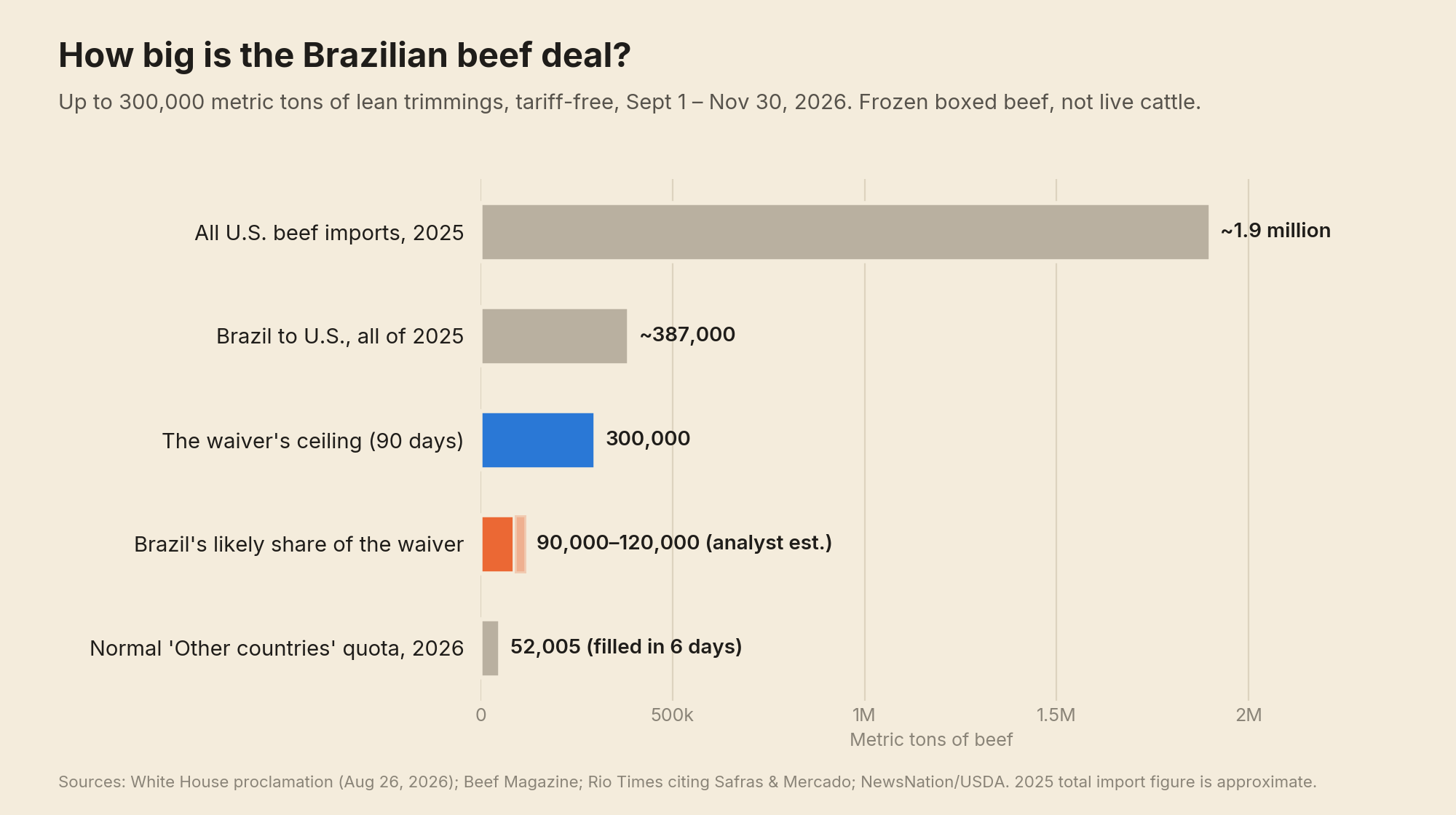
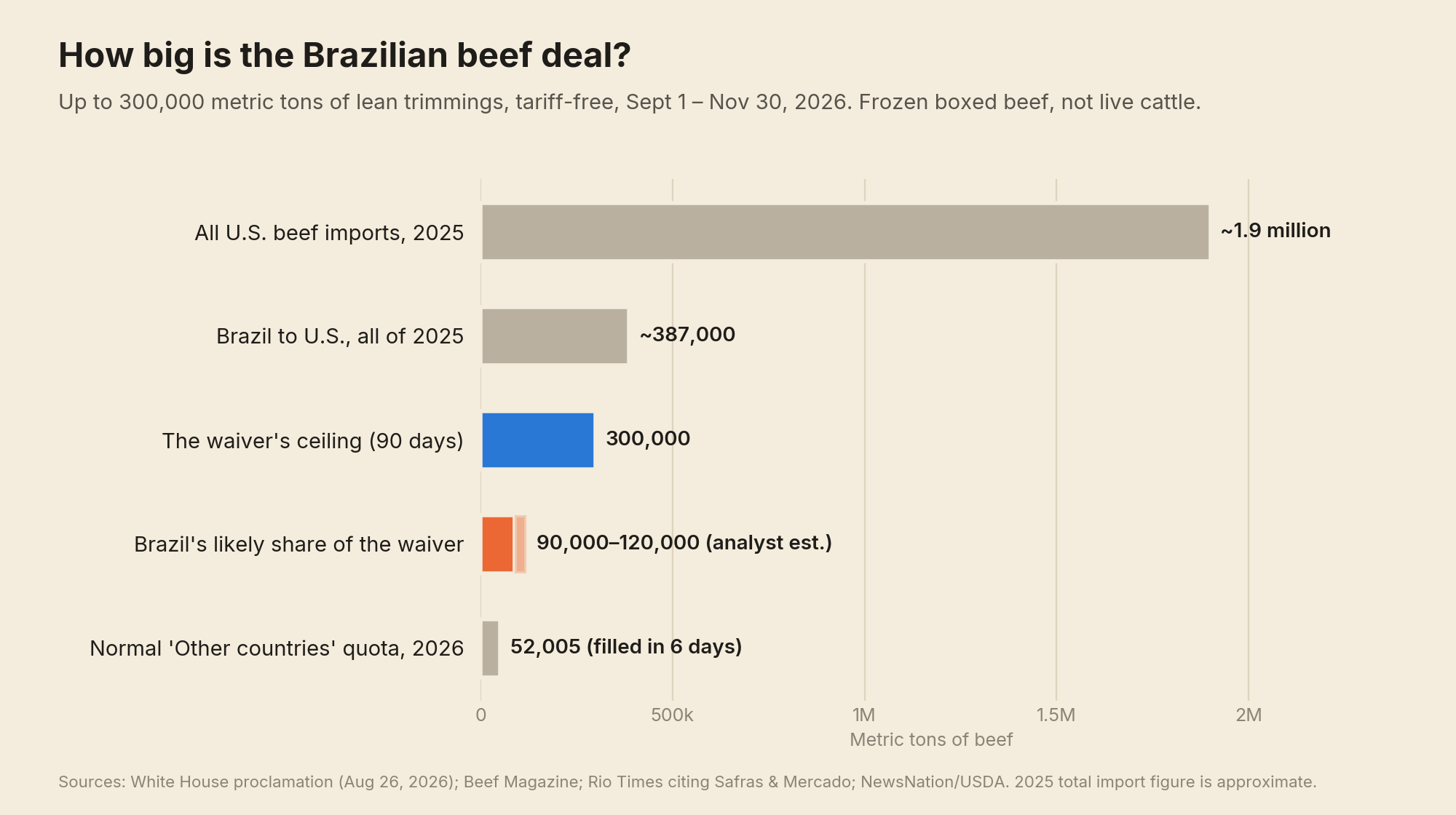
Three hundred thousand tons sounds like a flood. Stacked up against everything else, it looks different:
- The U.S. imported roughly 1.9 million metric tons of beef in 2025. In the first half of 2026 alone it was nearly 1.5 million, up 12% from a year earlier.
- Brazil alone shipped about 387,000 tons to the U.S. in 2025, with the tariff in place.
- Brazil's normal tariff-free slice is tiny. The shared "Other Countries" quota for 2026 was 52,005 tons, and it filled within six days of January. Everything after that paid the 26.4%, and Brazil kept shipping anyway.
That last point matters. One market economist, Altin Kalo of Steiner Consulting, put it bluntly: imported beef was already trading at a steep discount, and the out-of-quota tariff "has not been an issue for importers" because record amounts were already coming in. The tariff was a cost, not a wall.
And Brazil won't get the whole 300,000. One Brazilian consultancy expects Brazil to take 30 to 40% of it, around 90,000 to 120,000 tons over three months. The Brazilian exporters' own lobby called the gains "limited," partly because the 25% discount eats the margin. Shipping takes 20 to 25 days, so the first window was half gone before a boat could cross. Analysts expected September volumes to stay near their recent pace of 25,000 to 30,000 tons a month.
In terms people can picture, market advisor Scott Varilek put the full 300,000 tons at about 44 days' worth of U.S. ground beef. That's real, but it's not the end of the world.
Where it bites: not the steak, the hamburger
This is where a rancher's view helps, because the headlines lump all "beef" together.
A steer that grades Choice goes to a packer and gets broken into steaks, roasts, and trim. The middle meats (ribeyes, strips, tenderloins) are what restaurants and butcher shops pay up for. Frozen Brazilian lean trim doesn't compete with a ribeye. Nobody grills 90CL.
What it does compete with is the lean grinding beef that comes from cull cows and bulls: the old dairy cows, the open heifers, the cows that didn't breed back, the bull that's done his job. On a cow-calf place, those culls are a real paycheck. Cull cow prices have been at record highs, largely because U.S. beef cow slaughter was down more than 20% early this year as ranchers kept cows to rebuild. Lean trim was scarce, and scarce lean trim is exactly what this waiver is meant to fix.
There's another catch for the "lower prices" promise. Most imported grinding beef from Brazil or Australia is frozen, and a big share goes to food service, mostly fast food, while many grocery stores sell only fresh ground beef. So the first place you'd expect any savings is the drive-thru, not the meat case at your store.
Are cull cows already feeling it? It's too early to say for sure, but here's one data point. At the Ogallala, Nebraska sale barn, boner slaughter cows brought $160 to $171 per hundredweight on August 19. On September 2, the day after the waiver started, they brought $142 to $153. The South Central Livestock Exchange's reports show a similar slide between August 13 and September 10. Be careful with that, though. Cull cow prices usually fall in the fall anyway as more cows come to town, and two barns over a few weeks aren't a trend. It's worth watching, not a verdict.
What the market did
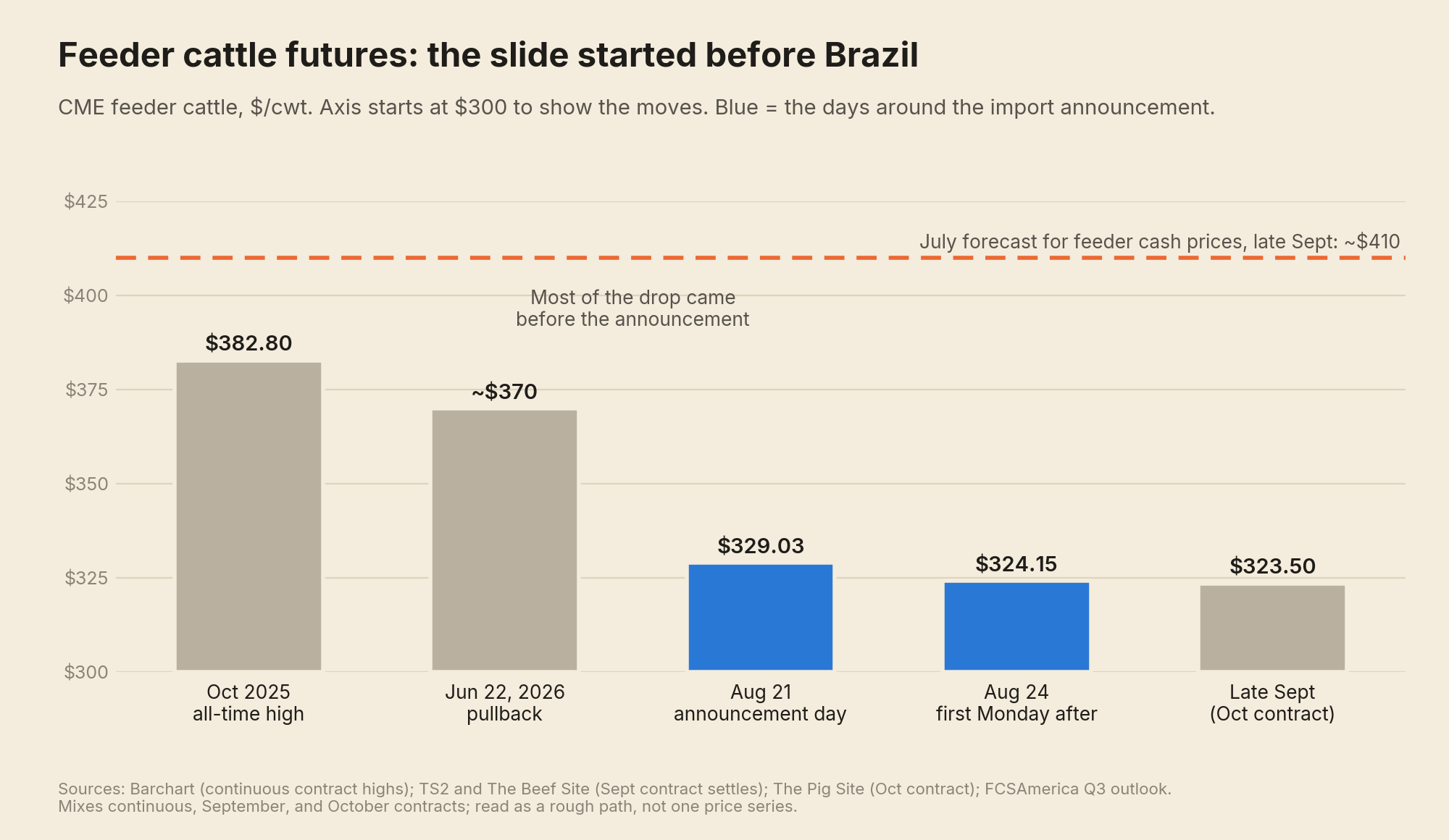
When Trump posted the plan on Friday, August 21, live and feeder cattle futures gapped lower at the open, hitting eight-month lows. September feeders recovered by the close. Then on Monday they fell again: down 4.87 cents to $324.15 per hundredweight. As of late last week, the October feeder contract sat at $323.50.
Every cattle group in the country hated it, and they said so. NCBA said it was "disappointed." The U.S. Cattlemen's Association was sharper: "You don't put America first by putting U.S. cattle producers last." R-CALF called it doubling down on a failed strategy.
But look at the chart above. Feeder futures were already sliding before Brazil ever came up. The continuous contract hit a record of $382.80 last October, was still near $370 in late June, and by the day of the announcement had already fallen to about $329. Most of that drop happened before the waiver. A farm lender's outlook back in July expected feeder cattle prices to rally toward $410 by late September. The futures are nowhere near that.
So what knocked them down? That brings us to the things that matter more.
The bigger variables
1. Mexican feeder cattle. The U.S. closed the border to Mexican cattle over New World screwworm. USDA started a phased reopening last month and is adding a port in New Mexico. For scale, Mexico sent about 1.24 million head north in 2024, nearly all of them feeders: the same thing I sell, going into the same feedlots. The first port reopened on August 24, the same Monday feeder futures took their hit, and futures had already dropped more than $20 since early August. That competes with my calves far more directly than any frozen trim.
2. Screwworm itself. The flesh-eating parasite was confirmed in Texas in June and has spread through the summer, including a case in a horse. It doesn't affect the meat, but it can shut the border again, restrict cattle movement, and make the futures swing hard in both directions.
3. The Canada fight. This one's close to home in North Dakota. The U.S. put 50% tariffs on roughly $20 billion of Canadian goods effective August 22, and Canada answered with counter-tariffs on C$27.6 billion of U.S. goods effective September 8. In February, Dennis Laycraft of the Canadian Cattle Association said Canadian feedlots were going to import over 500,000 head of U.S. feeder cattle, far beyond any number they'd seen. For northern calves, that's a real bidder at the sale barn. I couldn't confirm whether live cattle are on either side's tariff list, so that's one to watch closely.
4. The herd. The U.S. cattle herd is the smallest it's been in 75 years. That scarcity is what built these prices, and it hasn't gone away. Drought has pushed some heifers off ranches, which adds feeder supply in the short term, but that's liquidation, not the herd growing.
5. And then the Brazil waiver. For feeder calves, it's mostly a signal, not a supply shock.
So, will it break the American cattleman?
Not this deal, not by itself. The tonnage is small next to what already comes in. It's aimed at hamburger trim, not the cattle most of us sell as calves. And the Brazilians themselves don't expect to fill much of it.
But the signal is real, and it's why the market flinched. This is the second time this year the administration has moved to push beef prices down with imports: the Argentina deal in February, now this. With midterms coming and ground beef averaging $6.89 a pound in July, about 57% more than five years ago, affordability is a political issue. The market now has to price in the chance of a third intervention, and a fourth. That caps the upside. When the herd is at a 75-year low and ranchers are deciding whether to keep heifers and rebuild, a ceiling on the reward is exactly the wrong message. That's the NCBA's point, and it's a fair one.
There's also the question of who asked for this. According to the Wall Street Journal, Joesley Batista, co-owner of JBS, the world's largest meatpacker, met Trump in the Oval Office on August 20 and discussed how more Brazilian beef could help if the tariff were dropped. The next day Trump announced the plan. Forbes reports that a JBS subsidiary was the single largest donor to Trump's inaugural fund, and that the European Union banned Brazilian beef imports over antibiotic rules effective September 3, leaving Brazilian packers with product to place. There's no public evidence the waiver was written for JBS. But the timing is what it is, and readers can weigh it.
To be fair, the same week brought something ranchers have wanted for a long time. On September 4, Trump signed an order aimed at letting farmers and ranchers process, package, and sell their own meat across state lines, so they "don't have to go through the Big Four processors." He also called for mandatory country-of-origin labeling on foreign beef, though that needs Congress. If either one actually happens, it could matter more to a small producer over the long run than 90 days of trim imports.
What to watch through November
This is a 90-day experiment, and we're about a month in. Here's what I'll be tracking for a follow-up when the window closes:
- Did the tranches fill? How much actually entered, and how much came from Brazil.
- Cull cow prices vs. the normal fall decline. If they drop harder than usual, the trim is landing.
- Ground beef prices. Did the 25% discount ever reach a consumer, or did it stop at the importer and the packer?
- Feeder futures into the November and January contracts, and whether they follow the border news or the import news.
- The Mexican border and screwworm.
- Canada: whether cattle get caught in the tariff crossfire.
- A third intervention. If another import deal shows up when this one ends, that's the real answer to the headline.
My take
[I went into this expecting to shrug, and mostly I still do. This isn't the cattle I raise, and it isn't what's going to set my calf check this year. The border, the bugs, and the Canada fight are what I'm watching.
What bothers me isn't the beef. It's the reflex. Twice in one year, when beef got expensive, Washington reached for imports instead of asking why the herd is at a 75-year low in the first place: drought, input costs, four packers holding most of the leverage. You don't rebuild a herd by capping the reward for rebuilding it.
To my America First friends: this one isn't a betrayal, but it's worth watching. And if the processing order turns into real rules that let a guy sell his own beef across state lines, that could end up being the part of this story that actually matters.]
How we dug into this
This started research on this project with AI after my friends asked about "the Brazilian cattle". We searched trade and ag press (Beef Magazine, Drovers, DTN/Oklahoma Farm Report, Farm Policy News at Illinois), wire and business coverage (Forbes, The Hill, Rio Times, Morning Ag Clips), USDA's Economic Research Service, the Canadian government's tariff list, and sale barn reports. Futures prices come from daily market reports, which mix different contract months, so the chart is a rough path rather than a single price series. The Brazilian share of the waiver is one consultancy's estimate. The order of the "bigger variables" is my judgment as a producer, not a model. Charts were built in Python. We'll revisit this when the 90-day window closes at the end of November.
Sources
- [Rio Times: EU suspends Brazilian beef just as Trump's waiver opens the U.S. market](
- [Rio Times: Argentina left out of expanded U.S. beef quota, Brazil gains](
- [Beef Magazine: Dissecting Trump's beef "deal"](
- [Ag Bull Trading: Trump beef proclamation opens quota to Brazil, but gives it no set-aside](
- [Morning Ag Clips: Brazilian beef stands to benefit from U.S. import tariff suspension](
- [NewsNation: How much beef the U.S. already imports and where it comes from](
- [Drovers: Trump announces deal to slash ground beef prices by 25%, sends markets lower](
- [Oklahoma Farm Report: Trump announces 90-day tariff-free beef import plan](
- [TS2: U.S. cattle futures slide on Trump beef import proposal](
- [The Beef Site: Cattle futures dip as Trump moves to ease beef tariffs](
- [The Pig Site: CME cattle and hog futures report (September 2026)](
- [Barchart: How will screwworm impact cattle prices?](
- [FCSAmerica: Third quarter beef outlook](
- [USDA ERS: Cattle & Beef Market Outlook](
- [Drovers: 2026 cull cow prices and tighter supplies](
- [Ogallala Livestock Auction: Market recap](
- [South Central Livestock Exchange: 2026 market reports](
- [The Beef Site: Cattle futures rise amid screwworm concerns](
- [Cattle Buyers Weekly: Ag imports largely avoid tariffs](
- [Government of Canada: U.S. products subject to counter tariffs](
- [Manitoba Co-operator: Trade uncertainty weighs on Canadian beef sector](
- [Davis Wright Tremaine: Section 338 tariffs on Canadian goods](
- [Blakes: Canada imposes counter-tariffs on $27.6 billion of U.S. imports](
- [Forbes: How a Brazilian billionaire won a U.S. tariff exemption for beef the EU won't buy](
- [Forbes: Trump confirms tariff-free beef is coming from Brazil and Argentina](
- [Farm Policy News (Illinois): Trump says Brazil, Argentina will supply tariff-free beef](
- [The Hill: Trump signs orders on beef imports and labeling](