




Read
Burning Money: The Waste Everyone Has Noticed and Nobody Wants to Solve
Why Bakken flares still burn, who pays for them, and why nobody has put them out.
Every dispatch is also a podcast. Follow on Spotify ↗
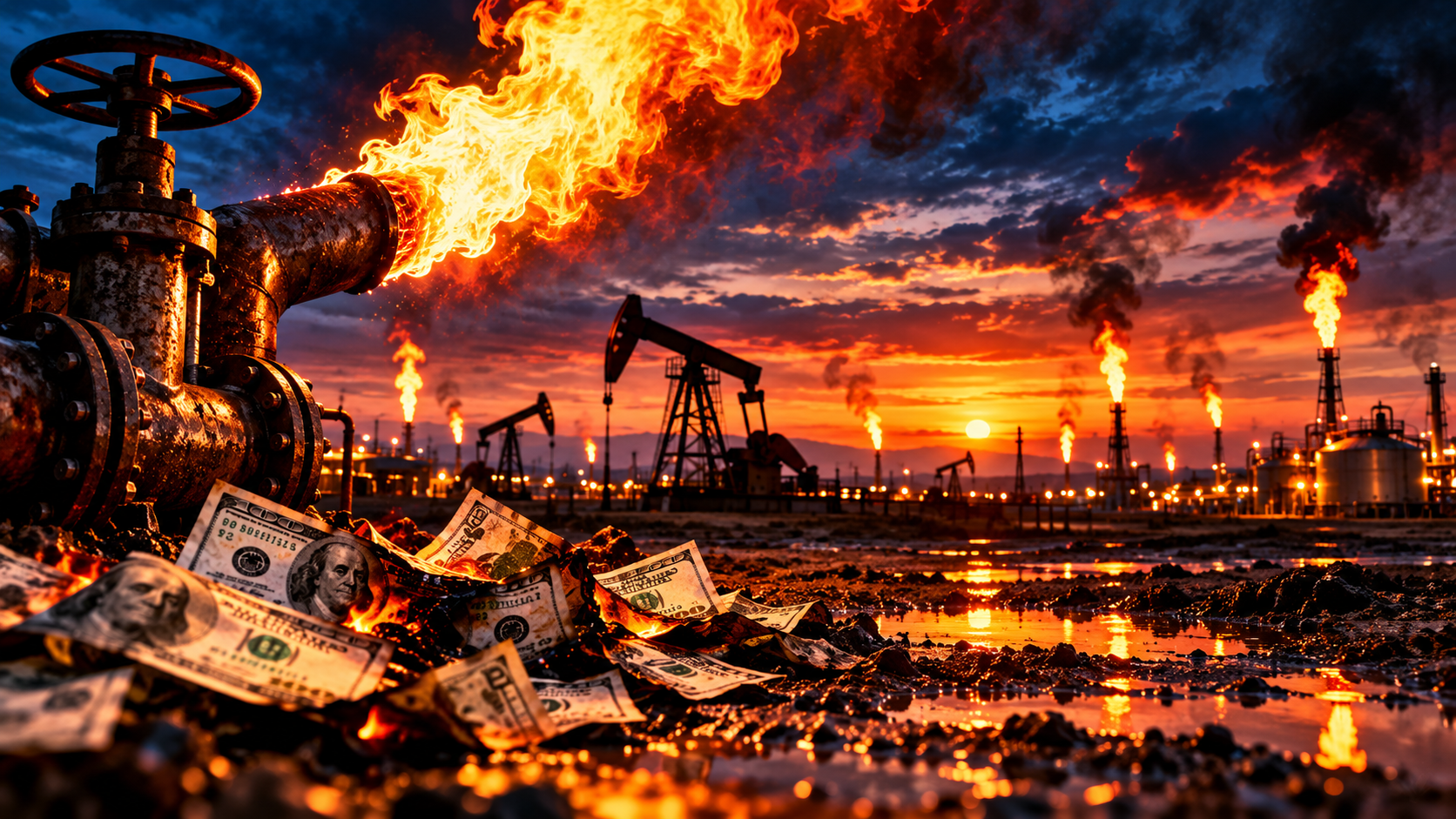
Step outside at night almost anywhere in the Bakken and look up. When I was a kid, the sky out here was thick with stars. Now I'd guess at least half of them are gone. Then look around: a ring of orange flames on the horizon, burning day and night, some of them for a decade.
The question is simple: that's natural gas, it's worth money, so why are we setting it on fire? And why, after years of rules, targets, pipelines, and clever startups, are some of those flames still burning?
The short answer is that North Dakota mostly fixed its flaring problem. It now captures about 95 percent of its gas, up from about 81 percent in 2019. The flares still burning are mostly the leftovers: wells where a pipe doesn't pay, plus gas with nowhere to go when the lines are full or down. Either way, burning it is the cheapest option for the company that owns it. Everyone else splits the bill.
What's actually burning
Oil wells don't just produce oil. They also bring up gas, a lot of it. Oil is the product the companies drill for. The gas comes along whether they want it or not, and it has to go somewhere. If there's a pipe, it goes to a processing plant and gets sold. If there isn't, it gets burned at the well. That's a flare.
The volume isn't small. In the first seven months of 2026, North Dakota flared an average of about 156 million cubic feet of gas per day, according to the state's Department of Mineral Resources. Over a year, that's about 57 billion cubic feet.
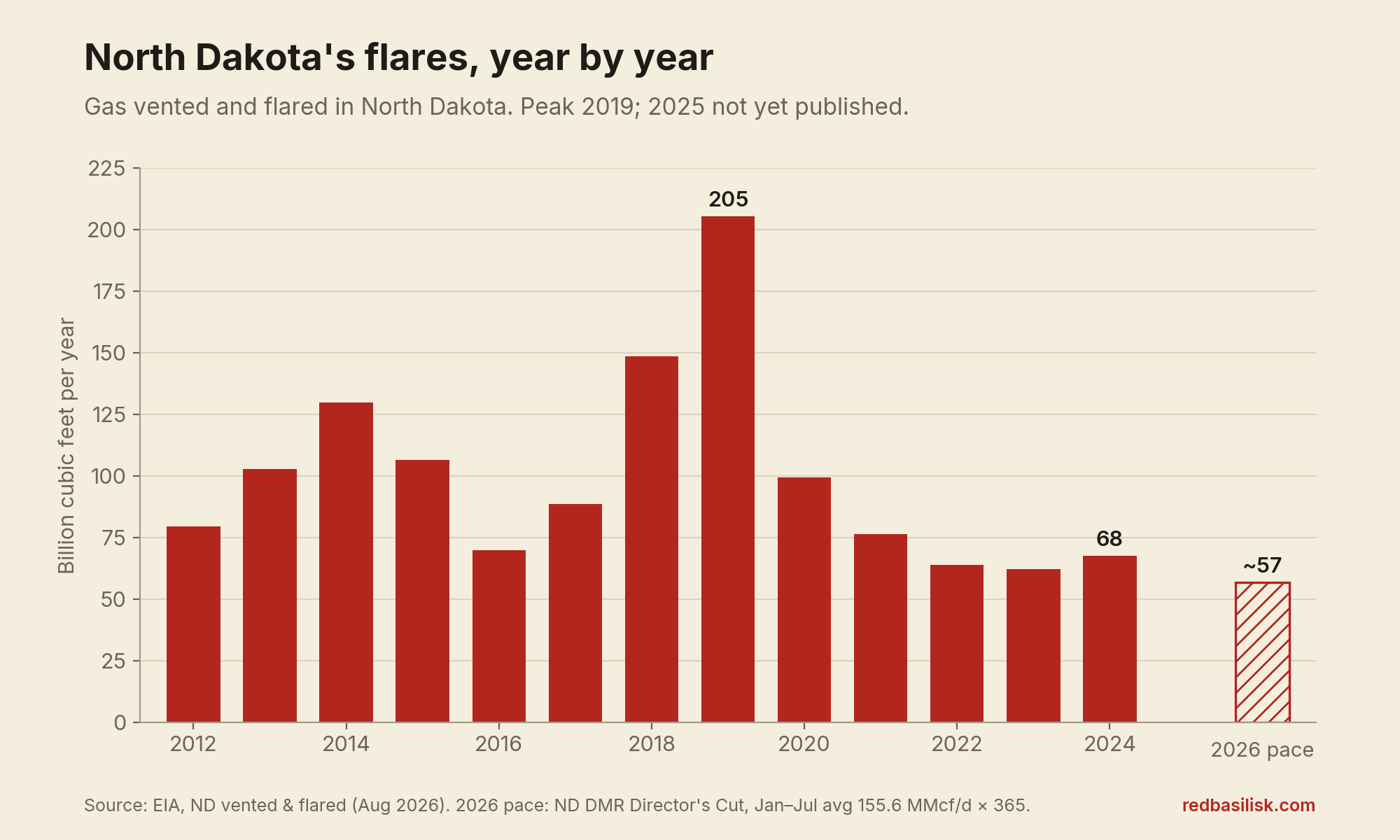
Here's what that means in plain terms. We ran the numbers ourselves, so treat them as ballpark. If you ran all of that gas through ordinary generators, you'd get something like 650 to 700 megawatts of power, around the clock. That's enough electricity for roughly half a million average American homes.
Priced as gas, it's worth somewhere around 80 to 200 million dollars a year. The low end is what one big Bakken producer, Chord Energy, was actually paid for its gas in 2025, well below the national benchmark price. The high end is that national benchmark, the Henry Hub price, which averaged $3.52 in 2025. Bakken gas also carries propane and butane, which are worth more, so even the high number undersells it.
Zoom out and it gets bigger. Nationally, the federal Energy Information Administration counted about 335 billion cubic feet vented and flared in 2024. The World Bank, which measures flares from satellites, puts U.S. flaring lower, around 5.6 billion cubic meters in 2025, or roughly 200 billion cubic feet. The two numbers count different things, but either way it's enough gas to run a few gigawatts of power.
Worldwide, the World Bank says 167 billion cubic meters were flared in 2025, worth about 54 billion dollars. That's the third straight year of increase, and the most since 2019. The U.S. actually cut its flaring the most of any country last year, down 7 percent. But that drop came mostly from the Permian Basin in Texas and New Mexico. The Bakken went the other way, with flaring up 4 percent.
Why it burns: a price, not a ban
Let's explain the flares burning for years.
North Dakota law lets a new oil well flare its gas for one year. After that, the law says flaring must stop. The well has to be capped, hooked to a gas line, fitted with a generator or capture system that uses most of the gas, or use another approved process that shrinks the flare by more than 60 percent.
But there are two ways around it.
The first is simply paying. If a company keeps flaring past a year, the penalty is that it owes royalties and production tax on the burned gas, as if it had sold it. So after the first year, unless the well has an exemption, the mineral owners get paid either way. The flare keeps burning.
The second is an exemption. A company can ask the state for permission to keep flaring by showing that connecting the well is "economically infeasible." In plain terms: the pipe would cost more over the life of the well than the gas would earn. If the math says the pipe doesn't pay, the flare is legal.
On top of that sits the state's main flaring rule, Order 24665, from 2014. It sets a gas capture target. The target started at 74 percent and climbed in steps to 91 percent in November 2020, where it sits today.
The key detail is that the target is a percentage, and it's measured by operator. The state checks each company's capture rate statewide first, then by county, then field, then individual wells. A company that captures 95 percent of its gas overall is in compliance, even if a handful of its wells flare almost everything they produce. Individual wells only get restricted when the company misses the target at the higher levels.
So when you drive past a flare that's been burning for yearsl, it's probably not breaking any rule. The state target lets operators flare up to 9 percent of their gas. Right now they're flaring about 5.
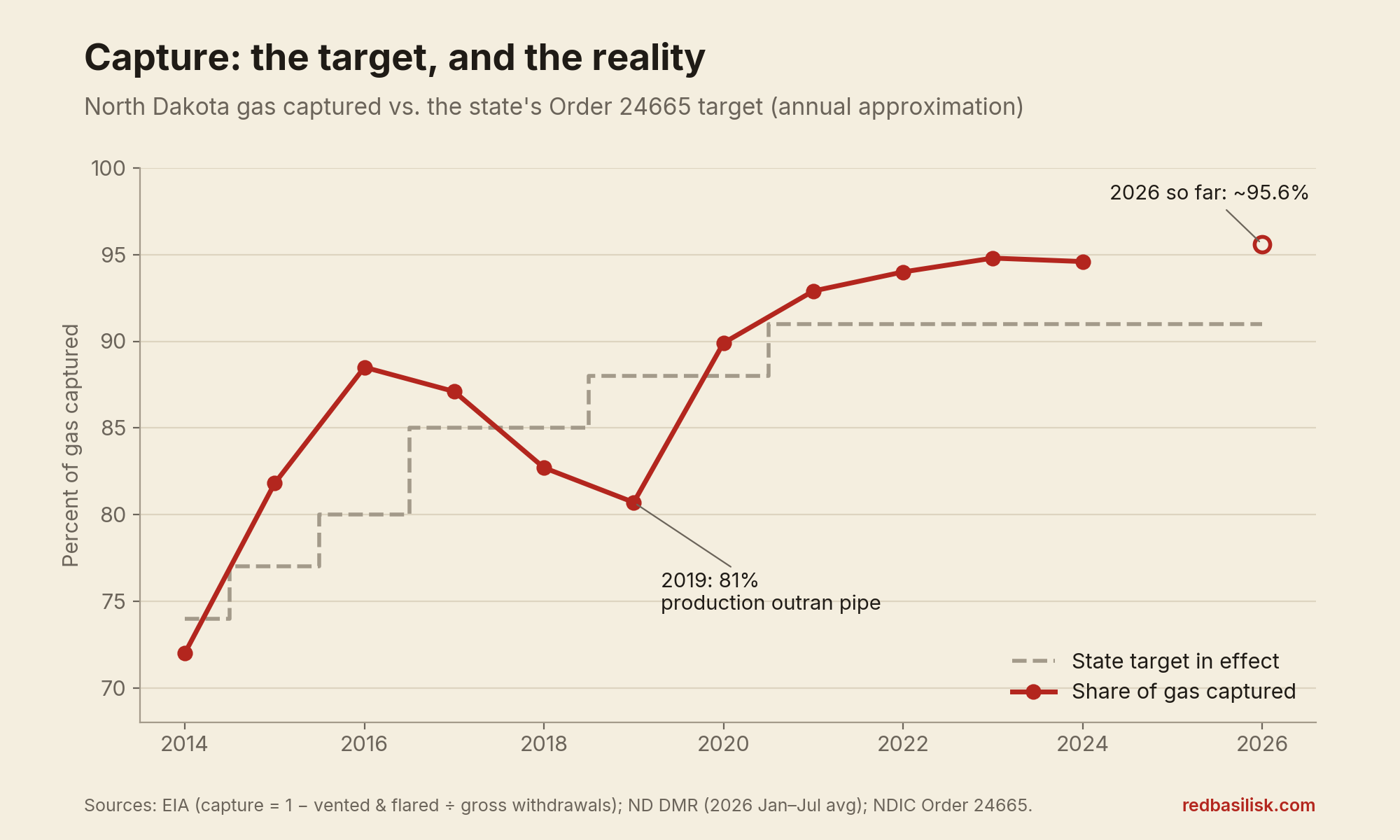
The chart shows how that played out. Capture climbed fast after 2014, then slid backward in 2018 and 2019. Oil production outgrew the pipes, and the state missed its target every month after March 2018 and into 2020. Then new processing plants came online, COVID cut production, and capture jumped. It has stayed above the 91 percent target year by year ever since.
The volume fell too, but not as fast as the share, because production kept growing. North Dakota now captures a bigger share of a much bigger pile of gas. Five percent of 3.6 billion cubic feet a day is still a lot of fire.
What actually worked
Plenty of people have looked at those flares and seen free money. Here's how their ideas turned out.
Pipelines and gas plants did the heavy lifting. Nothing else comes close. North Dakota's gas processing capacity grew from about 1 billion cubic feet a day in 2013 to 4 billion in 2021. That buildout is why capture went from the 70s to the mid-90s. The same story played out nationally in 2025. The World Bank credits one new pipeline in Texas, Matterhorn Express, as a key reason U.S. flaring dropped. It gave Permian gas a way to market, and the flares went down.
The next big one here is the Bakken East pipeline, a 374-mile line planned to carry up to about 1.4 billion cubic feet a day across the state. In April, the Industrial Commission committed up to 500 million dollars in state support. The company plans to file with federal regulators by the end of 2026 and wants gas flowing in phases by late 2029 and 2030. It isn't approved yet.
Pipelines have a catch that every landowner out here knows. You need easements along the whole route, negotiated with each owner, or, for a federally approved line, taken through eminent domain. The permitting runs through federal regulators, and a single project can take years. Bakken East asked to start federal pre-filing review in December 2025, and on the company's own schedule, gas won't reach the east end until the end of the decade.
The clever fix worked, but stayed small. The most famous idea was Crusoe. Starting in 2018, the company pulled up to well pads with shipping containers full of computers. It piped the flare gas into generators and used the power to mine bitcoin on site. The oil company got paid for gas it had been burning for nothing, and the flare went out.
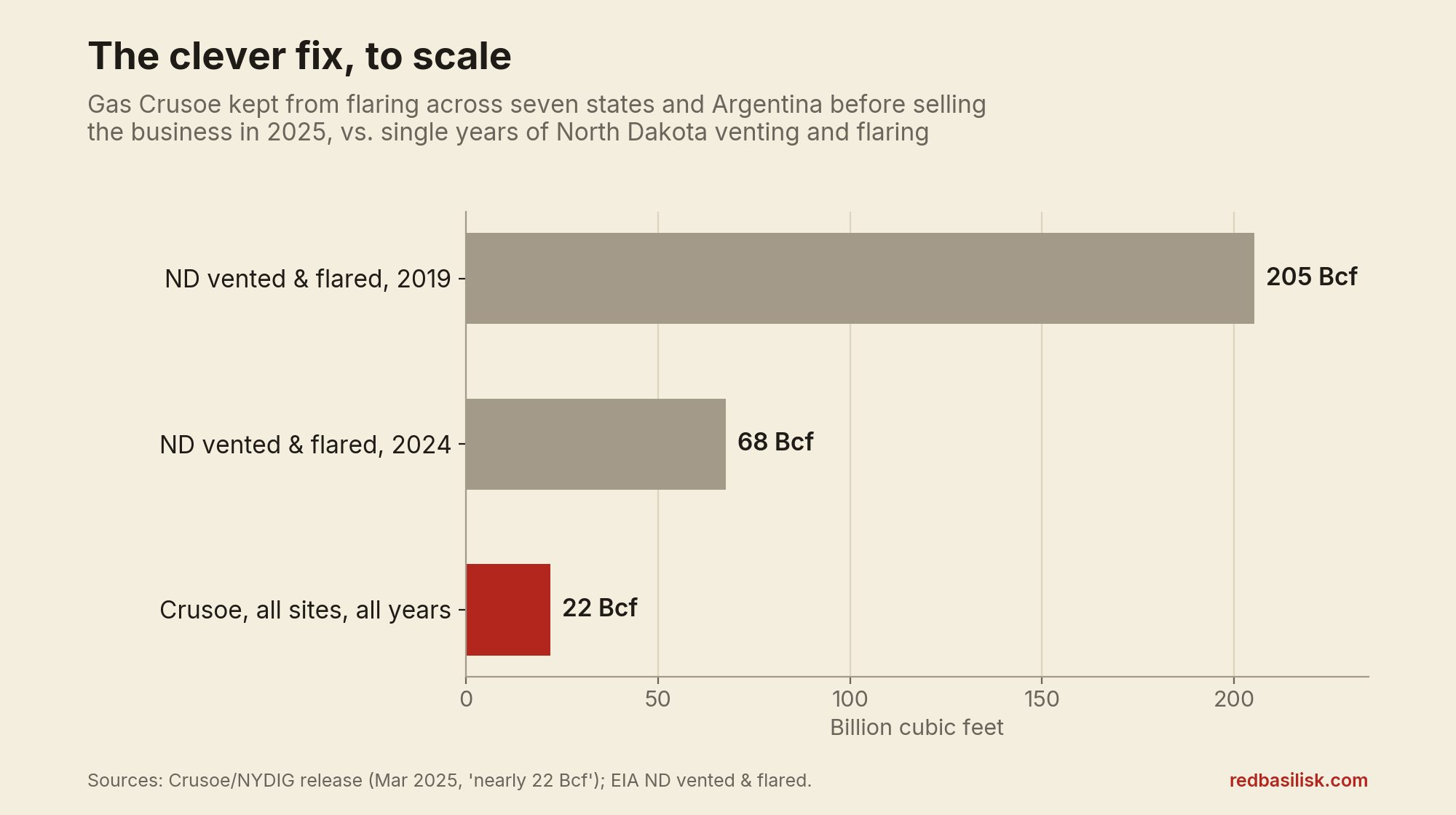
It worked. Crusoe deployed more than 425 of those modular data centers across seven states and Argentina. By its own count, it kept nearly 22 billion cubic feet of gas from being flared.
That sounds like a lot until you put it next to North Dakota. That's the company's lifetime total, across every site it ran. North Dakota vented and flared about three times that much in 2024 alone, and about nine times that much in 2019.
In 2025, Crusoe agreed to sell its flare-gas and bitcoin business to a company called NYDIG and went all-in on AI data centers. That includes the giant Stargate campus in Abilene, Texas, built for Oracle and OpenAI. The company that proved wellhead computing works ended up building some of the biggest power-hungry facilities in the country. NYDIG, which took over that business, applied this year for an air permit for a gas-fired power and computing site in Williams County.
The lesson isn't that the idea failed. It's that a trailer on a well pad solves one well at a time. Good for a remote well, not a basin.
The tax credit mostly went unused. North Dakota tried paying companies to capture gas. Its flare-reduction tax credit was complicated enough that only about 10 percent of the money set aside was ever paid out. In 2023, the state added a grant program, pitched as help for smaller wells. It covers projects like capturing propane and butane, generating power, and even computing.
The absurd part
Here's something that sounds made up.
While North Dakota burns its gas, the United States imports it. Most imports come by pipeline from Canada, about 8.6 billion cubic feet a day in 2025. Some of that crosses North Dakota on the way. The Alliance pipeline enters the U.S. at Sherwood, North Dakota. The Northern Border pipeline crosses the state after entering in Montana. Those same pipes also carry Bakken gas. Canadian gas rides through the Bakken while Bakken gas burns next to the road.
Then there are the tankers. In 2025, the U.S. imported about 14 billion cubic feet of liquefied natural gas by ship. The biggest single destination was Everett, Massachusetts, outside Boston, and the biggest supplier was Trinidad. North Dakota flares roughly four times that much every year.
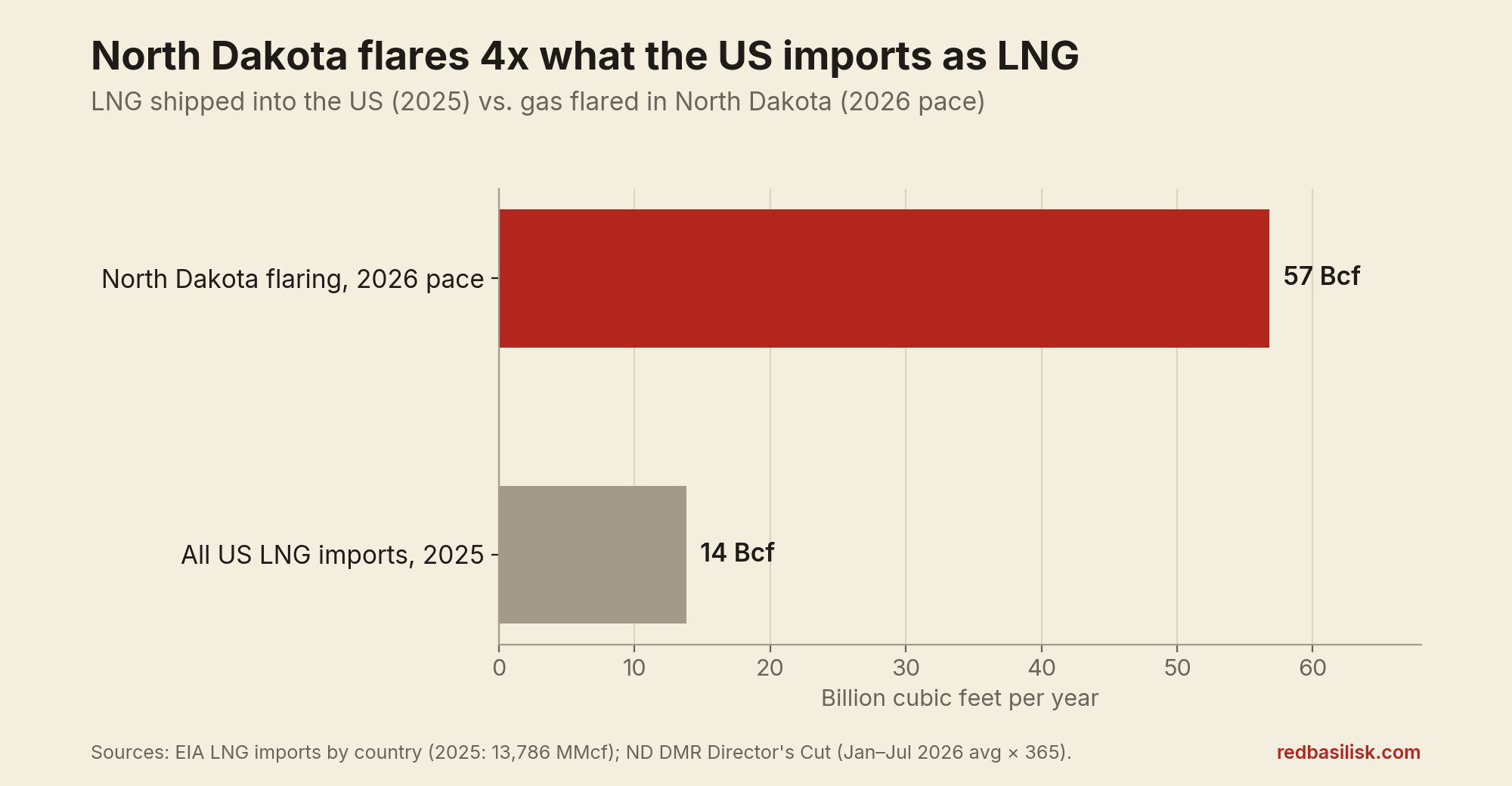
Why would the world's largest LNG exporter buy LNG at all? Blame a shipping law from 1920, the Jones Act. It says any cargo moving between two U.S. ports has to travel on an American-built, American-crewed, mostly American-owned ship. There isn't a single American LNG tanker that qualifies. So a Gulf Coast export terminal can ship gas to Europe or Asia, but it can't legally ship it to Boston. So the LNG New England buys to get through winter, when its pipelines are maxed out, has to come from abroad.
A bill to exempt LNG tankers from that rule was introduced in Congress this March. As of this writing, it hasn't moved out of subcommittee.
To be fair, the imports are tiny next to exports. The U.S. shipped out about 15 billion cubic feet of LNG a day in 2025, more than any other country. But the picture still says a lot about how energy policy works: gas burning in North Dakota, gas arriving by tanker in Massachusetts, and a century-old shipping law between them.
The fight over the rules
For a while it looked like federal rules would finish what the state started.
In a rule finalized in December 2023 and published in March 2024, the EPA ended routine flaring at new oil wells. Wells built after May 2024 had until May 7, 2026 to stop flaring as a routine practice. Their gas had to go to a pipeline, be used on site, or be injected back underground.
Then the administration changed, and so did the direction.
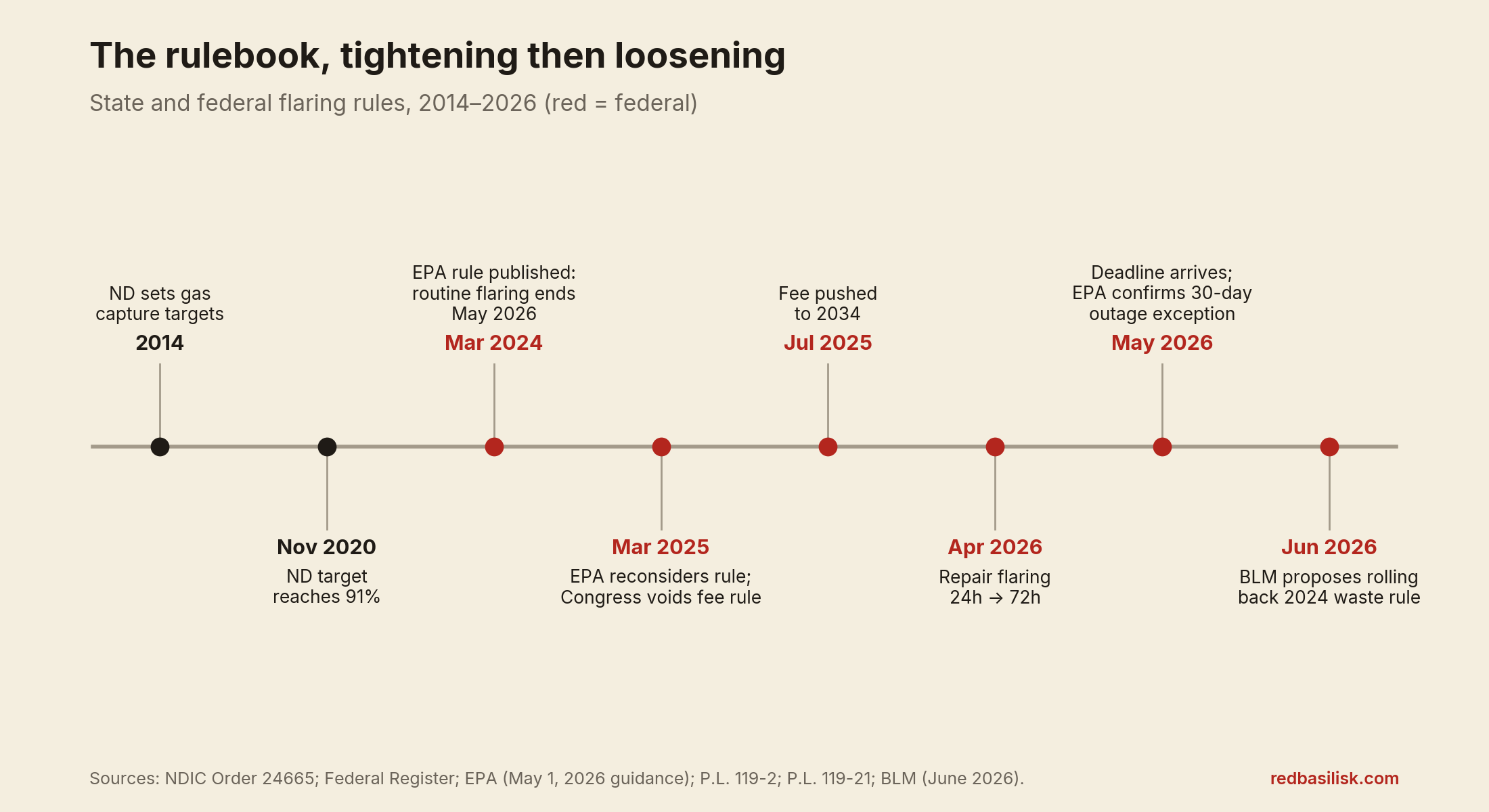
In March 2025, the new EPA announced it would reconsider the whole rule. That same month, Congress used the Congressional Review Act to wipe out the regulations behind a new federal fee on wasted methane. That July, the One Big Beautiful Bill Act pushed the fee's start date back to 2034.
The May 2026 flaring deadline itself never moved. Instead, the rules around it loosened. In April, the EPA extended the time a company can flare for repairs and troubleshooting from 24 hours to 72. Six days before the deadline, it issued guidance confirming that an existing provision lets companies flare for up to 30 days per incident when a pipeline or gathering system goes down for reasons they don't control. In June, the Bureau of Land Management proposed rolling back much of its own 2024 waste rule for federal land, including its limits on royalty-free flaring. That rule was already blocked in North Dakota by a court order.
Here's who wants what, and why.
Bakken producers told the EPA the deadline would force them to shut in oil. Continental Resources said it logged more than 630 extended flaring events over two years, and blamed about two-thirds of them on things outside its control, mostly problems with third-party gathering systems. Chord Energy listed toxic hydrogen sulfide, full pipelines, midstream outages, and production surges. North Dakota's congresswoman, Julie Fedorchak, said up to 40,000 barrels a day could have been shut in. Their motive is straightforward: oil is the money, and they don't want to stop pumping it because a gas line is full.
Environmental groups say the waste is inexcusable. The Environmental Defense Fund estimated in June that more than 5.4 billion dollars' worth of natural gas had been wasted since the administration stopped enforcing federal methane rules in March 2025. They also point out that flaring isn't just carbon dioxide. Some methane escapes unburned, and methane traps far more heat than CO2 in the short run. EDF has sued over the April rule change.
The administration frames its changes as removing burdens on American energy producers. EPA Administrator Lee Zeldin says America already produces energy cleaner than anywhere else. Energy Secretary Chris Wright says the changes give producers the certainty they need to keep producing.
The state sits in the middle. It relies on oil tax revenue, it wants the gas captured and sold too, and it's putting up to half a billion dollars behind a pipeline to do it.
The methane nobody counts
This part rarely makes the news, and it matters.
Regulators have long assumed a flare burns up 98 percent of the methane going into it. In a study published in 2022, researchers who flew aircraft over more than 300 flares in 2020 and 2021 in the Bakken, the Permian, and the Eagle Ford measured what was actually coming out. The flares were destroying about 91 percent on average.
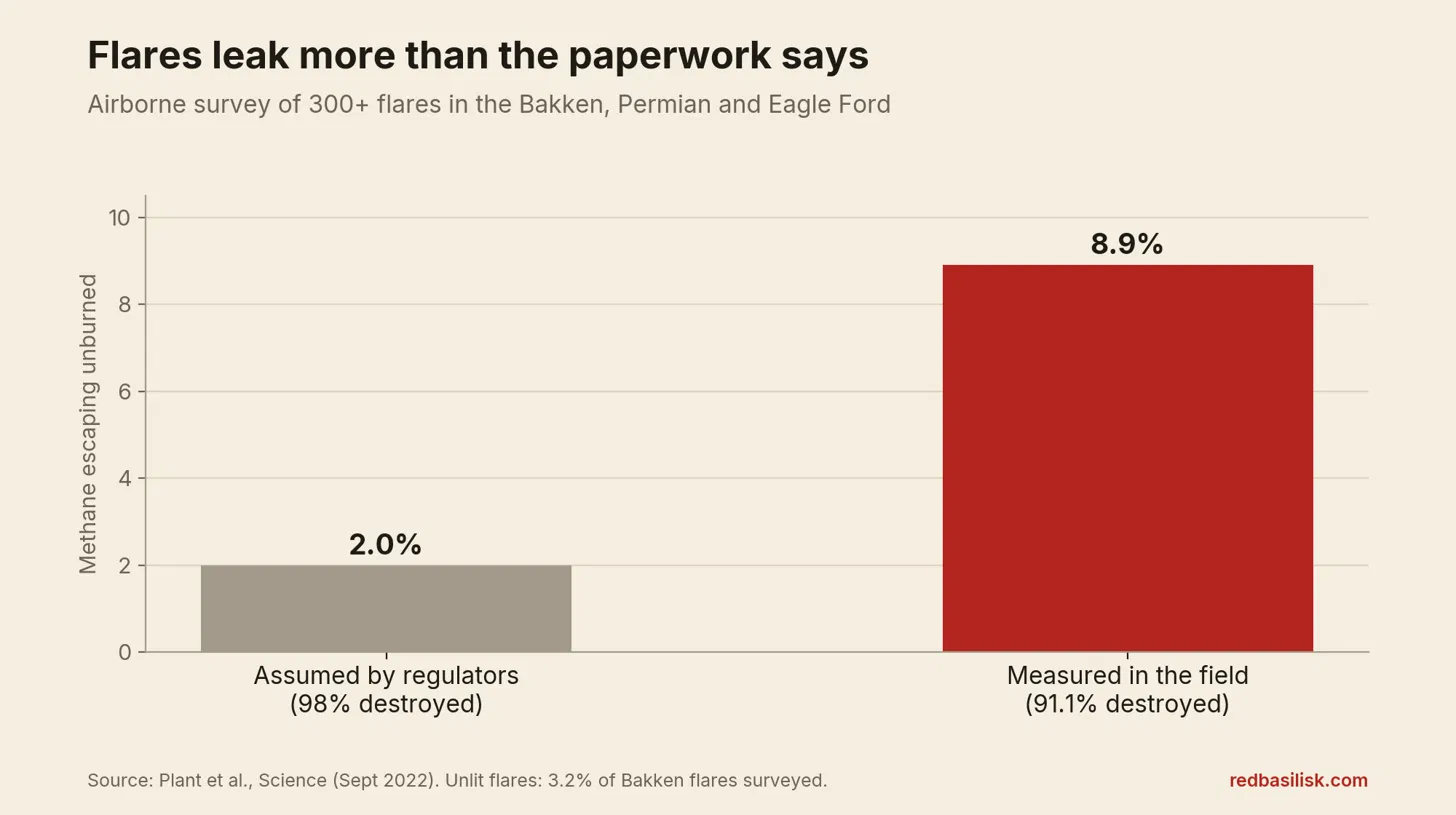
That gap sounds small. It isn't. It means roughly five times more methane is escaping than the paperwork assumes. About half the problem is flares that aren't burning cleanly. The other half is flares that aren't lit at all. In the Bakken, about 3 percent of the flares surveyed were unlit, venting raw gas straight into the air. Even the World Bank's global emissions estimate still assumes 98 percent. So the flames you can see are only part of it.
The stars
Back to where we started.
The loss of the night sky out here isn't just nostalgia. In 2015, a National Park Service night-sky scientist told reporters that man-made light visible in the north unit of Theodore Roosevelt National Park rose about 500 percent between 2010 and 2013. That was faster than at any other national park. Park staff blamed flares right outside the park boundary, along with drilling rigs and new development. NASA satellite images from 2012 show one of the least populated parts of the country lit up at night, mostly by drilling rigs and worker housing, with some flares mixed in.
What does that do to wildlife? We couldn't find a single peer-reviewed study of how flare light affects wildlife in the Bakken. What we do know comes from other places. Hundreds of studies show artificial light at night disrupts birds, insects, and bats. The U.S. Fish and Wildlife Service warns that gas flares attract migrating birds at night and can burn them. At a gas plant in New Brunswick in 2013, about 7,500 migrating songbirds died at a single flare on a foggy night. And a North Dakota study found grassland birds avoid well pads and roads, even before you count the light.
That's a real gap. The Bakken sits under a major bird migration route, and it's had flares for more than fifteen years. Someone should be measuring it.
Who pays for the fire
So why hasn't anyone solved this?
The honest answer is that the big part got solved. Pipelines and processing plants took North Dakota from flaring more than a third of its gas at the 2011 peak to under 5 percent today. That's a real achievement, and the people who built it deserve credit.
The flares left are mostly the ones where every option costs more than burning, or where the pipe is there but full. Pipe to a remote well costs more than its gas is worth. A generator needs someone to buy the power. Trucks can't make it pay. Paying royalties on burned gas is cheaper than all of it. The rules were written to allow exactly this.
But "cheapest" only counts the company's costs. The mineral owner gets royalties on gas that could have been worth more sold as propane and fuel. The public gets methane, five times more than the paperwork says. And everyone who lives out here gets a sky with a lot fewer stars.
That's what "burning money" really means. It's not only the company's money going up in smoke. It's everyone else's, paid in things that never show up on a balance sheet.
My take
Honestly, I am just tired of the flare in my backyard. I am annoyed by the light pollution. It's ugly and hard on wildlife. I would like to see byproducts planned for ahead of time, and handled when they are produced, not put off for 10 years. After writing this article, it's clear that they could be much worse than they are, but 1 for every 20 is a lot. I would rather see 1 for every 200.
How we dug into this
The research was done with AI tools. Separate research passes pulled from North Dakota's Department of Mineral Resources monthly reports, EIA data, the World Bank's 2026 Global Gas Flaring Tracker, the Federal Register, EPA and BLM documents, company letters to the EPA, and peer-reviewed research. A separate AI fact-check pass then checked every figure against its source before publishing.
A few notes on the numbers:
- The power, homes, and dollar figures for North Dakota's flaring are our own math, from the state's reported flare volumes and published gas prices. We assumed a typical generator efficiency and the average U.S. household's electricity use. They're estimates, not reported figures.
- The EIA and the World Bank measure U.S. flaring differently. EIA combines venting and flaring from operator reports. The World Bank measures flaring only, from satellites, and it recalibrated its whole history this year. We say which one we're using each time.
- North Dakota's annual flaring chart uses EIA's vented-and-flared series through 2024. The 2026 bar uses the state's monthly flared figures, which are defined slightly differently.
- The 500 percent night-sky figure comes from a 2015 news report quoting a National Park Service scientist. We could not find the original NPS dataset.
Sources
- North Dakota Department of Mineral Resources, Director's Cut monthly reports, 2025–2026 (latest: September 21, 2026).
- North Dakota Century Code 38-08-06.4, flaring restrictions.
- N.D. Admin. Code 43-02-03-60.2, flaring exemption.
- NDIC Order 24665 guidance policy (gas capture targets).
- EIA, North Dakota natural gas vented and flared (annual).
- EIA, U.S. natural gas vented and flared (annual).
- EIA, "North Dakota flared 19% of its natural gas production in 2019" (April 22, 2020).
- EIA, North Dakota gas capture and processing capacity.
- EIA, Henry Hub natural gas spot price.
- Chord Energy, fourth quarter and full year 2025 results (February 25, 2026).
- World Bank, 2026 Global Gas Flaring Tracker (June 23, 2026).
- North Dakota Monitor, "Industrial Commission votes to commit up to $500 million to natural gas pipeline" (April 29, 2026).
- FERC, Bakken East Pipeline Project.
- MDU Resources, second quarter 2026 results.
- Crusoe, "NYDIG to acquire Crusoe's bitcoin mining operation" (March 25, 2025).
- Crusoe, Abilene data center live (September 30, 2025).
- ND Department of Environmental Quality, NYDIG DFM air permit ACP-18228.
- EcoVapor, North Dakota SB 2089 overview (May 2023).
- ND Legislature, SB 2089 (2023) bill overview.
- EIA, U.S. natural gas imports by country.
- EIA, LNG imports into Everett, MA.
- EIA, pipeline imports from Canada, 2025.
- EIA, U.S. LNG exports 2025 (July 14, 2026).
- DOE, natural gas points of entry and transporters.
- Congressional Research Service, "U.S. LNG Trade Rising, But No Domestic Shipping."
- H.R. 8020, American LNG First Act of 2026.
- Federal Register, EPA methane rule OOOOb/c (March 8, 2024).
- Federal Register, EPA reconsideration final rule (April 9, 2026).
- EPA, "EPA Clarifies When Oil and Natural Gas Producers Can Flare After Phase Out Deadline" (May 1, 2026).
- EPA, operator letters on the associated gas deadline (Chord, Continental, Kraken).
- Congress.gov, H.J.Res.35 (P.L. 119-2).
- Congressional Research Service, R48906, methane Waste Emissions Charge (April 15, 2026).
- BLM, 2024 Waste Prevention Rule.
- Federal Register, BLM proposed rescission (June 24, 2026).
- Rep. Julie Fedorchak, statement on EPA guidance (May 1, 2026).
- EDF, "EPA Issues Guidance on Oil & Gas Methane Pollution Flaring Standards" (May 1, 2026).
- EDF, lawsuit opposing EPA's weakening of methane standards (June 9, 2026).
- EPA memo on associated gas flaring after the phase-out (April 30, 2026).
- Federal Register, PHMSA advance notice on automated hazmat transport (December 4, 2025).
- Harvard Environmental and Energy Law Program, EPA methane rule tracker.
- Plant et al., "Inefficient and unlit natural gas flares both emit large quantities of methane," Science (September 29, 2022).
- KUNC / Inside Energy, "From Texas to North Dakota, the glow of energy development has dimmed the stars" (October 26, 2015).
- National Park Service, the Bakken oil boom and Theodore Roosevelt National Park.
- NASA Earth Observatory, gas drilling in North Dakota at night.
- U.S. Fish and Wildlife Service, threats to birds: gas flares.
- CBC, "7,500 songbirds killed at Canaport gas plant in Saint John" (2013).
- USGS, Thompson et al., grassland bird avoidance of oil wells and roads (2015).
- World Bank, CNG commercialization study (October 2015).
- Aurora, driverless network expands to 10 routes (February 11, 2026).
- FreightWaves, Atlas and Kodiak driverless truck fleet (July 31, 2026).
- CFR 397.5, attendance of hazmat vehicles.