




Read
Is the DSA Communist? Part 1: What the DSA Actually Is
We tested the charges against the Democratic Socialists of America layer by layer, from its platform to its leaders to the streamers who campaign for it.
Every dispatch is also a podcast. Follow on Spotify ↗
This month, a former conservative influencer named Ashley St. Clair sat down for a CNN interview and announced she is now a dues-paying member of the Democratic Socialists of America. She joked about being one of the communists now. When the reporter teased her about being a dangerous leftist radical, she answered by singing "Bella Ciao."
For a lot of people, that clip was the last straw. The DSA has been everywhere this year. Its members are winning primaries, its candidate became mayor of New York, and its critics have two charges they repeat constantly. The first is that the DSA is communist under a different name. The second is that it keeps ending up on the side of Islamist extremists.
We wanted to know what's actually true. So we tested both charges the slow way, one layer at a time. Before we get there, though, let's start with the song.
The song that started it
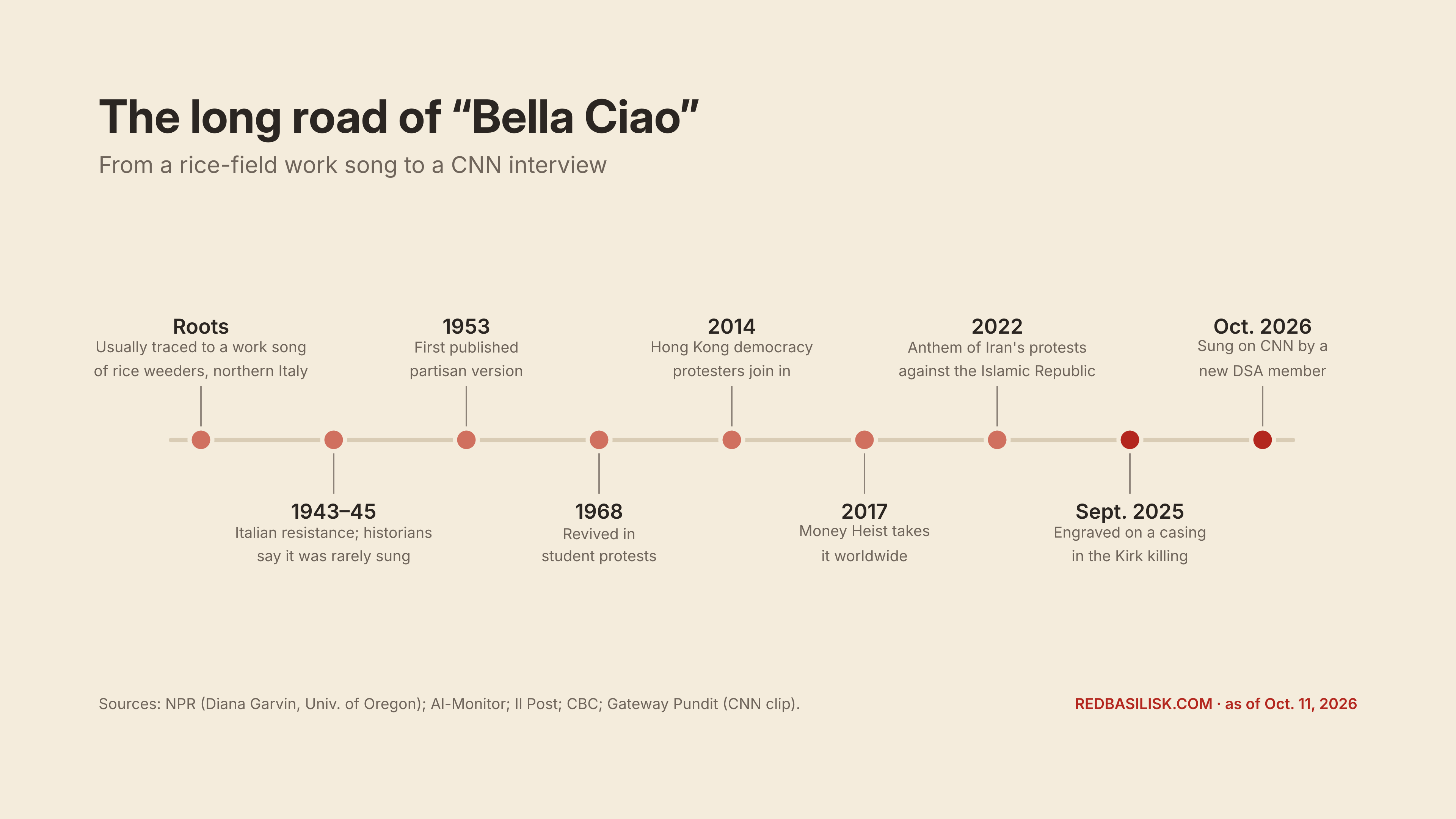
"Bella Ciao" did not begin as a communist anthem. It is usually traced to a work song of women who weeded rice fields in northern Italy, though its origins are disputed. Historians say it was rarely sung during the Italian resistance in World War II. It spread after the war, came back in the student protests of 1968, and went global with the Netflix series Money Heist.
The Italian resistance itself was a mix of communists, socialists and Catholic democrats, and part of the song's later appeal was that no single party owned it. In 2014, Hong Kong's democracy protesters joined in singing it. In 2022, Iranian protesters sang it against the Islamic Republic. It was played at memorials for Charlie Hebdo cartoonists murdered by jihadists.
Then it got a much darker association in this country. When Charlie Kirk was assassinated in September 2025, the accused shooter had engraved the song's chorus on one bullet casing. Another read "Hey fascist! Catch!"
So the song is not a communist hymn. But in America today, singing it in answer to "are you a radical?" carries a charge it never used to carry, whatever St. Clair meant by it.
How we tested it
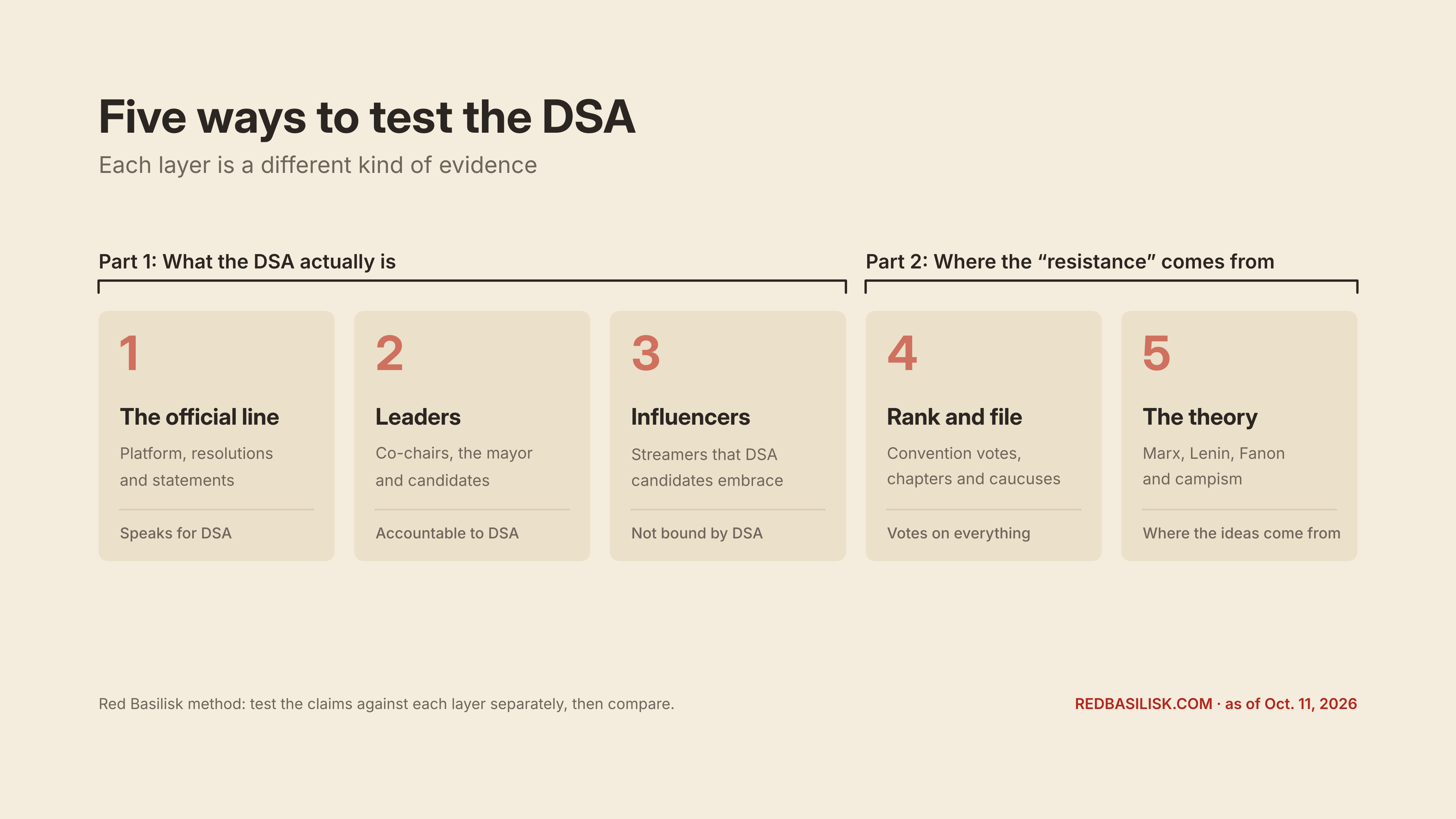
An organization can be judged a few different ways, and they don't always agree. So we split the evidence into five layers:
- The official line: what the DSA says about itself in its platform, its resolutions and its statements.
- The leaders: its national co-chairs and the politicians who carry its endorsement.
- The influencers: the streamers and personalities who campaign for DSA candidates but answer to nobody in the organization.
- The rank and file: how the members actually vote.
- The theory: where these ideas come from in the first place.
This dispatch covers the first three. Part 2 covers the members and the theory.
Then we broke the two big charges into smaller ones that can be checked. "Communist under a different name" becomes three questions. Is the official goal to abolish capitalism? Do self-described communists run the national leadership? Did the DSA drop its old safeguards against communists? "Sides with Islamist extremism" becomes three more. Do official DSA bodies refuse to condemn Hamas? Do they endorse armed resistance? Do DSA groups praise attacks on Jews and Israelis?
One thing turned up early, so we'll say it now. Nothing in the DSA's official documents endorses Islamist ideology itself. The record is about Palestinian armed groups and how the DSA talks about them. That distinction runs through everything that follows.
Layer 1: what the DSA says it is
The DSA was founded in 1982, when two groups merged. One was led by Michael Harrington, a socialist writer whose side treated opposing Soviet-style communism as a core moral duty. The other came out of the 1960s New Left. According to the DSA's own history, the two hardest issues in the merger talks were communism and the Middle East. Both are still the hardest issues today.
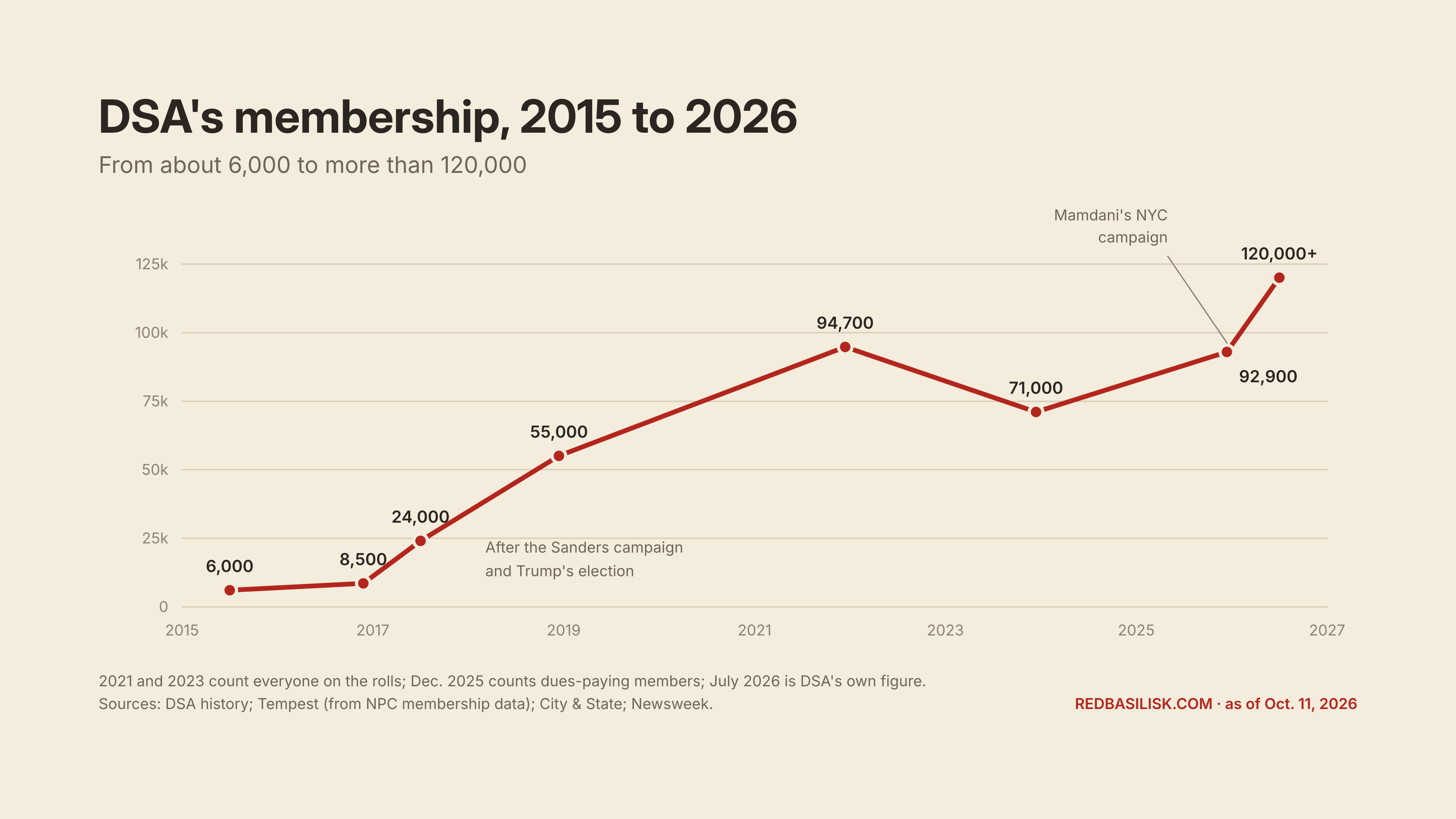
For most of its life, the DSA was small, around 6,000 members in 2015. The Bernie Sanders campaign and Donald Trump's election changed that. Counting lapsed members, membership passed 90,000 at the end of 2021 and sank back to about 71,000 by the end of 2023. It then surged during Zohran Mamdani's campaign for mayor of New York. In July of this year, the DSA said it had passed 120,000 members.
What does it say it wants? Its mission statement says capitalism is a system built by the owning class to exploit everyone else, and that it must be replaced with democratic socialism. The same page says the DSA leaves authoritarian versions of socialism behind, and it wants collective ownership of key industries like energy and transportation.
In July, the DSA released a new national program called "Workers Deserve More." It is worth reading for yourself, because it is unusually blunt. Its end goal is a classless society. It says the DSA is building a party to "draft a new constitution" and create "a democratic socialist republic." On the economy, it calls for public ownership of the largest corporations and essential industries, plus aggressive wealth taxes. On government, it would abolish the Senate and the Electoral College, and replace the President and the Supreme Court with leaders chosen by Congress. It calls for cutting police and prisons as steps toward abolishing both.
On foreign policy, it calls for ending all aid to Israel and recognizing a Palestinian "right to resist military occupation." It also calls for ending sanctions on Cuba, Venezuela and Iran.
Several DSA candidates have kept their distance from it. Wisconsin's Francesca Hong said plainly that it isn't her platform.
So how does this compare to communism? The destination lines up with Marx: no capitalism, social ownership, a classless society. The road does not line up with Lenin. The program talks about elections, multiple parties and a written constitution, not a one-party state. That gap is the whole question, so we'll keep it in mind as we go.
Who runs it
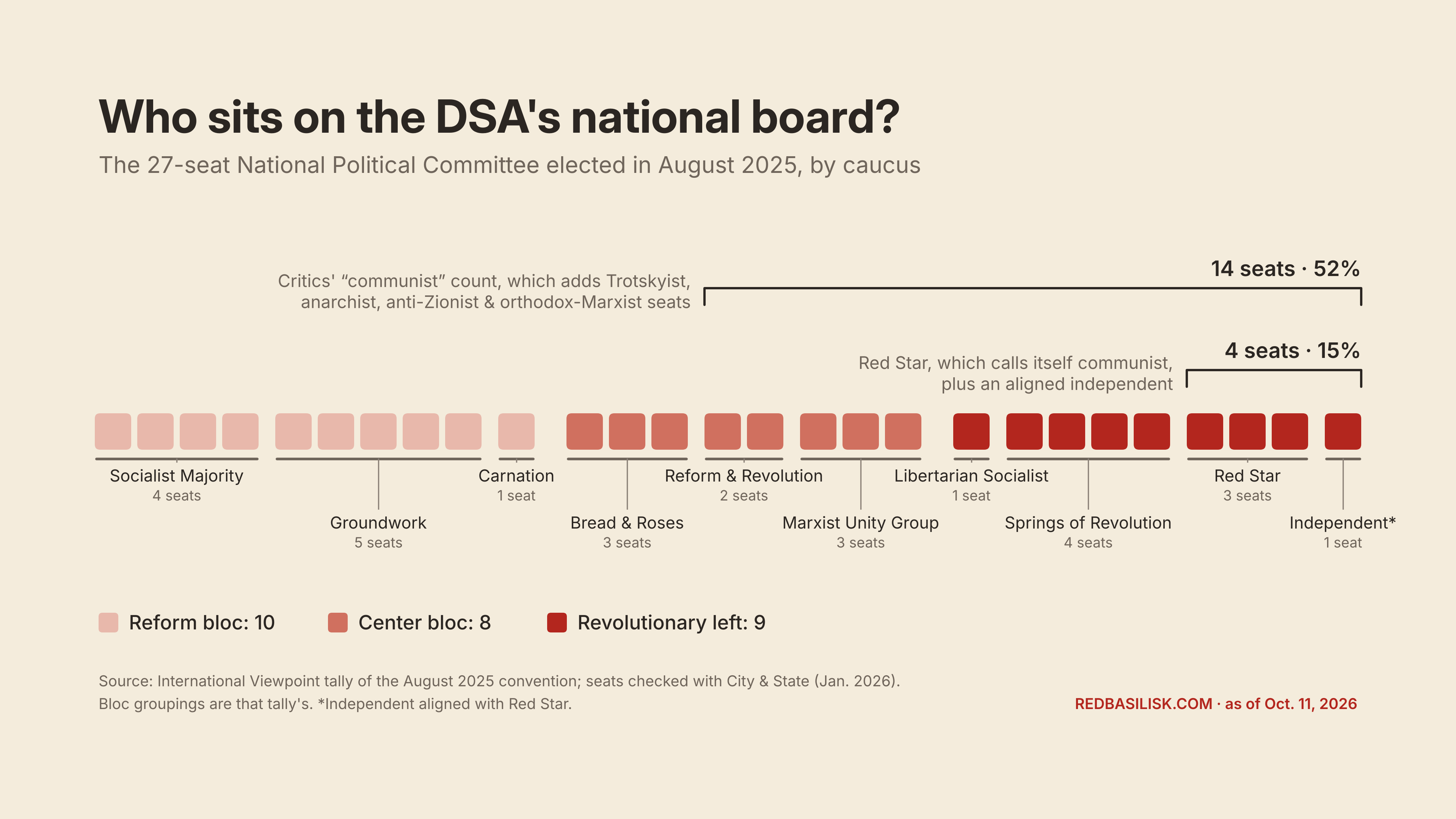
The DSA is not one thing. It's a coalition of factions, which it calls caucuses. More than 20 of them showed up at last year's national convention in Chicago. They range from election-focused reformers to groups that openly call themselves communist, like the Red Star caucus and the Liberation Caucus, which describes itself as Marxist-Leninist-Maoist.
Between conventions, the DSA is run by a 27-seat National Political Committee. You'll hear critics say communists hold 52 percent of it. That number does work out, but only if you count a Trotskyist caucus, an anarchist caucus, an anti-Zionist network and an orthodox-Marxist caucus as communist. Count only the seats held by Red Star, which calls itself communist, and an independent aligned with it, and you get about 15 percent. The board is closely split; some votes come down to 14 to 13.
One change matters more than the seat count. For decades, the DSA's bylaws barred members from belonging to a "democratic centralist" organization. That's Lenin's rule for running a party: argue in private, then everyone follows the line in public. It was a safeguard against outside communist groups taking the DSA over. At last year's convention, the DSA repealed it. Even a left-wing magazine friendly to the DSA described the old ban as a holdover from the organization's anti-communist days.
The record on Israel, Hamas and violence
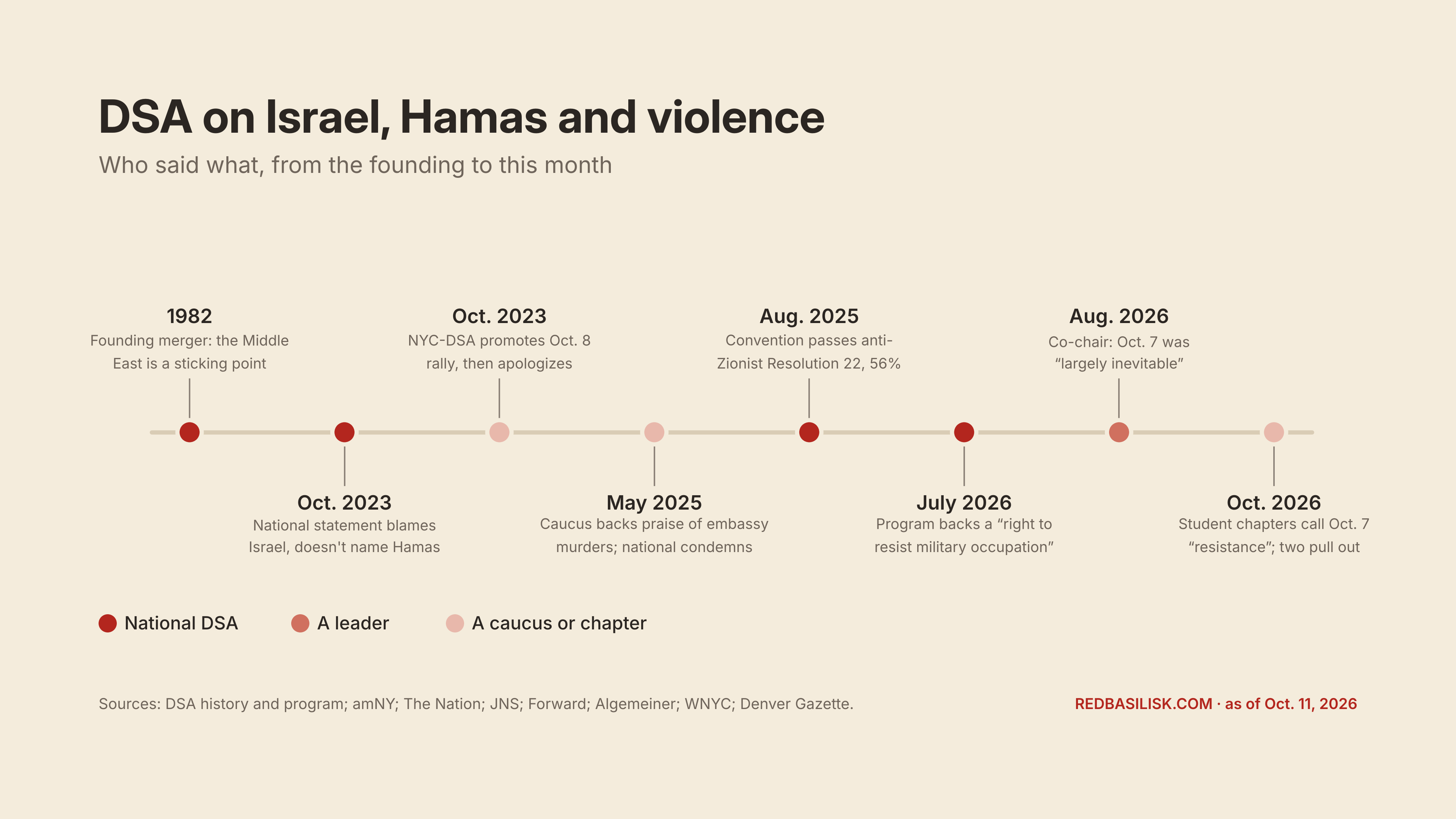
The Middle East was a fault line at the DSA's founding, and it still is. The 1982 merger backed Israel's right to exist alongside Palestinian self-determination. Over the following years, members came to support a Palestinian state and cutting U.S. military aid to push Israel out of the occupied territories.
The turning point was October 7, 2023. That day, the DSA's national statement blamed Israel's government for the attack and did not mention Hamas by name. The New York City chapter promoted a rally in Times Square for the next day, then apologized for its timing and tone. Maurice Isserman, one of the DSA's founding members, quit in protest.
In May 2025, a gunman murdered two young Israeli embassy staffers, Yaron Lischinsky and Sarah Milgrim, outside the Capital Jewish Museum in Washington. The DSA's Liberation Caucus signed on to a statement calling the killings legitimate resistance and called for the shooter's release. National DSA condemned the murders and said any statement otherwise was not the DSA's stance.
In August 2025, the national convention passed Resolution 22, titled "For a Fighting Anti-Zionist DSA," with 56 percent of the vote. It bars endorsements for candidates who oppose the boycott movement against Israel or vote for aid to Israel. It also makes saying "Israel has a right to defend itself" grounds for expulsion. And it affirms a Palestinian framework called the Thawabit, which includes a commitment to "resistance."
Here is the asymmetry that bothered us most. Under Resolution 22, defending Israel can get a member expelled. But we found no report that the Liberation Caucus faced any discipline for backing praise of the embassy murders. We also found no report of anyone actually being expelled under Resolution 22. Internal cases don't always make the news, so that is an absence of evidence, not proof.
And this month, student DSA chapters in New York co-signed a post calling October 7 "resistance against imperialism," for a rally aimed at Mayor Mamdani. Two of the three chapters pulled their names after the backlash.
So the official pattern isn't support for Islamism. Nothing on this list endorses Islamist rule, and the DSA's own program on women's rights and gay rights runs directly against Hamas. The pattern is a framework that files Palestinian armed groups under "resistance" and avoids condemning Hamas by name. The outright praise of killing comes from the fringe, and the national organization has distanced itself without disciplining anyone.
Layer 2: the leaders
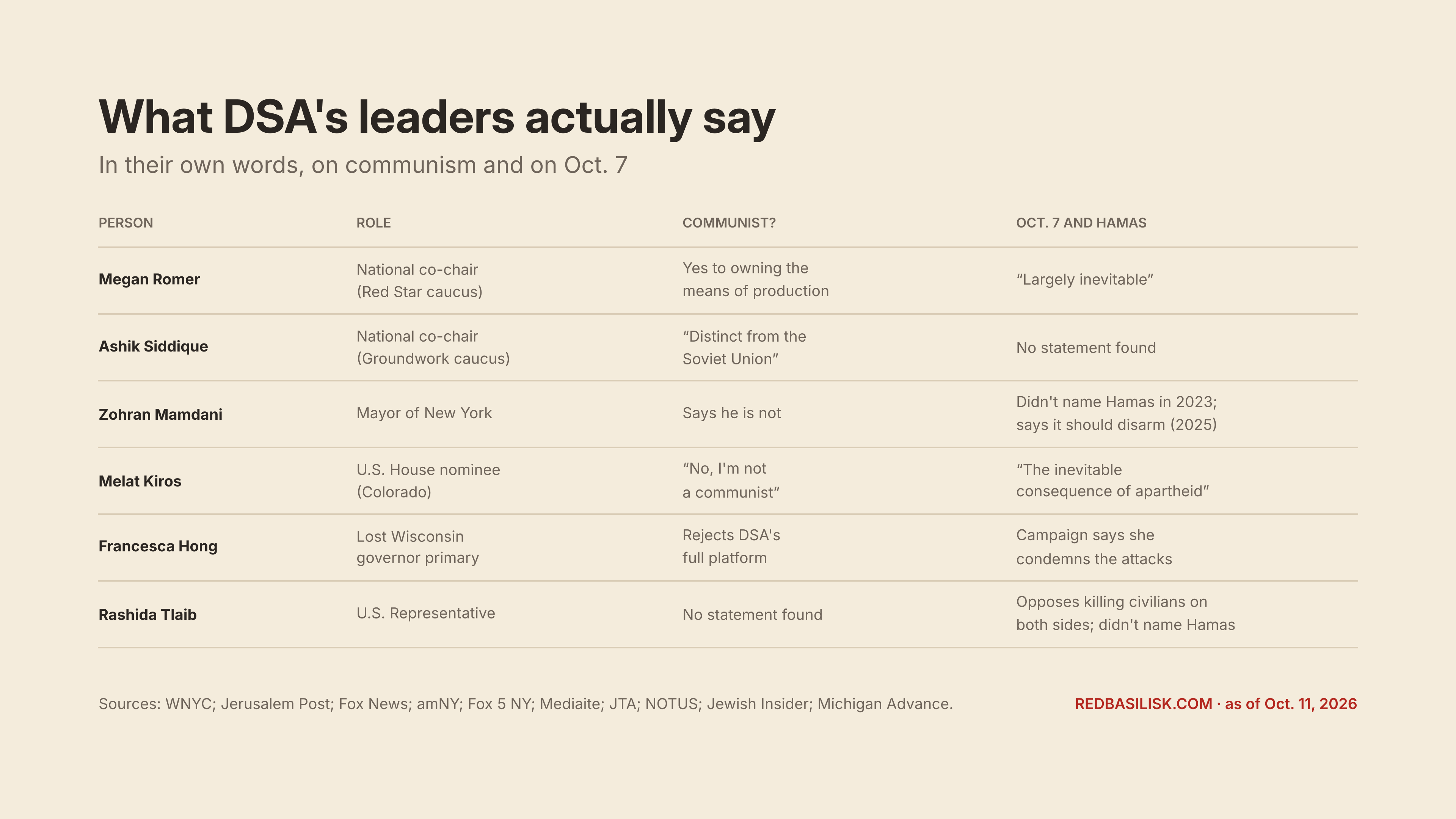
At the top, the split is sharp.
Megan Romer is one of the DSA's two national co-chairs, and she belongs to Red Star, the Marxist-Leninist caucus. In an August interview on the New Yorker Radio Hour, David Remnick asked whether she believes in owning the means of production. She said she does. In the same interview, she called October 7 "largely inevitable," and said she probably would have gone to that Times Square rally. She added that she was not defending harm to civilians. That caveat matters, and it's worth hearing in full. Some of the sharpest criticism of the interview came from inside the DSA, from its reform caucuses. National DSA didn't say anything either way.
Her fellow co-chair, Ashik Siddique, comes from the reformist Groundwork caucus. He has drawn the line the other way, telling Fox News that the DSA's goal is democratic socialism, distinct from the Soviet Union.
The DSA's elected officials mostly sound like Siddique, not Romer. Zohran Mamdani, now mayor of New York, has said he is not a communist, and his campaign has said the national DSA's positions differ from his own. His statement the day after October 7 mourned deaths on both sides without naming Hamas. He has moved since. In an October 2025 debate, he said Hamas should lay down its arms. His statement this October 7 says plainly that Hamas killed more than 1,100 Israelis. His new plan against antisemitism funds security for synagogues. And that has turned part of his own movement against him. This October 7, protesters, at least one carrying a Hezbollah flag, chanted "traitor" at him, and his security team moved him out of a vigil. Two days later, New York's DSA chapter said his police commissioner should be fired if she couldn't stop the NYPD's cooperation with immigration enforcement.
Melat Kiros, who beat a longtime congresswoman in Colorado's Democratic primary, told PBS she is not a communist and called the DSA's communists part of a big tent. She has also called October 7 "the inevitable consequence of apartheid." Francesca Hong, who narrowly lost Wisconsin's primary for governor in August, said she doesn't support the DSA's full platform, and her campaign says she condemns the October 7 attacks.
In Congress, Rashida Tlaib said days after the attack that she opposes targeting civilians in Israel or Palestine, without naming Hamas. Alexandria Ocasio-Cortez, whose 2024 endorsement the DSA pulled over Israel, has since pledged to oppose all military aid to Israel, including defensive systems, and rejoined the DSA in August, the organization confirmed.
Notice the word that keeps coming up. "Inevitable" came from a national co-chair and from a congressional nominee. It stops short of praise. But it treats the attack like weather, something that happened, rather than a choice Hamas made. Where that way of talking comes from is the main question of Part 2.
Layer 3: the influencers
The influencers say the most extreme things in this whole story. They also aren't bound by anything the DSA decides. So the useful test isn't just what they say. It's what the DSA's candidates do when they say it.
The biggest of them is Hasan Piker, a political streamer with about 3.1 million followers on Twitch and 1.9 million subscribers on YouTube. We could not confirm he is a dues-paying DSA member. He is clearly aligned, though. He interviewed Rashida Tlaib at the DSA's 2025 convention and campaigns for DSA candidates.
He calls himself a socialist. At a Yale debate in April, he said that if a dictatorship is inevitable, he'd rather have "a dictatorship of the proletariat." Describing a 2025 trip to China, he called Mao one of the world's great leaders while admitting there were "excesses." On Hamas and violence, he goes further than anyone in the layer above. He has called the Hezbollah flag "a dope flag." He has said he would vote for Hamas over Israel every time, calling himself a lesser-evil voter. In September, he said the United States is worse than al-Qaeda by body count. And in August, he warned that if American Jews keep tying themselves to Israel, someone will eventually "take action." He then said it wasn't a call for violence.
To be fair to him, there is evidence the other way. He condemned Charlie Kirk's killing the day it happened and told his audience not to joke about it, though in August he drew criticism for mocking Kirk with a meme song at a live show. On CNN, according to Fox News, he said Hamas has committed war crimes. He has rejected the conspiracy theory that Israel killed Kirk. But we found no plain, unqualified condemnation from him of the October 7 killings.
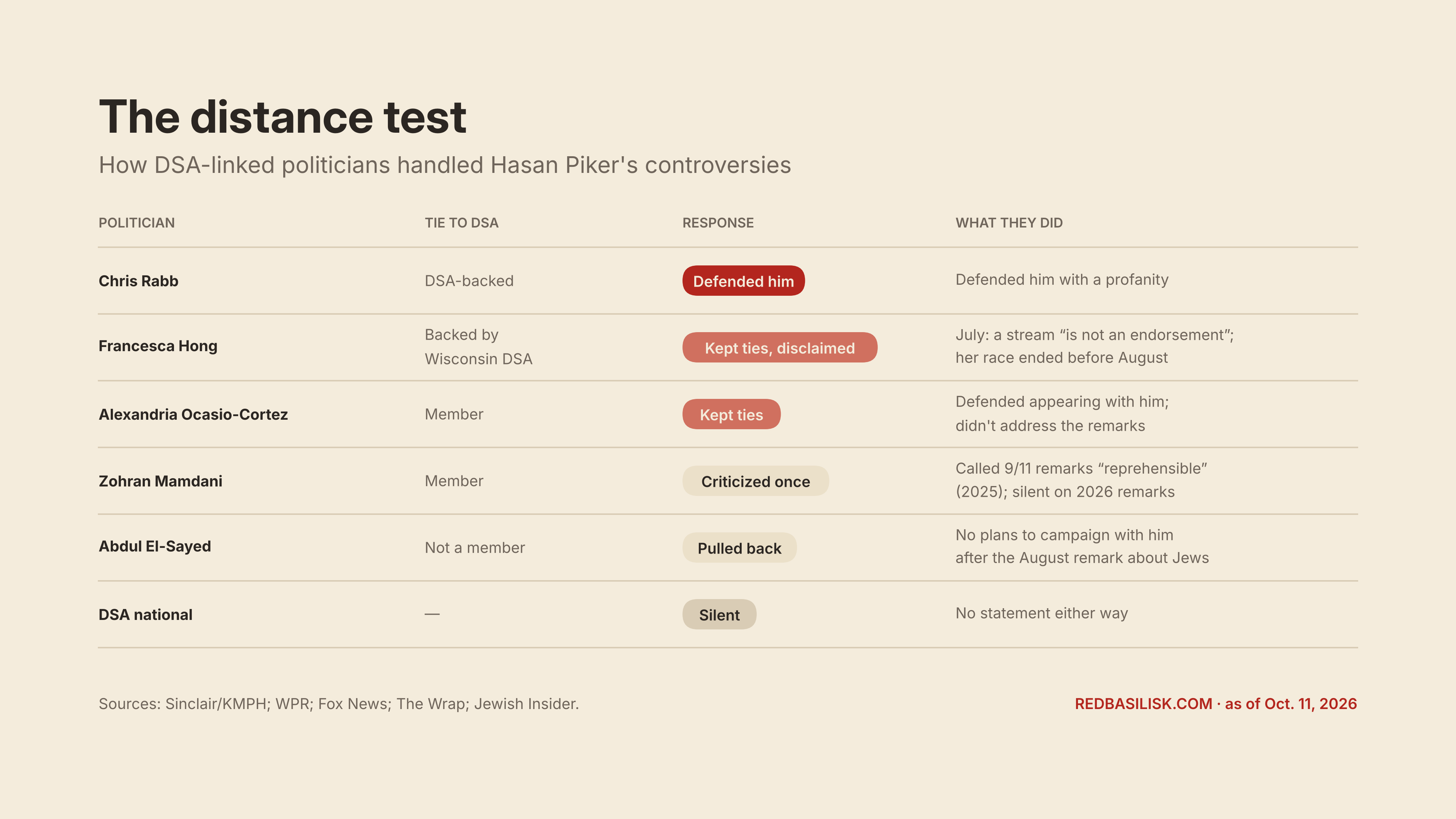
Now the distance test. As Piker's comments piled up this summer, the responses split. Abdul El-Sayed, running for Senate in Michigan and not a DSA member, said after the August remark about Jews that he had no plans to campaign with him again. Francesca Hong, facing criticism over Piker in July, kept appearing with him, and her campaign said a livestream "is not an endorsement." Her race ended before the August controversy. Pennsylvania's Chris Rabb, a DSA-backed nominee, defended him with a profanity. Mamdani had called Piker's old 9/11 comments reprehensible back in 2025, but we found no response from him this year. AOC defended appearing with Piker as coalition building, without addressing what he said. And national DSA said nothing at all.
The smaller names follow the same pattern. Ashley St. Clair, whose clip opened this story, hasn't drawn any comment from the DSA. A streamer called "Mike from PA" called Jewish ethnicity "demonic" in 2024, later apologized, and still hosted a DSA-backed candidate this year.
There's a counterweight worth naming. Jacobin, the most influential magazine on the DSA left, is independent of the organization, and its founder pulls the other way on communism. Bhaskar Sunkara, a former DSA vice chair, calls Stalin's Soviet Union a totalitarian regime, and defines democratic socialism as rejecting one-party rule.
What this layer shows is that the embrace is real. The influencers raise money and draw crowds for DSA candidates, and their audiences are far bigger than the DSA itself. When they cross a line, the response depends on the candidate. The organization stays quiet.
The scorecard so far
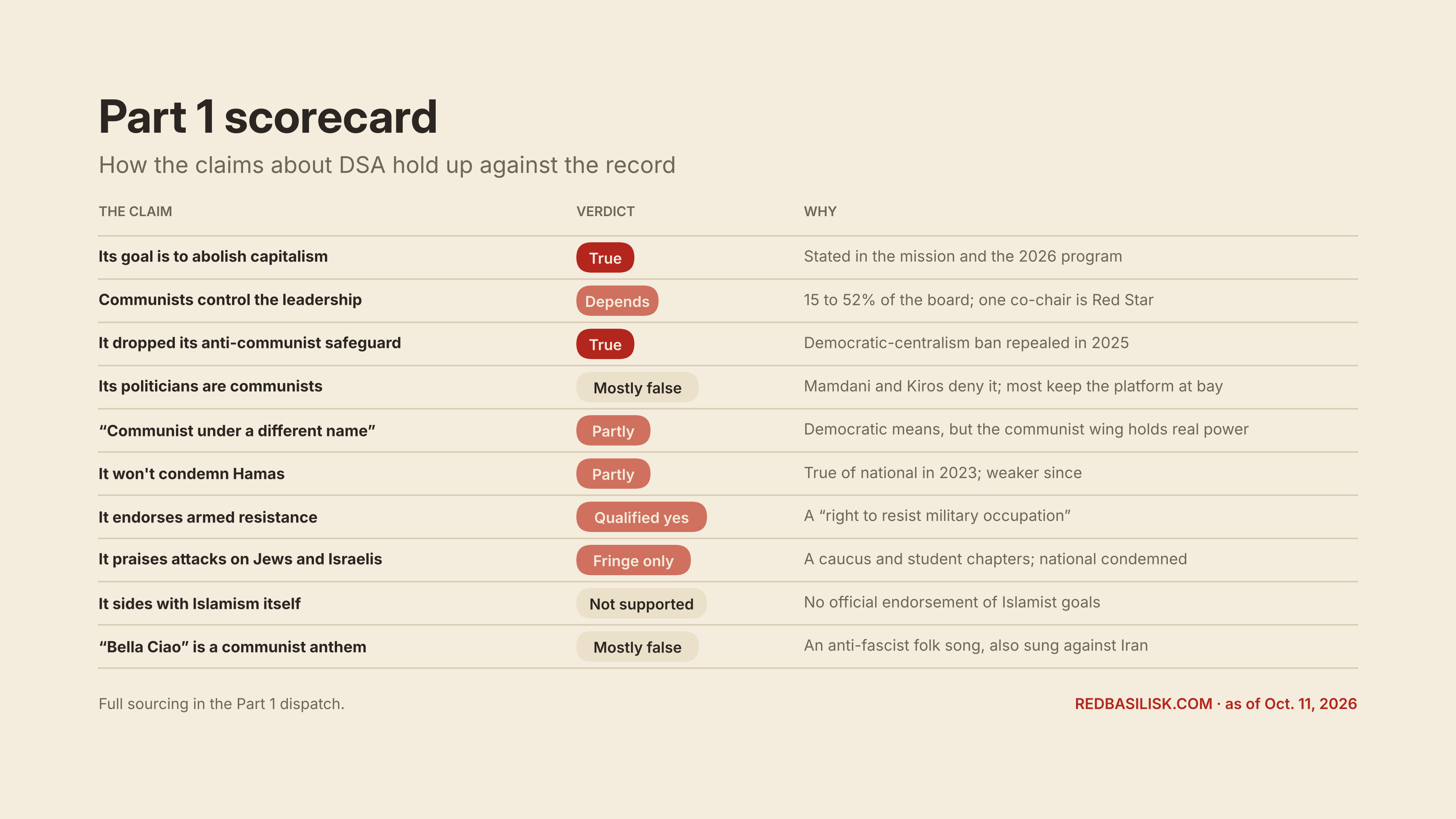
On communism, the DSA's goal of abolishing capitalism is out in the open, and it says so in its own documents. Its stated methods are democratic: elections, multiple parties, a new constitution. Most of its elected officials deny being communists and keep the national platform at arm's length. But its communist wing now holds somewhere between 15 and 52 percent of the national board, depending on who you count, one of its two co-chairs comes from that wing, and it dropped the rule that was built to keep communist groups out. It's less a communist party in disguise than a coalition whose balance has been moving toward its communist wing.
On Islamism, the honest answer is more specific than the charge. We found no official support for Islamist ideology. What we found is an official "right to resist," a national statement that wouldn't name Hamas, leaders who call October 7 "inevitable," and fringe groups that praised murder without facing discipline.
That leaves the most interesting question. Why does an organization whose own platform runs against everything Hamas believes keep ending up beside it? That's Part 2: what the members think, and where the "resistance" framing comes from.
How we dug into this
This dispatch was researched, written and illustrated with AI tools. We split the question into layers and researched each separately: the DSA's own documents, its national leaders and officeholders, and the influencers who campaign for its candidates. For the influencers, we tried to find the full context of viral clips rather than relying on trimmed versions, and we say where we couldn't.
Several things could not be confirmed. We could not find CNN's own copy of the St. Clair interview; our account relies on circulated clips and write-ups. We could not confirm whether Hasan Piker is a DSA member. The critics' 52 percent figure for communists on the national board comes from a count we could only partly reproduce, which is why we give a range. And an often-repeated claim that a DSA committee formally defended Iran's "right to self-defense" in 2024 turned out, as far as we could find, to be a single official's social media post, so we left it out.
Where our sources were partisan, on either side, we used them only for facts we could match elsewhere or for what someone actually said on the record. Before publishing, a separate AI agent fact-checked every claim in this piece against its sources.
Sources
- [What Is Democratic Socialism? (DSA)](
- [A History of the DSA (DSA)](
- [Workers Deserve More program (DSA)](
- [Red Star caucus on Megan Romer](
- [International Viewpoint: the 2025 convention](
- [City & State: DSA's internal caucuses](
- [Cosmonaut: the party echoes at the 2025 convention](
- [Portside: mass politics vs. vanguard party](
- [City Journal: "Actually, a Lot of DSA Members Are Communists"](
- [Algemeiner: Resolution 22](
- [amNY: NYC-DSA response to Oct. 7](
- [Fox News: Isserman quits DSA](
- [JNS: Liberation Caucus and the embassy shooting](
- [The Forward: DSA and the "Free Elias Rodriguez" post](
- [Denver Gazette: student chapters walk back Oct. 7 post](
- [WNYC: New Yorker Radio Hour, Megan Romer](
- [Jerusalem Post: Romer's remarks with her caveat](
- [The New Republic: Romer and DSA's internal backlash](
- [Fox News: Siddique on the Soviet Union](
- [Fox 5 NY: Mamdani's 2026 Oct. 7 statement](
- [AJC: Mamdani's antisemitism plan](
- [Jewish Chronicle: protesters at the Oct. 7 vigil](
- [Times of Israel: NYC-DSA and Commissioner Tisch](
- [Mediaite: Kiros on Firing Line](
- [JTA: Kiros and Jewish groups](
- [NOTUS: candidates and the DSA platform](
- [Semafor: DSA reworks its platform](
- [Michigan Advance: Tlaib on violence in Israel and Gaza](
- [Washington Sun: AOC's DSA membership](
- [Sinclair: who is Hasan Piker?](
- [The Nation: Piker at the Yale Political Union](
- [Cato Institute: Piker's Mao remarks](
- [Jewish Insider: Piker on Hamas](
- [Sinclair: Piker on al-Qaeda](
- [Sinclair/KMPH: El-Sayed distances from Piker](
- [CBC: reactions to Kirk's killing](
- [Variety: Piker interview](
- [WPR: Hong's livestreams](
- [Fox News: Rabb defends Piker](
- [The Wrap: AOC on Piker appearances](
- [Jewish Insider: Valdez and "Mike from PA"](
- [Twitchy: St. Clair clip](
- [Gateway Pundit: St. Clair CNN interview](
- [Democracy Journal: Sunkara's "The Socialist Manifesto"](
- [NPR via WBHM: how "Bella Ciao" is connected to Kirk's killing](
- [CBC: the inscriptions on the casings](
- [Al-Monitor: the protest anthem the world loves to sing](
- [Il Post: Hong Kong protesters sing "Bella Ciao"](
- [Moked: "Bella Ciao" and Charlie Hebdo](
- [Wikipedia: Democratic Socialists of America](
- [City & State: DSA's membership nearly doubled](
- [Tempest: DSA membership data](