




Read
Is the DSA Communist? Part 2: Where the "Resistance" Comes From
Why does a socialist group whose own platform opposes everything Hamas stands for keep ending up beside it? We checked the members and the theory.
Every dispatch is also a podcast. Follow on Spotify ↗
In Part 1, we tested the charges against the Democratic Socialists of America by looking at its official documents, its leaders and the influencers who campaign for it. Here's where that landed.
On communism, the answer was "partly, and increasingly." The DSA openly wants to abolish capitalism, but through elections and a new constitution. Most of its elected officials deny being communists. Its communist wing, though, now holds between 15 and 52 percent of the national board, depending on how you count, and one of its two national co-chairs comes from that wing.
On Islamism, the charge turned out to be the wrong description. We found no official support for Islamist ideology. What we found was an official "right to resist," a national statement that wouldn't name Hamas after October 7, leaders who call that attack "inevitable," and fringe groups that praised murder without facing discipline.
That leaves two questions. First, do the members actually think like their leaders? And second, why does an organization whose platform supports women's rights and gay rights keep ending up beside Hamas, a group that opposes both? This dispatch takes them in that order.
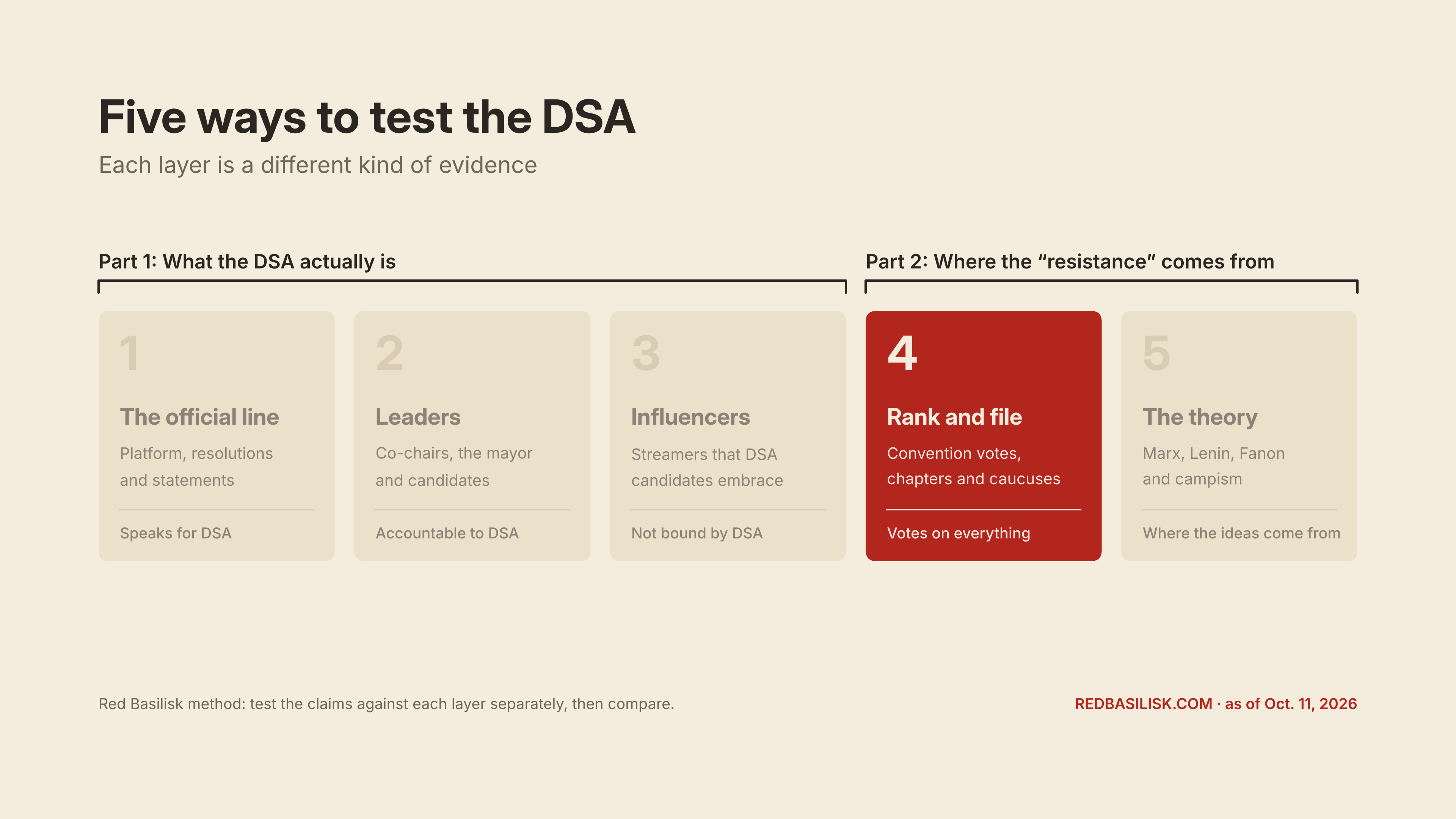
A](rb_dsa_layers.png)
Layer 4: the rank and file
There's a problem with measuring what DSA members think: nobody has asked them. We found no survey of DSA members on whether they consider themselves communists, or what they think about Hamas.
The best substitute is the national convention. About 1,200 delegates, elected by the chapters, speak for roughly 80,000 members. One caveat: delegates are the most active members, so they probably run hotter than the average person paying dues. Their votes are still the closest thing we have to a poll.
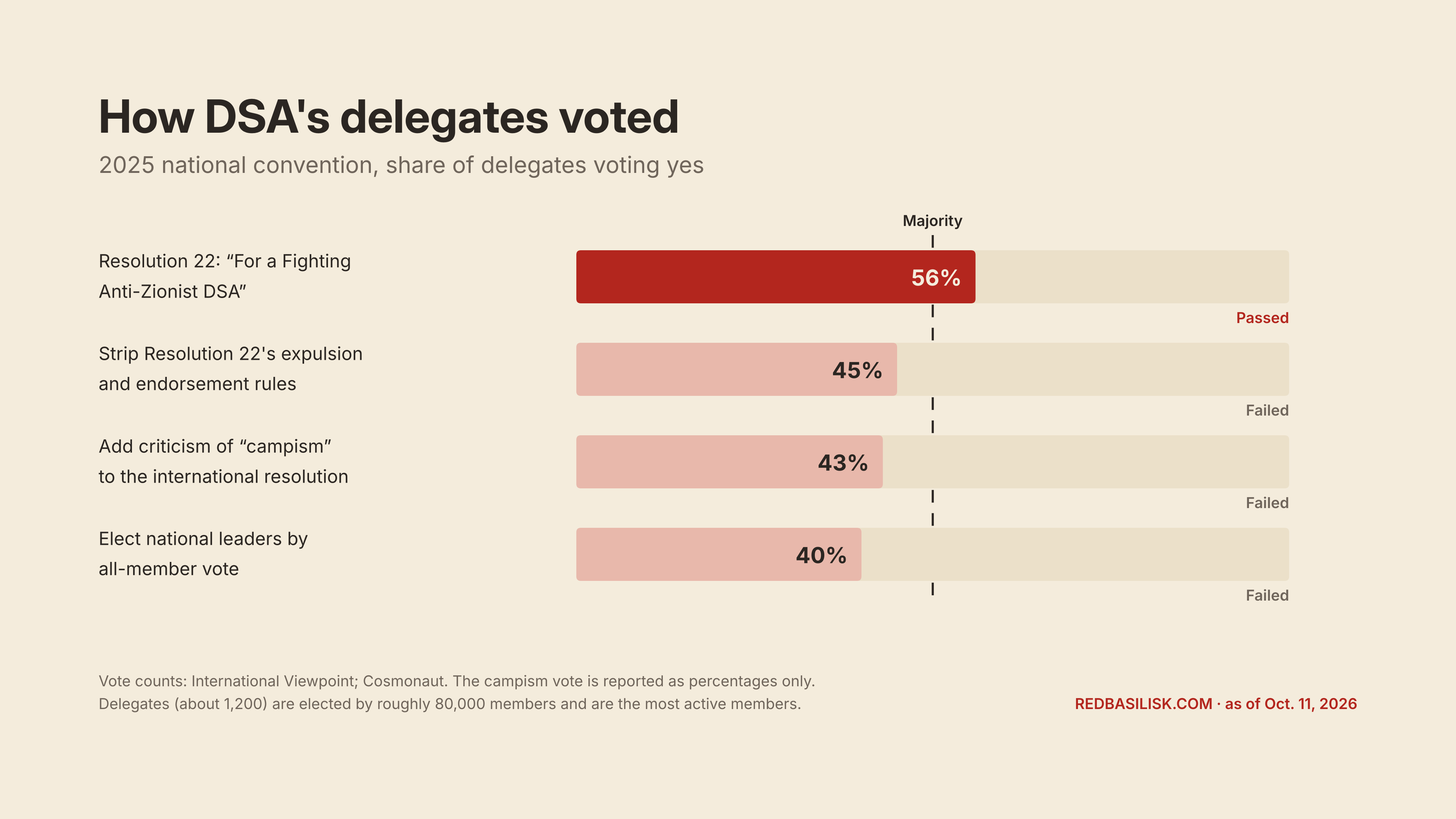
At the 2025 convention, Resolution 22, the hard line on Israel, passed with 56 percent. That's a majority, but not a landslide. A separate amendment to strip out the resolution's expulsion and endorsement rules got about 45 percent. Nearly half the delegates balked at expelling members over Israel. Another proposal would have added criticism of "campism," a term we'll explain below, to the DSA's international resolution. It failed, but 43 percent voted for it. And a proposal to let all members elect the national leadership directly failed too, which keeps power with the activists who show up to conventions.
So the membership is not uniform. On the clearest tests we have, a large minority disagrees with the hardest positions.
On communism specifically, some members say it out loud. The Red Star caucus writes, in its own words, "We in Red Star are communists." A fact-check by PolitiFact this summer concluded the DSA has communist members, but how many is unclear. And the biggest chapter cuts the other way. In New York, the reformist caucuses hold 53 of the 71 seats on the chapter's leadership committee. The national board leans further toward communism than the DSA's largest chapter does.
After October 7, the chapters split too. San Francisco's chapter wrote that violent oppression inevitably produces resistance. The Twin Cities chapter first put out a statement that left out Hamas. Three days later, it put out a second statement that strongly condemned attacks on civilians by Hamas, and admitted the first one had left out the Israeli victims. Red Star went the other way. In a 2024 article, it argued that supporting the Palestinian resistance without Hamas means supporting something that doesn't exist.
Some longtime members left. Founding member Maurice Isserman quit and named Red Star and other caucuses as entryists, meaning outside groups working to take the DSA over. Harold Meyerson, a member for 48 years, left too. Nobody has counted resignations, though. Membership had already been falling before October 7, and then it surged past 120,000 during Mamdani's campaign.
The Ukraine test
If the DSA simply backed whoever opposes America, it would have sided with Russia when Russia invaded Ukraine. It didn't. Its February 2022 statement condemned the invasion and demanded that Russian forces withdraw completely, though it also called for the U.S. to leave NATO. After that, the national board deadlocked between two factions: "campists" and "internationalists," a split we'll explain below. We couldn't find a single chapter or caucus that took Russia's side.
That matters. It means the "they just hate America" explanation is too simple.
The blind spot
But there's a pattern in what the DSA doesn't say. We found no DSA statement on China's treatment of the Uyghurs, on Hong Kong, or on the 2022 "Woman, Life, Freedom" protests in Iran, the ones where protesters sang "Bella Ciao" against the Islamic Republic. In 2021, a DSA delegation met Venezuela's Nicolás Maduro. In August of this year, the DSA marked the 100th anniversary of Fidel Castro's birth.
So the members don't back every enemy of the United States. But when a government that opposes the United States cracks down on its own people, the DSA tends to go quiet. That is the clue that leads to the theory.
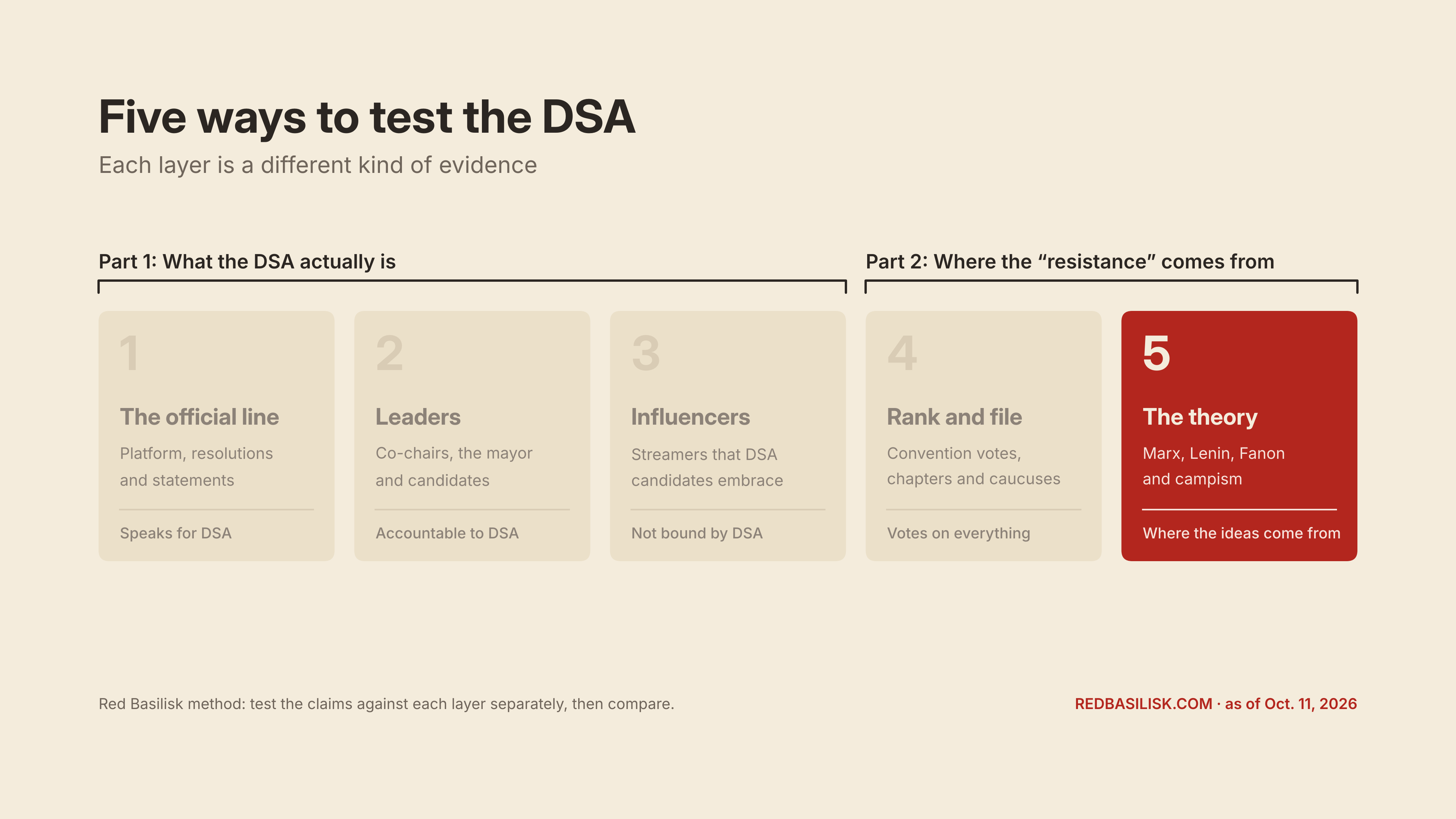
Layer 5: where the "resistance" framing comes from
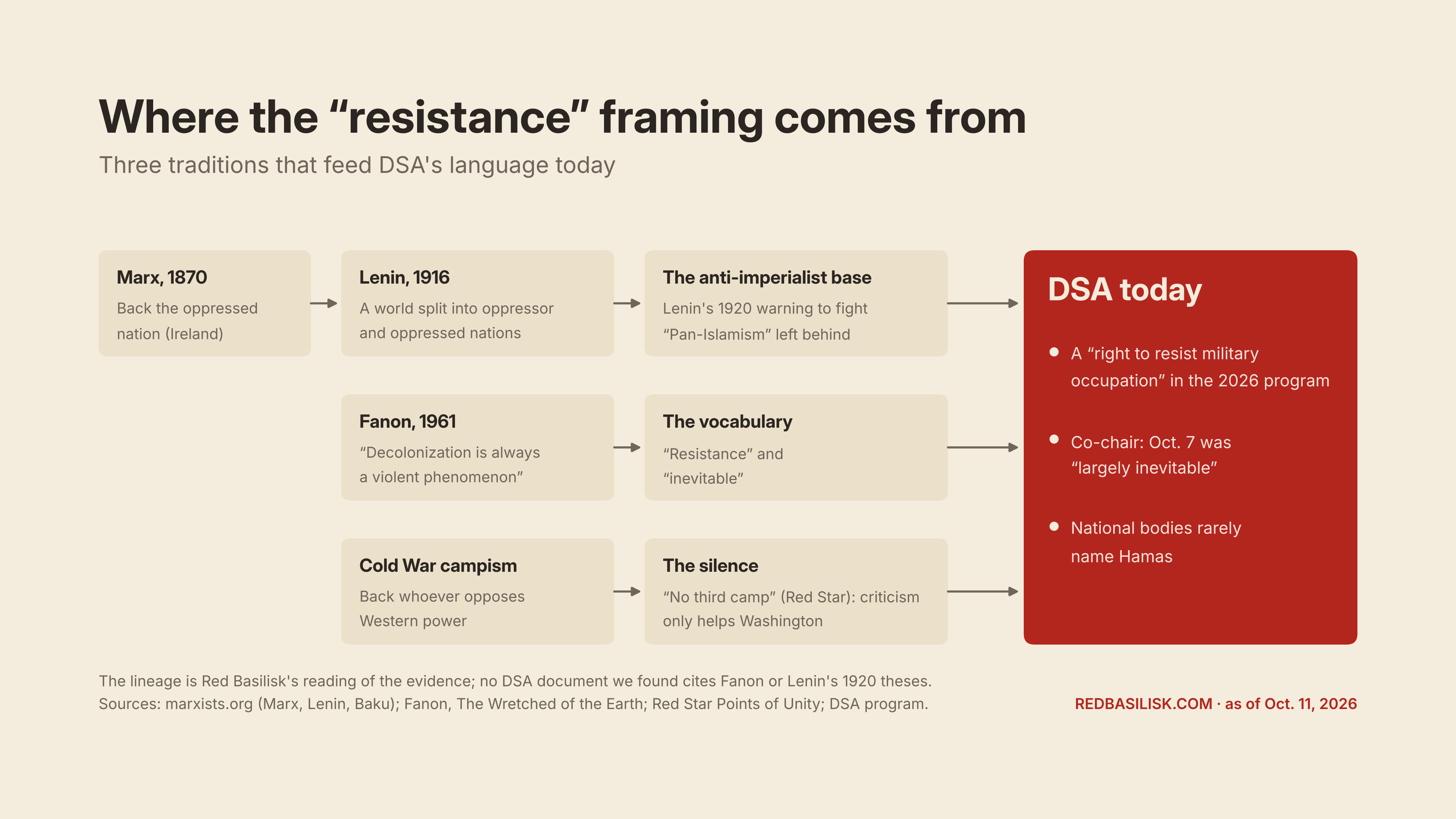
The short answer is that the framing comes less from Karl Marx than from three later traditions. The first is Lenin's split of the world into oppressor nations and oppressed nations. The second is Frantz Fanon's idea that colonial violence is produced by the colonial system itself. The third is a Cold War habit the left calls "campism." And here's the irony: the founding communist documents specifically warned against allying with Islamist movements.
Marx
Marx's famous line about religion being the opium of the people is gentler than its reputation. Just before it, he calls religion "the sigh of the oppressed creature." For Marx, religion was a symptom that would fade as conditions changed. It was never a movement to join.
The real root of today's framing is his writing on Ireland. Marx argued that English workers' contempt for the Irish was "the secret of the impotence" of the English working class. In other words, a worker in the stronger nation who looks down on the weaker one is weakening himself. That's the seed of the idea that socialists in a powerful country should take the side of the nation it dominates.
Lenin
Lenin built that seed into a worldview. In his 1916 book Imperialism, he divided the world into a handful of exploiting powers and a mass of exploited nations. Two years earlier he had written that socialists should "unconditionally support" an oppressed nation's fight against oppression, while refusing to back its "national exclusiveness."
Then, in 1920, he named the danger outright. In his draft theses for the Communist International, he told communists to fight "Pan-Islamism and similar trends." He also warned them not to paint non-communist liberation movements as communist.
That warning lasted a matter of weeks. At the Congress of the Peoples of the East in Baku that September, the Communist International's chairman, Grigory Zinoviev, called on the "peoples of the East" to wage "a holy war" against British imperialism. Tactics beat doctrine almost immediately.
What happened when communists tried it
For decades afterward, Palestinian Marxists and Islamists were enemies, not allies. The Popular Front for the Liberation of Palestine and the Democratic Front, both secular Marxist groups backed by the Soviet Union, led the Palestinian left. In 1980, Islamists who would later found Hamas attacked leftists in Gaza and burned the Red Crescent office run by a leftist leader.
Iran is the starkest warning. In 1979, Iran's communist Tudeh party backed Ayatollah Khomeini's revolution. By 1983, the new regime had arrested its leaders and banned the party. In 1988, it executed thousands of political prisoners, and leftists among them were killed as apostates. Many on the left took one lesson from that: backing Islamists because they oppose the West can get you killed.
The alliance has come back anyway, on the battlefield. BBC Verify found that the two Marxist Palestinian groups took part in the October 7 attack alongside Hamas.
The Trotskyist bargain
In 1994, the British Trotskyist Chris Harman wrote an influential essay arguing that Islamism was neither fascist nor progressive. His formula was "with the Islamists sometimes, with the state never." In the same breath, he said socialists must still defend women and minorities against the Islamists. His party, Britain's Socialist Workers Party, went on to ally with Islamist-linked groups in the antiwar movement of the 2000s. Two days after October 7, its newspaper's headline told readers to rejoice at the attack.
Where "inevitable" comes from
Frantz Fanon was a psychiatrist who joined Algeria's war of independence against France. He was influenced by Marx but was not a communist. His 1961 book The Wretched of the Earth opens by declaring that "decolonization is always a violent phenomenon." Fanon saw the colonial world as split absolutely into settlers and natives.
In that frame, violence is produced by the system. The choices of the people who commit it drop out of view. That's the logic behind the word "inevitable," whether it comes from San Francisco's DSA chapter in 2023 or the DSA's national co-chair this year. And it's why calling October 7 "inevitable" feels, to people who use the word, like an explanation rather than an excuse.
Why Hamas goes uncriticized
"Campism" means picking a side between two camps: the West, and everyone opposing it. A campist backs whatever force opposes Western power, whatever that force does to its own people. Red Star, the caucus of one of the DSA's national co-chairs, states it directly in its Points of Unity: "There is no such thing as a third camp." It argues that criticizing movements that oppose the United States only does Washington's work for it.
That explains the blind spot from Layer 4. It explains the silence on Iran's protesters and the warmth toward Cuba. And it explains why a group with a feminist, pro-gay-rights platform will avoid criticizing Hamas by name. Once the world is two camps, criticizing your own camp feels like helping the enemy.
The left's own critics
Some of the sharpest criticism of all this comes from inside the left. The socialist writer Michael Walzer blamed fear of being called Islamophobic and "enemy of my enemy" thinking. The scholar Fred Halliday pointed out that jihadists were killing leftists long before they turned on the West. And two American socialists, Dan La Botz and Stephen Shalom, put the point about October 7 plainly: "Understanding and justification are not the same."
The verdict
So, is the DSA communist? Yes, and increasingly. It wants to abolish capitalism and says so in the open. Its stated means are democratic. Most of its officeholders deny being communists. But its communist wing holds a real share of national power, and it dropped the rule that was built to keep them out.
Does it side with Islamist extremism? "Sides with Islamist extremism" is the wrong description, but the right one isn't much kinder. Today's DSA framing rests on Lenin's anti-imperialism with Lenin's own warning about Islamism dropped. It takes its vocabulary of "resistance" and "inevitable" from Fanon. And its refusal to criticize Hamas comes from campism, stated openly by the caucus of one of its national co-chairs.
The critics noticed something real. It just doesn't come from sympathy for political Islam. It comes from a worldview that sorts everyone into two camps, and then refuses to look closely at its own.
My take
I think we all knew the answer to this question before we started, but having an AI prove it and show exactly the degree was a worth while excersize in my opinion. I will be sure to keep an eye on them and check back again.
How we dug into this
This dispatch was researched, written and illustrated with AI tools. For the members, we used a fixed method to avoid cherry-picking. We checked the same list of issues (communism, October 7, Ukraine, China, Iran, Venezuela and Cuba) against the same sources each time: convention votes, statements from the largest chapters, and caucus publications. We report what we didn't find as well as what we did.
The biggest gap is that no survey of DSA members exists on these questions, so convention delegates stand in for the membership, and they are the most active members. We found no separate vote count for the 2025 repeal of the democratic-centralism ban. Chris Harman's "with the Islamists sometimes" formula is widely attributed to his 1994 essay. We confirmed it in the Spanish translation; the English text we could reach was cut off.
The lineage in Layer 5, from Lenin to Fanon to campism, is our reading of the evidence. No DSA document we found cites Fanon or Lenin's 1920 theses directly. The classical texts we quote are from the Marxists Internet Archive. Before publishing, a separate AI agent fact-checked every claim in this piece against its sources.
Sources
- [Marx, Critique of Hegel's Philosophy of Right, introduction (1843)](
- [Marx, letter to Meyer and Vogt on Ireland (1870)](
- [Lenin, Imperialism, chapter 10 (1916)](
- [Lenin, The Right of Nations to Self-Determination, chapter 4 (1914)](
- [Lenin, Draft Theses on the National and Colonial Questions (1920)](
- [Congress of the Peoples of the East, Baku (1920)](
- [Chris Harman, The Prophet and the Proletariat (1994), Spanish edition](
- [Frantz Fanon, Concerning Violence](
- [Red Star caucus, Points of Unity](
- [Red Star caucus, "Communists Belong in DSA"](
- [Algemeiner: Red Star's 2024 article on Hamas](
- [International Viewpoint: the 2025 convention](
- [Cosmonaut: the party echoes at the 2025 convention](
- [PolitiFact: are democratic socialists communists?](
- [City & State: DSA's internal caucuses](
- [City & State: DSA's membership nearly doubled](
- [Twin Cities DSA: follow-up statement](
- [The Nation: Isserman, "Why I Just Quit DSA"](
- [American Prospect: Meyerson on divisions in DSA](
- [The Nation: DSA's Ukraine statement](
- [New Politics: DSA and the Russian war on Ukraine](
- [Council on Foreign Relations: the DSA's Maduro trip](
- [Council on Foreign Relations: the PFLP and DFLP](
- [Wikipedia: the January 1980 Mujama al-Islamiya riot](
- [Wikipedia: the 1988 executions of Iranian political prisoners](
- [GlobalSecurity: the Tudeh party](
- [L'Orient Today: other armed groups in the Oct. 7 attack](
- [Socialism Today: the SWP and the Israel-Palestine conflict](
- [Michael Walzer, "Islamism and the Left," Dissent](
- [Fred Halliday via History News Network](
- [International Viewpoint: an internationalist critique of campism](
- [Tempest: La Botz and Shalom on Oct. 7](