




Read
New Cars Suck
Everyone's braced for the car kill switch, the surveillance already ran for years, and right to repair just got gutted.
Every dispatch is also a podcast. Follow on Spotify ↗
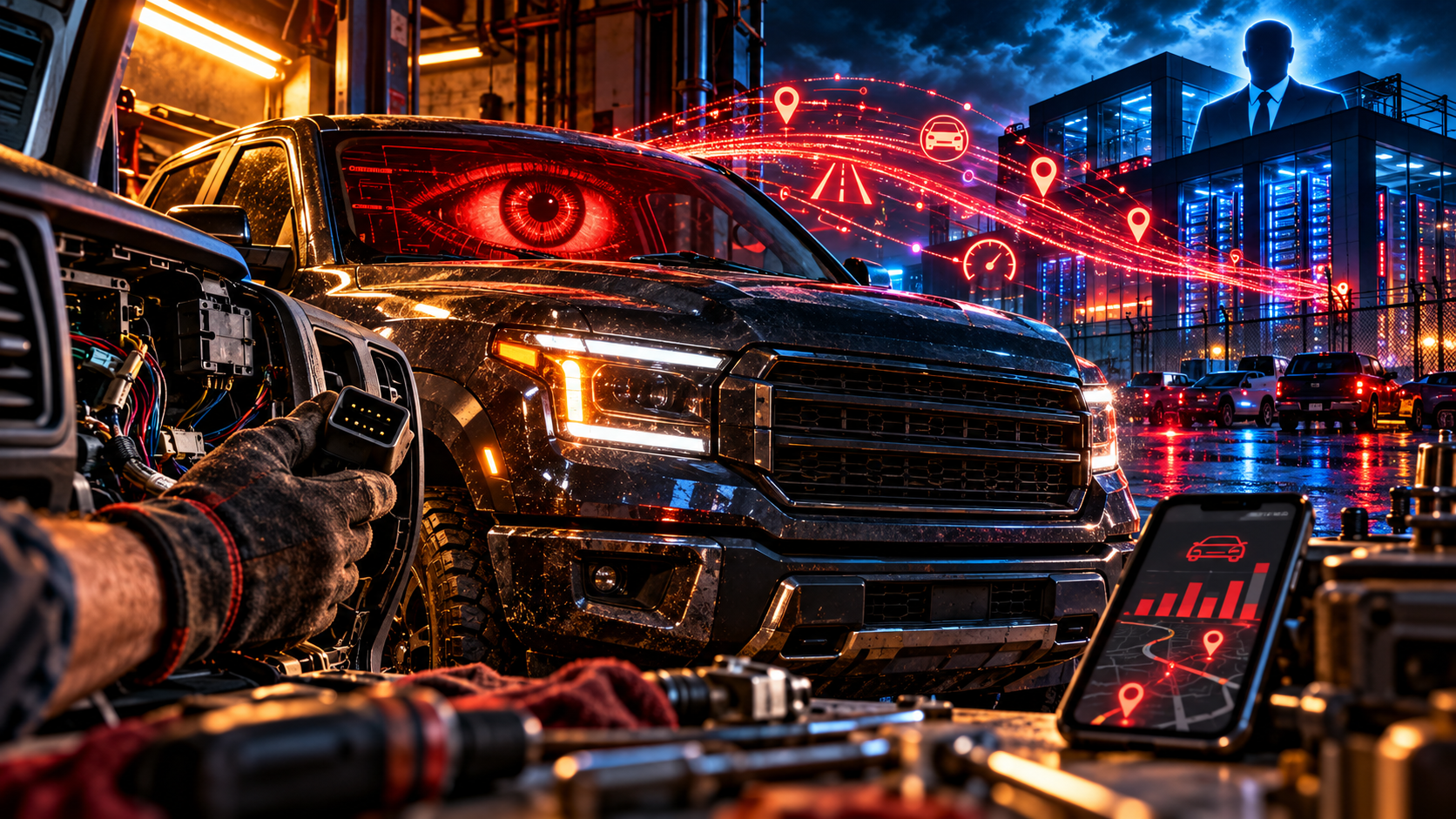
"All our cars will have remote kill switches soon. They want to track you and watch you, and they'll use "safety" to do it, worse than any Flock camera. Miss an insurance payment and they'll hunt you down."
Some of these fears are wrong. One is already true and has been for years. And the law that was supposed to give you some control over your own truck just got quietly hollowed out in committee. Here's the sort, as of September 27, 2026.
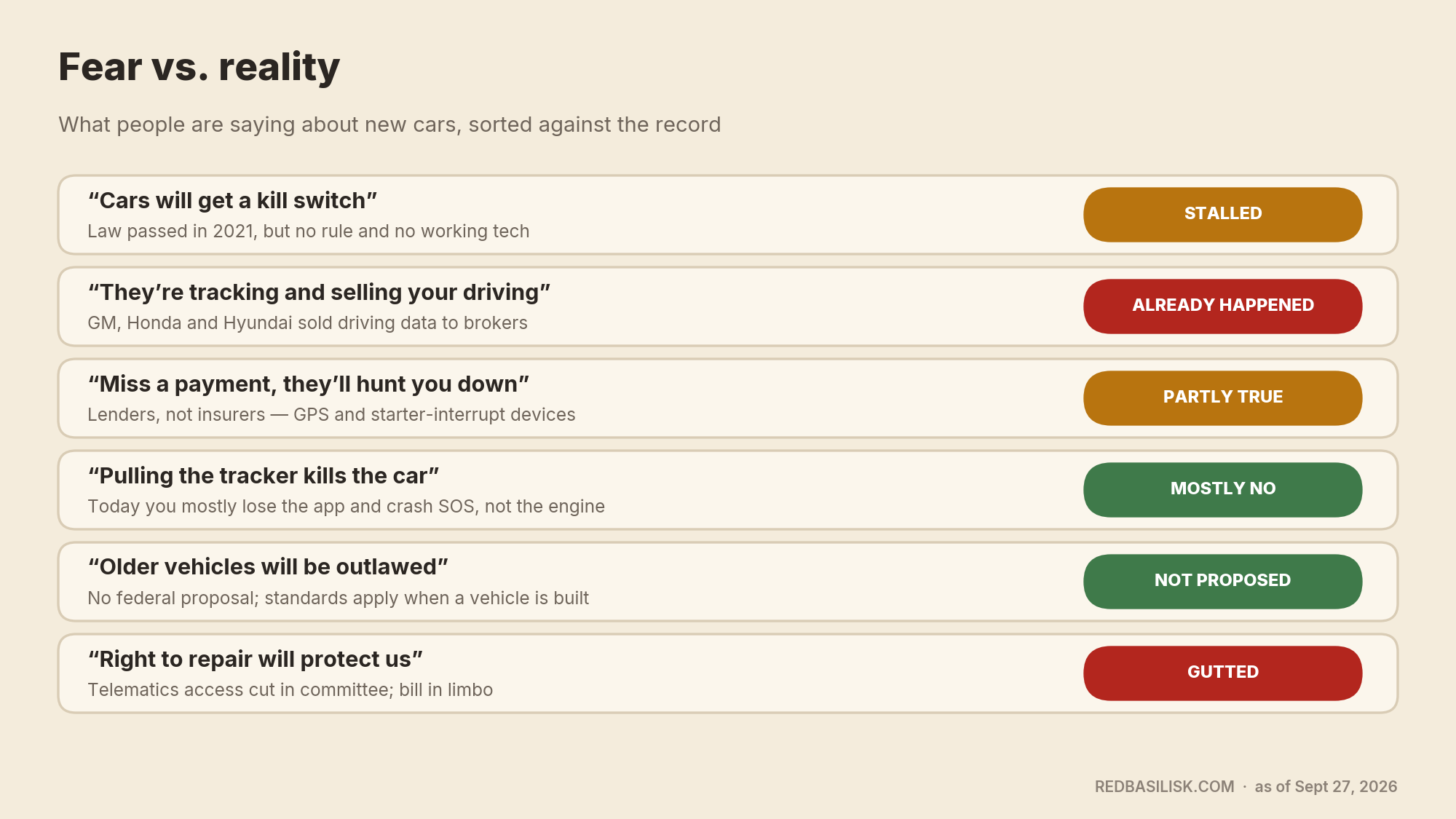
The "kill switch": real law, no rule, no working tech
The kill switch fear comes from a real place. Section 24220 of the 2021 Infrastructure Investment and Jobs Act tells the National Highway Traffic Safety Administration (NHTSA) to write a safety standard requiring new passenger vehicles to carry "advanced drunk and impaired driving prevention technology." That means a passive system that watches the driver, or senses blood alcohol, and prevents or limits the vehicle's operation if it decides you're impaired.
Two things matter about that. First, it isn't a remote switch. As written, nobody in an office flips it. The car decides for itself, locally, based on what its sensors think of you. That's arguably worse in a different way, because there's no one to call when it's wrong.
Second, it doesn't exist yet. NHTSA was supposed to finish the rule by November 2024 and missed it. In early 2026 the agency told Congress that no commercially available system detects alcohol impairment accurately and passively, and that detection near the legal limit still produces too many errors. Even once a final rule is published, automakers get up to three more years to comply.
The law itself hasn't gone anywhere, though. A House amendment to block its funding failed in January 2026. A newer amendment, added in committee, would only bar FY2027 money from being spent on it, and the House hasn't taken up that bill.
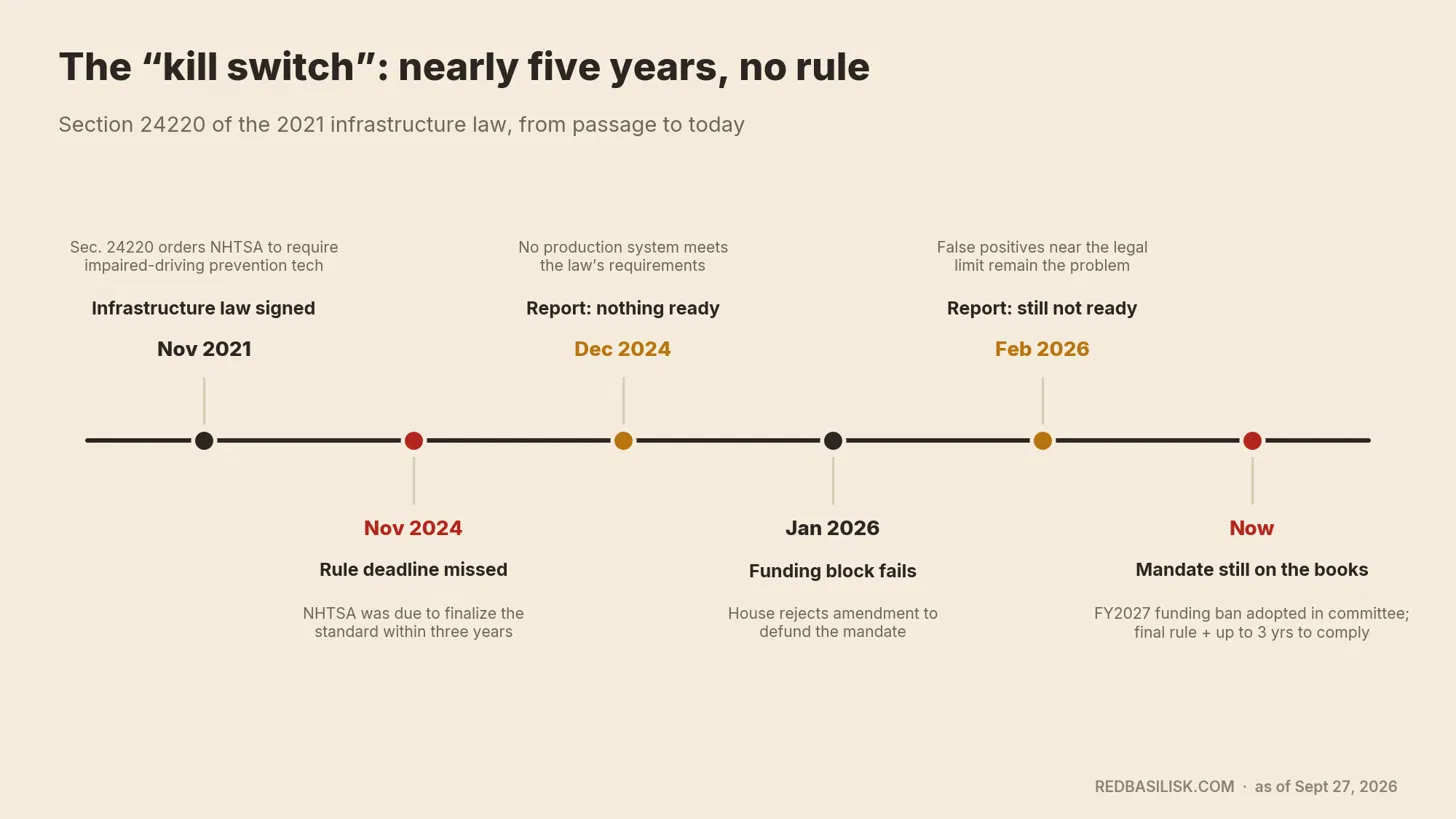
Verdict: stalled, not dead. Nothing in your 2027 model is going to shut you down for being drunk. But the mandate is still on the books, waiting for the technology to catch up.
The tracking: this one already happened
Here's the part people should actually be angry about, and it didn't need a new law.
For years, General Motors enrolled drivers in its OnStar Smart Driver feature and collected their location and driving behavior, including hard braking, hard acceleration, speeds over 80, and even seat belt use, with location logged as often as every three seconds, according to the FTC. Owners were told it was a coaching tool to help them drive better. The data went to the data brokers LexisNexis and Verisk, which packaged it into driving reports and sold them to insurers. People saw their premiums jump, or lost coverage outright, and had no idea why.
GM wasn't alone. When Senators Ron Wyden and Ed Markey dug into it in 2024, Honda admitted to sharing data from about 97,000 cars with Verisk for $25,920, roughly 26 cents a car. Hyundai shared data from 1.7 million cars for about 61 cents apiece, and it enrolled drivers automatically whenever they turned on the car's internet connection. Your driving record went for the price of a gumball.
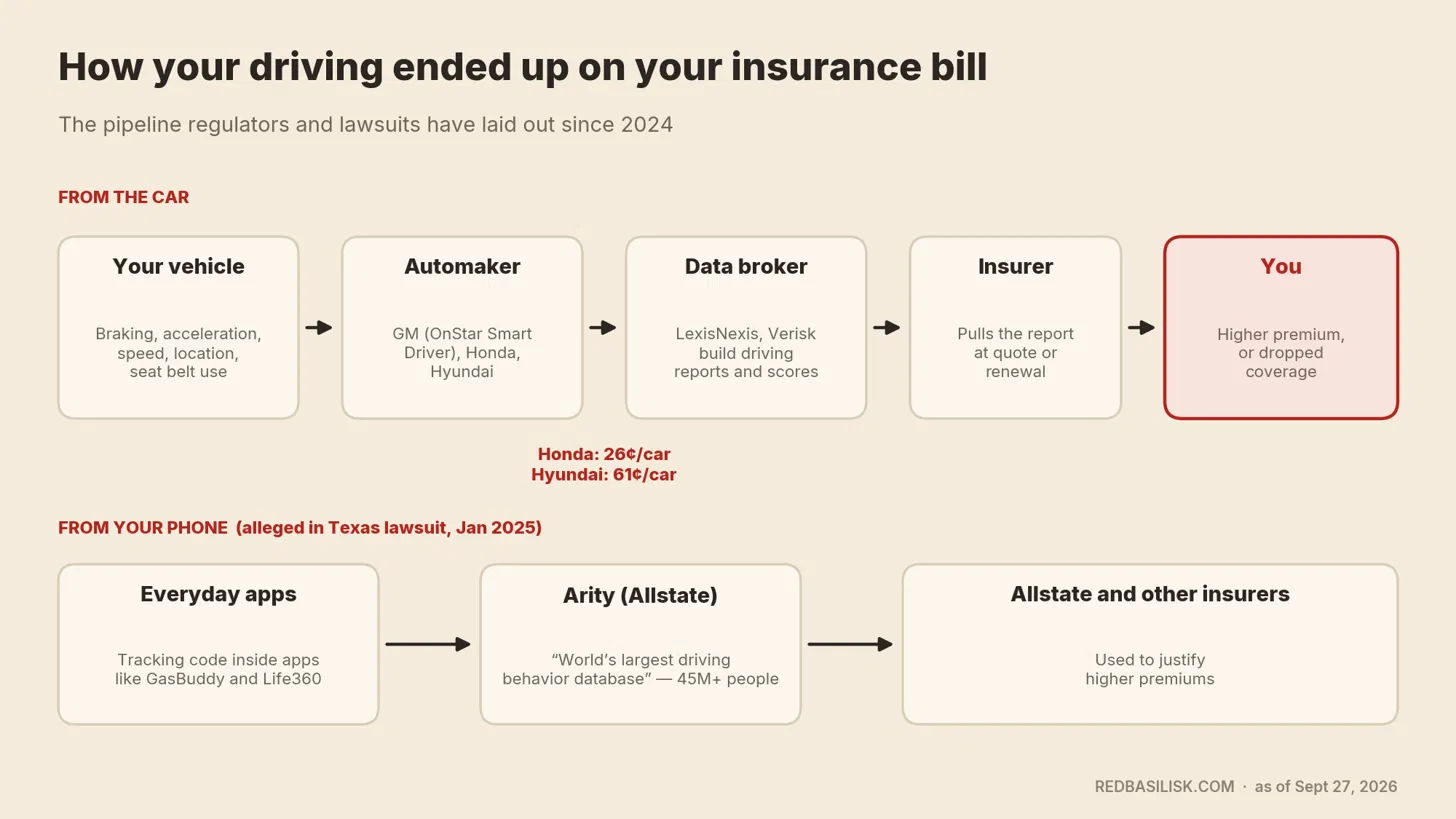
It doesn't even have to come from the car. Texas sued Allstate and its data company Arity in January 2025, alleging they paid app makers to hide tracking code inside ordinary phone apps like GasBuddy and Life360, then built what Allstate called the world's largest driving behavior database from more than 45 million people. Texas had already sued GM the summer before.
The Federal Trade Commission finalized its order against GM and OnStar in January 2026. GM is barred from sharing location and driving data with consumer reporting agencies for five years, and for twenty years it has to get clear consent before collecting connected-car data, and let owners see it, delete it, and turn it off.
That's a real win, but it binds one company. Michigan's insurance regulator has said insurers there aren't prohibited from using third-party data to set rates, and many states have no specific rule against it.
Verdict: already happened. The fear is right about the tracking. It's just wrong about the timeline. It wasn't a future government plot; it was a revenue stream that ran for years before anyone noticed.
"Miss a payment and they'll hunt you down"
Not your insurance company. But your lender, maybe. Subprime auto lenders have used GPS trackers and starter-interrupt devices for years, so a missed payment can mean a truck that won't start and a repo man who knows exactly where it's parked. That's a contract term you sign at the dealership, not a federal mandate, and it's worth reading the paperwork for.
Verdict: partly true, and older than people think.
Will pulling the tracker kill the truck?
On today's vehicles, usually not. The cellular connection and GPS typically live in one module, often called the telematics control unit or TCU. Unplug it or pull its fuse, and what you usually lose is the phone app, remote start, over-the-air updates, and the automatic crash call. A driver-attention camera, like the ones on hands-free highway systems, usually just disables that feature when it's covered or removed. Your backup camera is different; that one's federally required, so you will have to leave it alone.
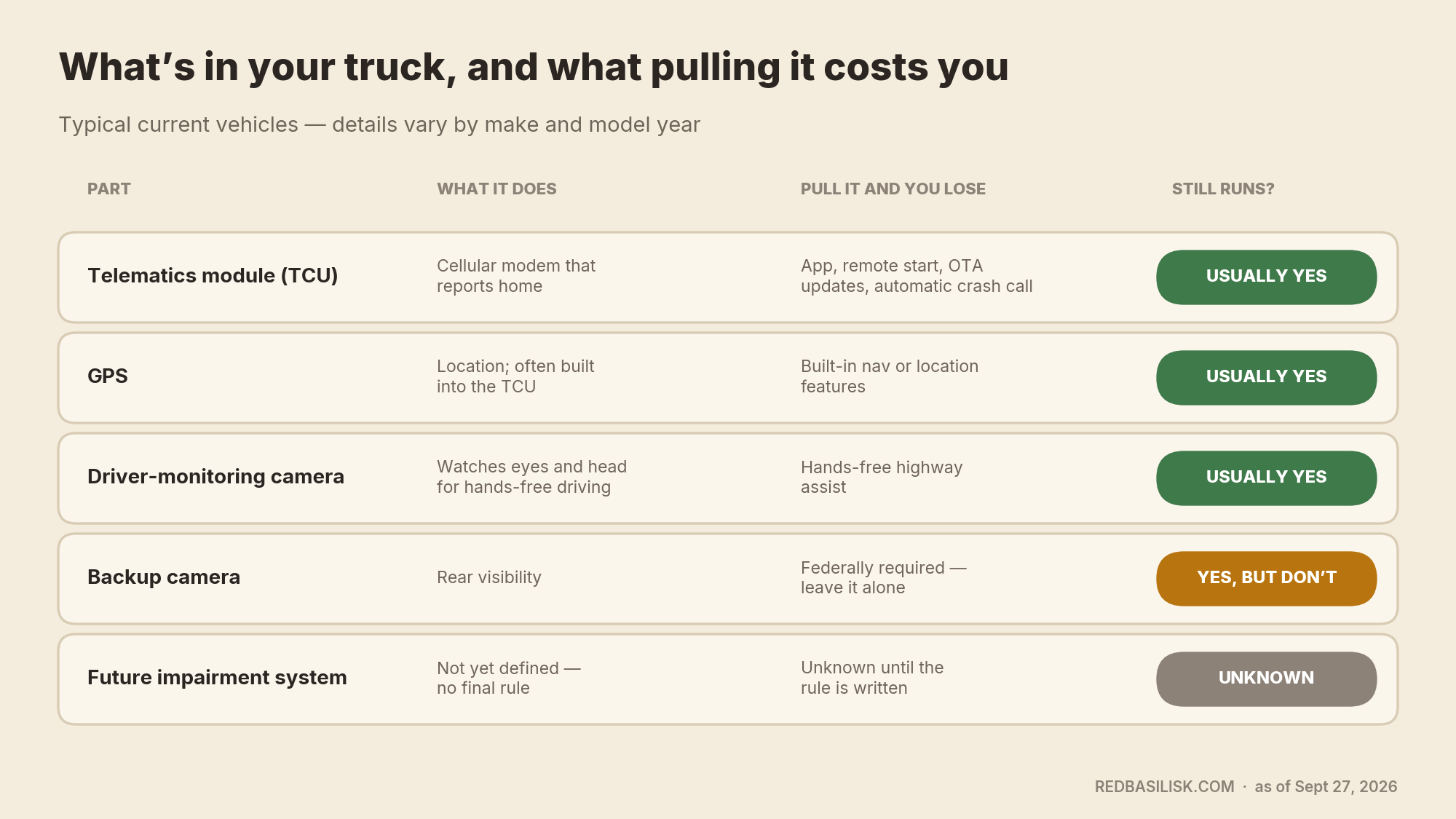
There's a legal wrinkle most people don't know. Federal law (49 U.S.C. 30122) bars manufacturers, dealers, rental companies, and repair businesses from knowingly disabling required safety equipment. It doesn't list the owner. So if a future impairment system becomes required equipment, federal law wouldn't stop you from removing it from your own truck (state inspection rules may differ), but your mechanic couldn't legally do it for you. On the software side, the U.S. Copyright Office has carved out an exemption allowing owners to get into their vehicle's computer for diagnosis, repair, and lawful modification. It doesn't cover subscription-locked features, and it isn't a pass on emissions or safety rules.
The honest caveat: if the future impairment system ends up wired into the ignition, removal may mean a no-start. Nobody knows yet, because the rule doesn't exist.
Verdict: mostly no, today. Unknown tomorrow.
Will they outlaw older vehicles?
There's no federal proposal to ban them. Safety standards apply to a vehicle when it's built, so an old truck stays legal under the rules it was built to. The real pressure is sideways: insurance discounts for monitored driving, state inspections, and parts that get harder to find every year. If anything, older rigs are turning into the privacy option, and that's going to show up in what they sell for. Restoring an old car with your money instead, and taking good care of it might be the move until things change.
Verdict: not proposed.
Right to repair just got gutted
This is the part that got the least coverage.
The REPAIR Act, sponsored by Rep. Neal Dunn (R-Fla.) and Rep. Marie Gluesenkamp Perez (D-Wash.), with Sens. Josh Hawley (R-Mo.) and Ben Ray Luján (D-N.M.) in the Senate, would have given owners and independent shops access to the data their vehicles generate, including the wireless telematics feed that automakers keep for themselves. It had real bipartisan support.
In May, the House Energy and Commerce Committee set the full bill aside and dropped a narrower version into its vehicle title, H.R. 7389, the Motor Vehicle Modernization Act. The committee cut the telematics access requirement. What's left mostly takes the voluntary 2014 and 2015 agreements automakers already made with independent shops and makes them enforceable by the FTC. Dunn himself said it doesn't fully reflect the original bill.
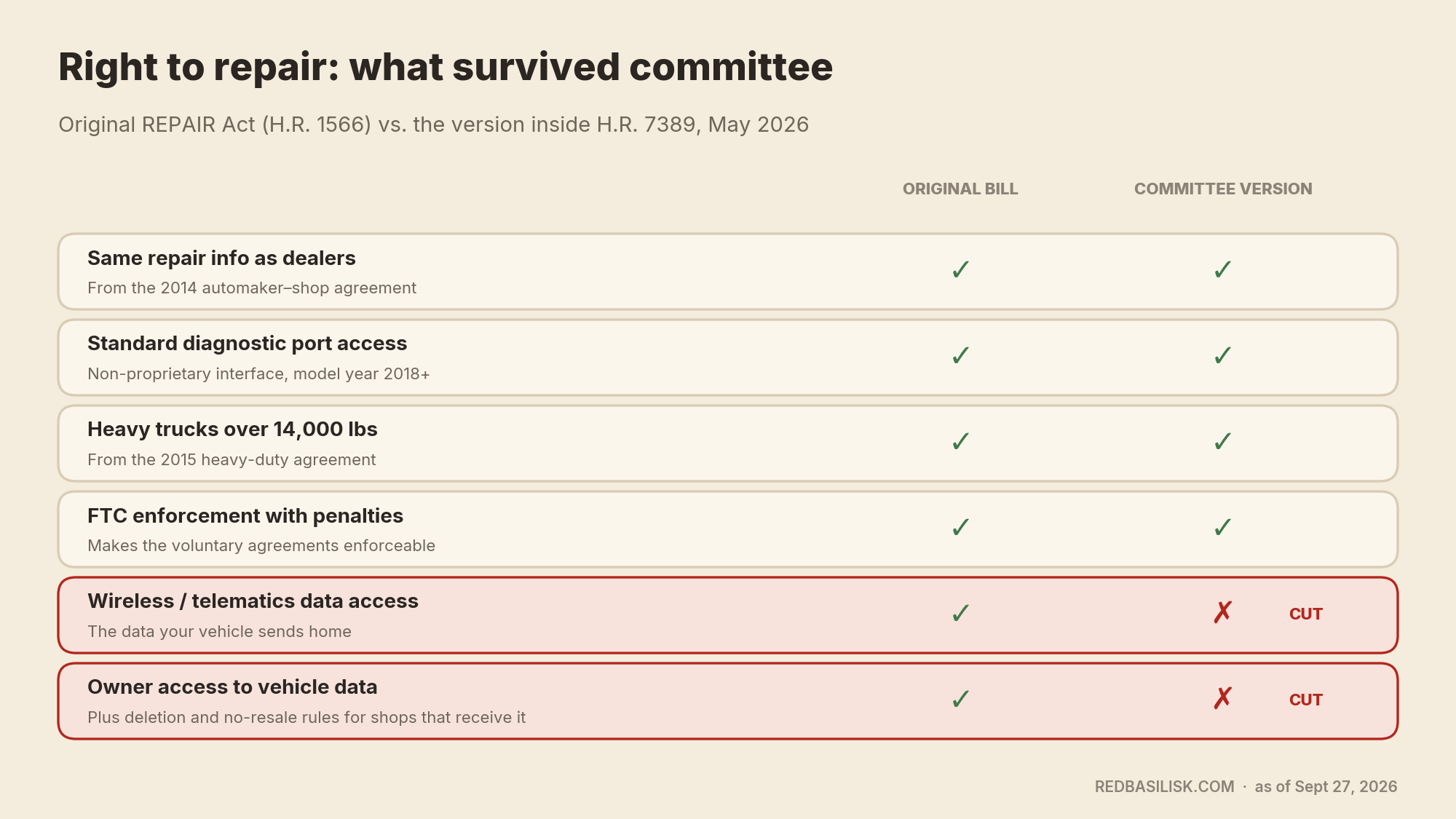
In other words, you'd get a legal right to the shop manual and the diagnostic port, but not to the data your truck is sending home right now. And the fight in Massachusetts shows how hard automakers will push. Voters there passed a telematics access law in 2020, and it still hasn't delivered that access, tied up by an automaker lawsuit that a federal judge rejected in 2025 but that is still on appeal, and stalled because the independent body meant to run the data system was never set up.
Even the watered-down version is stuck. It rides on the five-year transportation bill, and that authority runs out September 30. The House cut its September session short, ending any chance of a full reauthorization before the deadline, and Congress had already passed a continuing resolution extending the programs through December 11.
Verdict: the telematics fight was lost in committee, and the rest is in limbo.
Is any of this avoidable?
More than people think. GM killed Smart Driver within weeks of the New York Times exposing it. Verisk shut down its driving score product the same spring. Repeal efforts on the impairment mandate have drawn votes from both parties, though mostly Republicans, and the agency in charge of it admits the technology doesn't work yet. Right to repair polls well with just about everyone.
The pattern is that the industry rarely wins the big public votes. It wins the details, in committee, where almost nobody is watching. That's where pressure has to land: specific provisions, specific members, on the record.
For you, today:
Check your automaker's privacy portal, opt out of data sharing, and request deletion. Skip "driving score" and "driver feedback" features, and be careful with insurance tracking apps and plug-ins. Look at what apps on your phone can see your location in the background. Know that unplugging the TCU is an option on most current vehicles, and know what you give up. Read your loan paperwork for GPS and starter-interrupt clauses. My take
If safety were the only goal, the national speed limit would be 30 mph and nobody would die on the highway. We don't do that. We accept risk on principle, on roads and a lot of other rights. So "safety" alone can't be the whole argument. The fairer version of the other side: drunk driving puts the risk on other people, not just the driver, and we already have checkpoints and license suspensions for it. The stronger critique isn't that they don't care about safety; it's that this tool treats every sober driver as a suspect and has a known false-positive problem.
How we dug into this
We took each claim and tried to match it to something on paper: a statute, a rulemaking, a court order, a bill's text, or a named lawsuit. We checked the status of the Section 24220 impaired driving rule through NHTSA's reports to Congress and recent coverage, the GM and OnStar case through the FTC's final order, and the automaker data sales through the Wyden–Markey letter and follow-up reporting. For right to repair, we compared what the original REPAIR Act covered against what survived the House Energy and Commerce markup, using trade association and legal analyses from both the aftermarket and consumer sides. Congressional timing came from transportation policy trackers. Before publishing, a separate AI agent that hadn't seen the drafting checked every claim and chart against primary sources where it could, including the bill text and NHTSA's reports, and we corrected what it caught. Everything here reflects the record as of September 27, 2026. The transportation extension runs through December 11, so check the date before you share.
Sources
- [Consumer Reports: No, Your Car Isn't Getting a 'Kill Switch' in 2027](
- [Carscoops: Federally Mandated Driver Surveillance Tech Faces Delay](
- [Rep. Michael Cloud: Kill Switch Technology Raises Concerns](
- [Repairer Driven News: Federal Law Mandating 'Kill Switches' Remains Intact](
- [National Law Review: Section 24220 for Passenger Vehicle "Kill Switch"](
- [FTC: Final Order Against GM and OnStar](
- [Hintze Law: FTC Finalizes Order Against GM and OnStar Over Driver Data](
- [State of Surveillance: FTC Bans GM From Selling Driver Data](
- [Wyden–Markey letter to the FTC on automaker data sales](
- [EFF: Senators Expose Car Companies' Terrible Data Privacy Practices](
- [Texas Attorney General: Lawsuit Against Allstate and Arity](
- [Hunton: Texas AG Sues Allstate Under State Privacy Law](
- [CVSN: Right to Repair Fact Sheet](
- [SEMA: House Committee Advances Right-to-Repair Provisions](
- [Aftermarket Matters: Committee Advances Right to Repair Provisions](
- [Autobody News: Right to Repair in 2026](
- [Eno Center for Transportation: Surface Reauthorization](
- [Holland & Knight: Surface Transportation Reauthorization Priorities](
- [49 U.S.C. 30122: Making safety devices and elements inoperative](
- [NHTSA: February 2026 Report to Congress on Impaired Driving Prevention Technology](
- [GovTrack: January 2026 House vote on defunding amendment](
- [Michigan Public: GM agrees not to sell driver data for five years](
- [H.R. 1566 (REPAIR Act) bill text](
- [Nelson Mullins: Massachusetts right to repair awaits First Circuit decision](
- [AASHTO Journal: Continuing resolution extends federal funding](
- [37 CFR 201.40: DMCA exemptions](