




Read
Laugh at the Devil: A Christian Defense of Halloween
If Christianity is true and the dark stuff is real, a goofy Halloween is one of the best things Christians do all year.
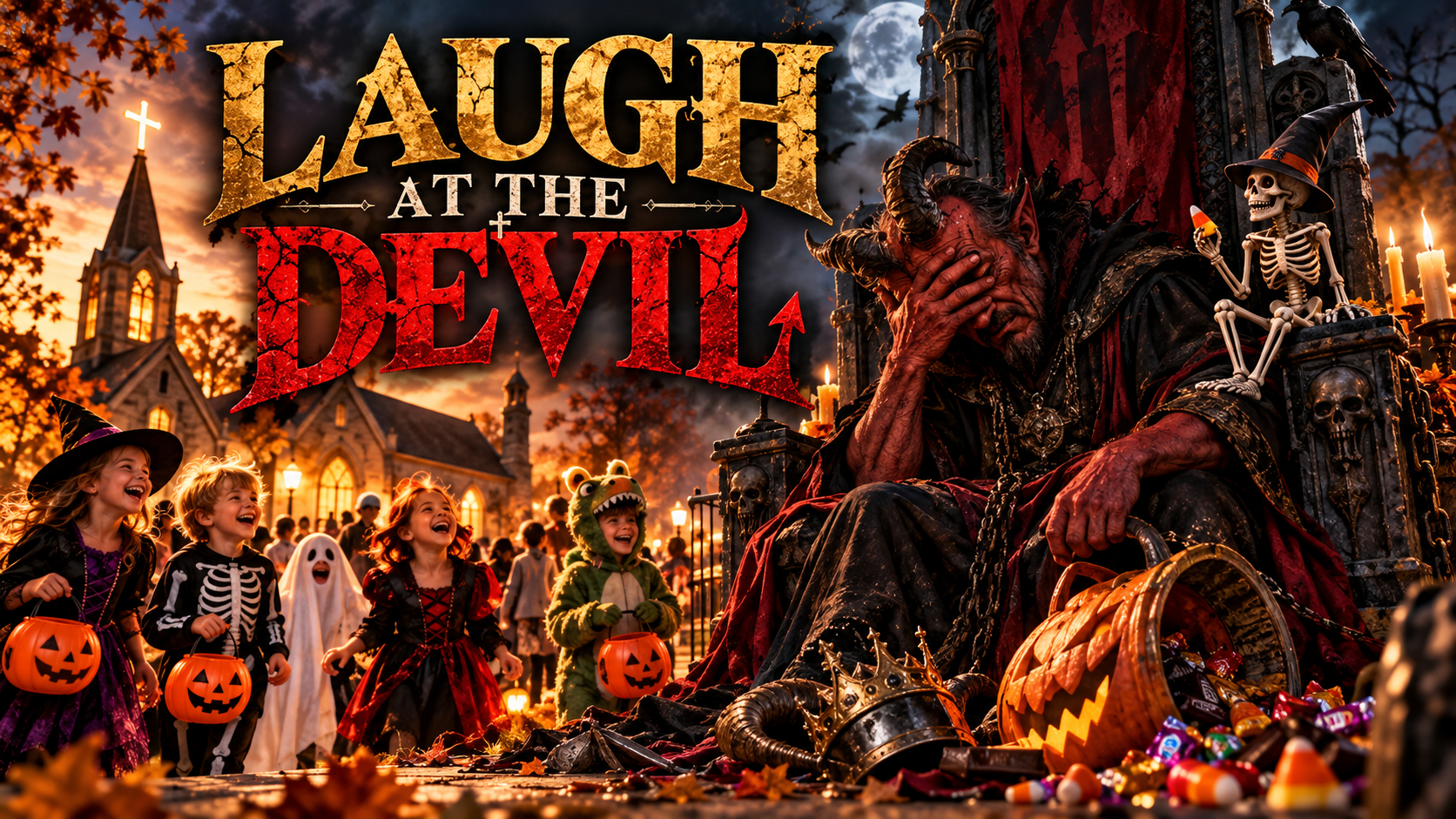
Every October, people warn that Halloween is the devil's holiday. Sometimes it's a pastor. Sometimes it's a Facebook post with a lot of capital letters. The argument goes like this: witchcraft is real, the devil is real, so stay away from his day.
I want to make the opposite case. If witchcraft works and Christianity is true, then Halloween, done right, is a good thing. Maybe one of the best things we do all year.
Here's how I'm going to get there. First, the ground rules. Then a quick history of whose holiday this actually is. Then three arguments: intention matters, Scripture laughs at darkness, and laughter is armor. Then I'll show you where the line is, because an argument that can't tell you what it rules out isn't worth much.
The ground rules
This piece grants two big claims for the sake of argument. Christianity is true. And the dark stuff is real: demons, curses, the whole bit.
I'm not going to spend this piece arguing either one. If you think neither is real, then Halloween is just candy and costumes, and you can enjoy it with a clear conscience and go on with your day. The question here is for people who take both seriously. If the devil is real, should a Christian dress up like a werewolf and go door to door?
I say yes. Here's why.
Whose holiday is it, anyway?
Start with the claim that Halloween is a pagan or satanic holiday that Christians borrowed. The history doesn't support it.
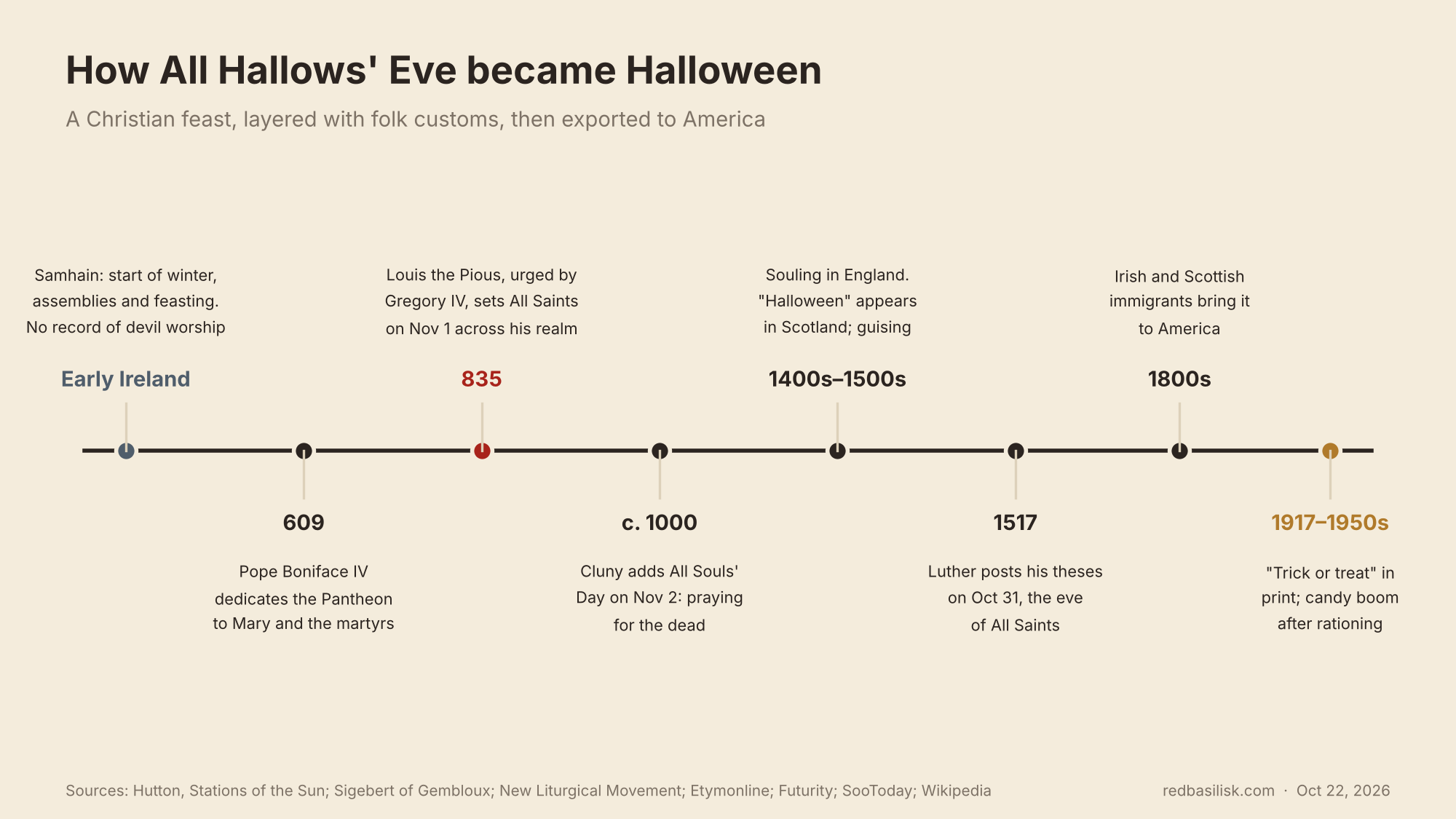
The name gives it away. Halloween is short for All Hallows' Eve, the night before All Saints' Day on November 1. "Hallow" is an old word for a saint. Back in 609, Pope Boniface IV dedicated the Pantheon in Rome to Mary and the martyrs. Tradition credits Pope Gregory III, a century later, with dedicating a chapel in St. Peter's to all the saints. In 835, at the urging of Pope Gregory IV, the emperor Louis the Pious set All Saints on November 1 across his empire. Around the year 1000, the monks of Cluny added All Souls' Day on November 2, a day to pray for the dead.
What about Samhain, the Irish festival everybody says Halloween came from? Medieval Irish stories describe it as the start of winter, a time for great assemblies, feasting, and contests, when the doors to the Otherworld stood open. The historian Ronald Hutton points out that none of the old tales actually show a religious ceremony. And here's the part that surprised me: early Irish church calendars marked a feast of all saints on April 20, not November 1. Hutton argues the November date came out of England and the Germanic lands, not from any plan to paper over Samhain.
Samhain was never a witches' sabbath, either. The idea of a dark god named Samhain, "Lord of the Dead," traces back to an 18th-century writer named Charles Vallancey, not to anything medieval. The tight link between witches and Halloween is mostly modern and largely American: Salem branding itself with witches starting in the 1890s, the Wicca movement claiming the date in the 1950s, and Salem's Halloween tourism after that.
The customs grew up around the Christian feast. In 15th-century England, the poor went "souling," door to door, collecting soul cakes in exchange for praying for the household's dead. In Scotland and Ireland, people went guising, in disguise, by at least the 1500s. The word "Halloween" itself is a Scottish shortening from that era. Irish and Scottish families carved lanterns out of turnips. When they came to America in the 1800s, they found pumpkins carved a lot easier.
Protestants have a stake in the night too. Martin Luther published his 95 theses on October 31, 1517, the eve of All Saints, because the crowds would be at the church the next day. Every Reformation Day lands on Halloween.
And trick-or-treating? A Canadian newspaper printed "tricks or treats" in 1917, and the exact phrase "trick or treat" was in print in Alberta by the mid-1920s. It caught on across America after World War II, once sugar rationing ended.
So the short version is this. Halloween isn't a satanic holiday the church stole. It was a Christian feast all along, with folk customs layered on top. We don't have to take it from anybody. We just have to throw the party right.
Argument one: intention is the whole game
You've probably heard that the Christmas tree started when St. Boniface chopped down Thor's sacred oak. The real story is a little different, and it's better. In the 720s, in what is now Germany, Boniface took an axe to the Oak of Jupiter at Geismar, a tree the local pagans held sacred. It came down in four pieces. According to his earliest biographer, he used the wood to build a chapel dedicated to St. Peter. The fir tree part is a legend from an 1891 story by Henry van Dyke. But the true version makes the point anyway. Boniface took the thing that belonged to a false god and made church furniture out of it.
That only works because of what was in his heart. Wood is wood. What changed was what it was for.
Paul makes the same argument in his letters to the Corinthians. Meat in the ancient market had often been sacrificed to idols first, and new Christians wanted to know if eating it was worship. Paul's answer: "we know that 'an idol is nothing in the world'" (1 Corinthians 8:4). His advice is to "eat everything that is sold in the meat market, without raising questions for the sake of conscience, since the earth is the Lord's, and all that is in it" (1 Corinthians 10:25–26). The same bite of meat could be worship or dinner. The difference was the heart of the person eating it.
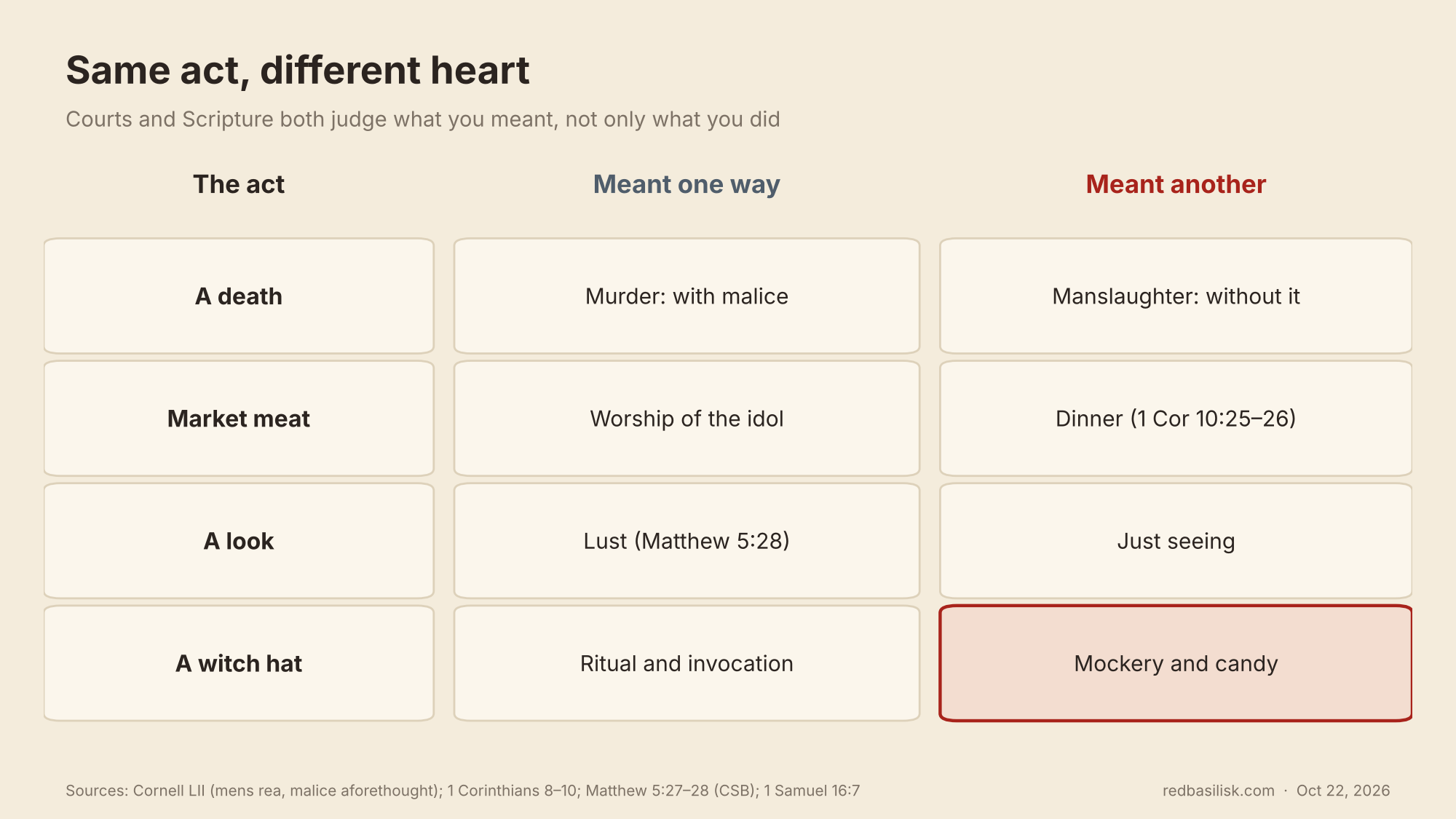
Our courts work the same way. The law calls it mens rea, the guilty mind. A death is a death, but whether it's murder or manslaughter turns largely on the killer's state of mind. Malice makes it murder. A killing without malice, like one in the heat of passion or through recklessness, is manslaughter. Same act, different heart, different crime.
Here's the weakness in our courts, though. A judge can't see inside you. A jury has to guess at your intent from what you said and did. Honestly, half the time you can't fully see your own intentions either. Jeremiah says as much: the heart is deceitful, "who can understand it?" The very next verse answers him: "I, the LORD, examine the mind, I test the heart" (Jeremiah 17:9–10).
That's the difference. Human courts guess. God knows. When Samuel went to anoint a king, God told him that "humans see what is visible, but the LORD sees the heart" (1 Samuel 16:7). Jesus takes the same principle so far that a lustful look counts as adultery in the heart (Matthew 5:28). In the Christian view, sin lives in the intent, and God reads it perfectly.
So think about what's actually in the heart of a seven-year-old in a werewolf costume. Nobody walking around in a Frankenstein mask thinks they're becoming Frankenstein. Nobody's actually hunting people or snatching kids. They're not invoking anything. They're merry-making. If God judges intent, and he does, a goofy costume is judged as exactly what it is.
Argument two: Scripture laughs at darkness
If intention were the only argument, I'd be saying Halloween is harmless. I'm saying something stronger: it's good. That's because mocking false gods isn't just allowed in the Bible. It's a weapon.
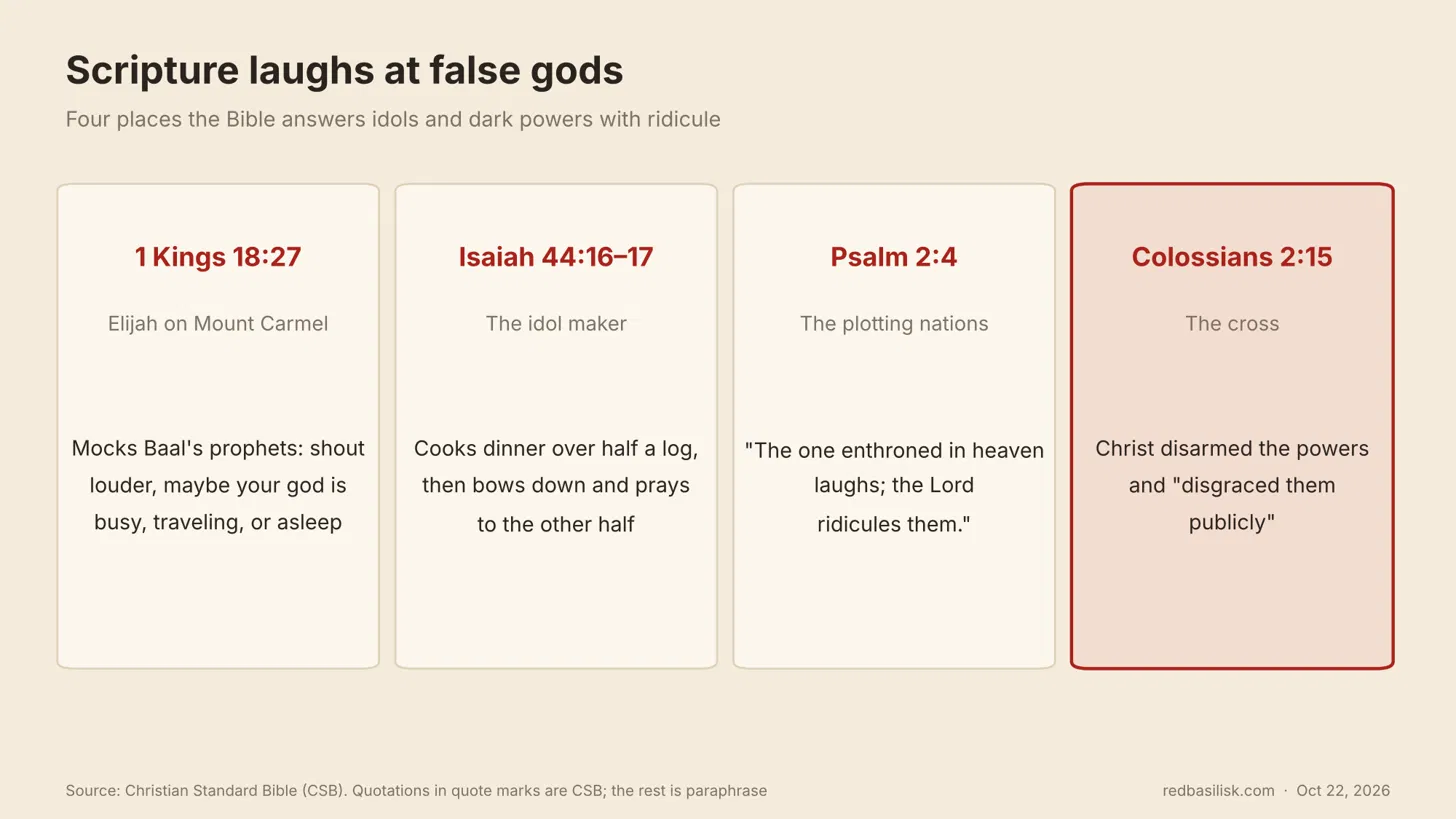
Take Elijah on Mount Carmel. Four hundred and fifty prophets of Baal spend all morning begging their god to send fire. Nothing happens. "At noon Elijah mocked them" (1 Kings 18:27). Shout louder, he tells them. Maybe your god is busy. Maybe he's off on a trip. Maybe he's asleep and you have to wake him up. That's a prophet of God doing trash talk. Then fire falls from heaven on Elijah's altar.
Isaiah does stand-up comedy about idol makers. A man cuts down a tree. With half of it, he builds a fire and roasts his dinner. With the other half, he carves a god, bows down, and prays to it, "Save me, for you are my god" (Isaiah 44:16–17). Isaiah's point: you just cooked lunch on your god's other half.
Psalm 2 shows the nations plotting against God, and his response is laughter: "The one enthroned in heaven laughs; the Lord ridicules them" (Psalm 2:4).
And the cross itself. Paul says that on the cross Christ "disarmed the rulers and authorities and disgraced them publicly; he triumphed over them in him" (Colossians 2:15). The picture is a Roman victory parade, where the defeated enemies were marched through the streets for the crowd to jeer at. The powers of darkness weren't just beaten. They were humiliated in public.
The church kept laughing
Christians kept that habit going for the next two thousand years.
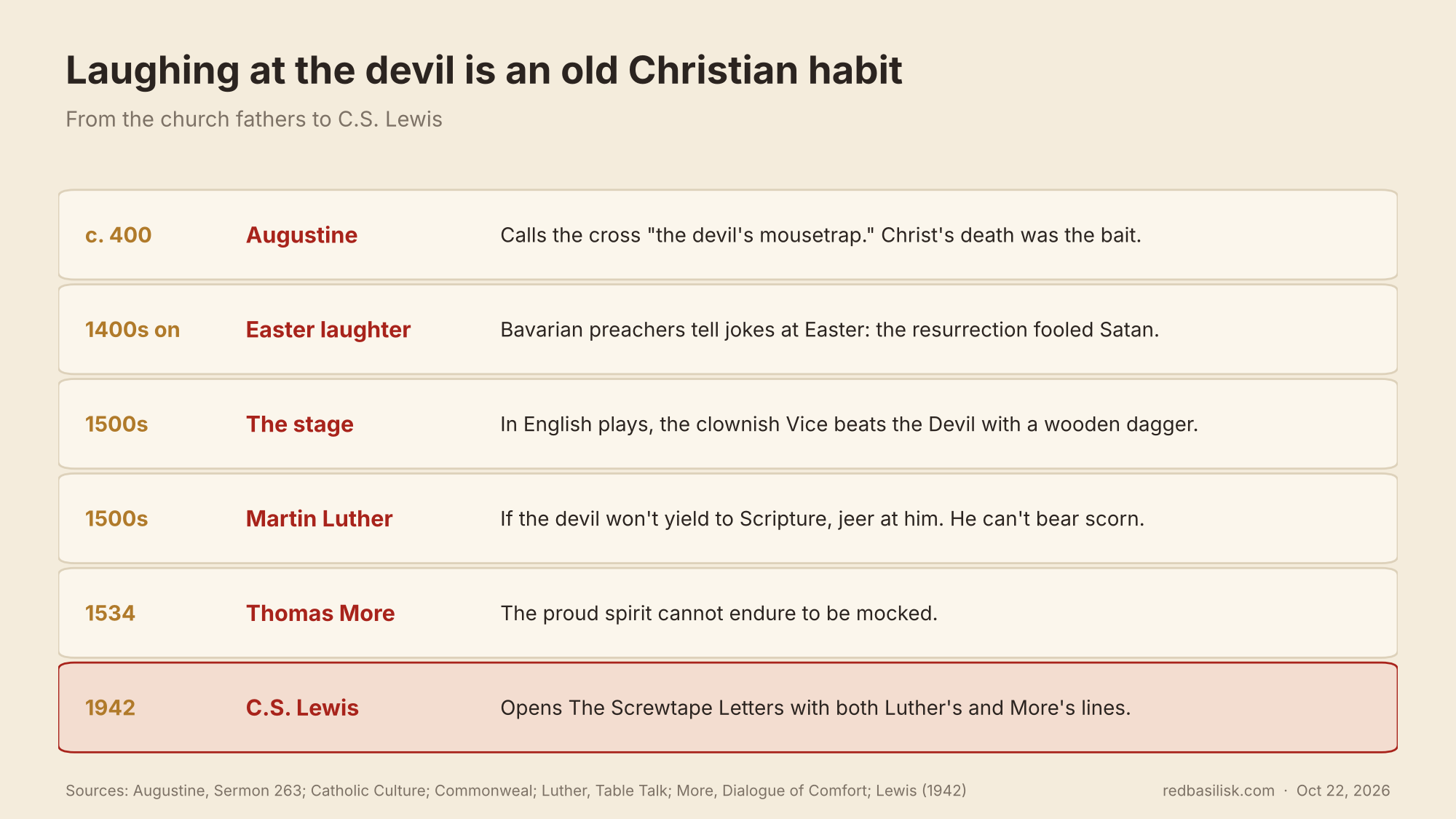
Around the year 400, Augustine called the cross "the devil's mousetrap." The devil went for the bait, which was the death of Christ, and the trap snapped shut on him.
In Bavaria, starting by the 1400s, preachers practiced the risus paschalis, the Easter laugh. On Easter Sunday, they told jokes from the pulpit to get the congregation laughing, because the resurrection was the joke God played on the devil. It got rowdy enough that Pope Clement X tried to ban it in the 1670s. But the idea behind it is old, and it goes back to the early church.
In the old English morality plays, the Devil was a figure for the crowd to laugh at. As one writer recalled in 1603, a clownish character called the Vice would leap onto the Devil's neck and beat him with a wooden dagger, and the audience loved it.
Martin Luther put it plainly: "The best way to drive out the devil, if he will not yield to texts of Scripture, is to jeer and flout him, for he cannot bear scorn." Thomas More, a Catholic who disagreed with Luther on almost everything, agreed with him on this. Writing in the Tower of London in 1534, More said that "the proud spirit cannot endure to be mocked."
Four hundred years later, C.S. Lewis wrote The Screwtape Letters, a book of letters from a senior demon to a junior one. Lewis opened the book with both of those quotes, Luther's and More's, side by side. The whole book is the devil being made ridiculous.
So when your kid puts on a witch hat and laughs at a plastic skeleton, they're standing in a very long Christian line.
Argument three: laughter is armor
Granting that demons are real, let me ask a different question. How likely is it that a kid in a costume gets possessed on October 31?
Think about how many layers of protection the average Christian kid walks around wearing. Were they baptized? How many people have prayed for them, and for how many generations? Did a grandmother pray over them every night? Is there a church family that knows their name? Scripture is blunt about the odds: "the One who is in you is greater than the one who is in the world" (1 John 4:4). And it says what our posture should be: "God has not given us a spirit of fear, but one of power, love, and sound judgment" (2 Timothy 1:7).
Fear is the posture the occult wants from you. It runs on mystery, secrecy, and dread. Take those away and it doesn't have much left.
That's where our culture has quietly done something brilliant. Look at how we picture witches. In The Wizard of Oz, in 1939, a house falls on one of them and her feet curl up under it. Bugs Bunny has been outsmarting a cackling witch named Witch Hazel since 1954. Our witches are goofy villains who lose to a rabbit.
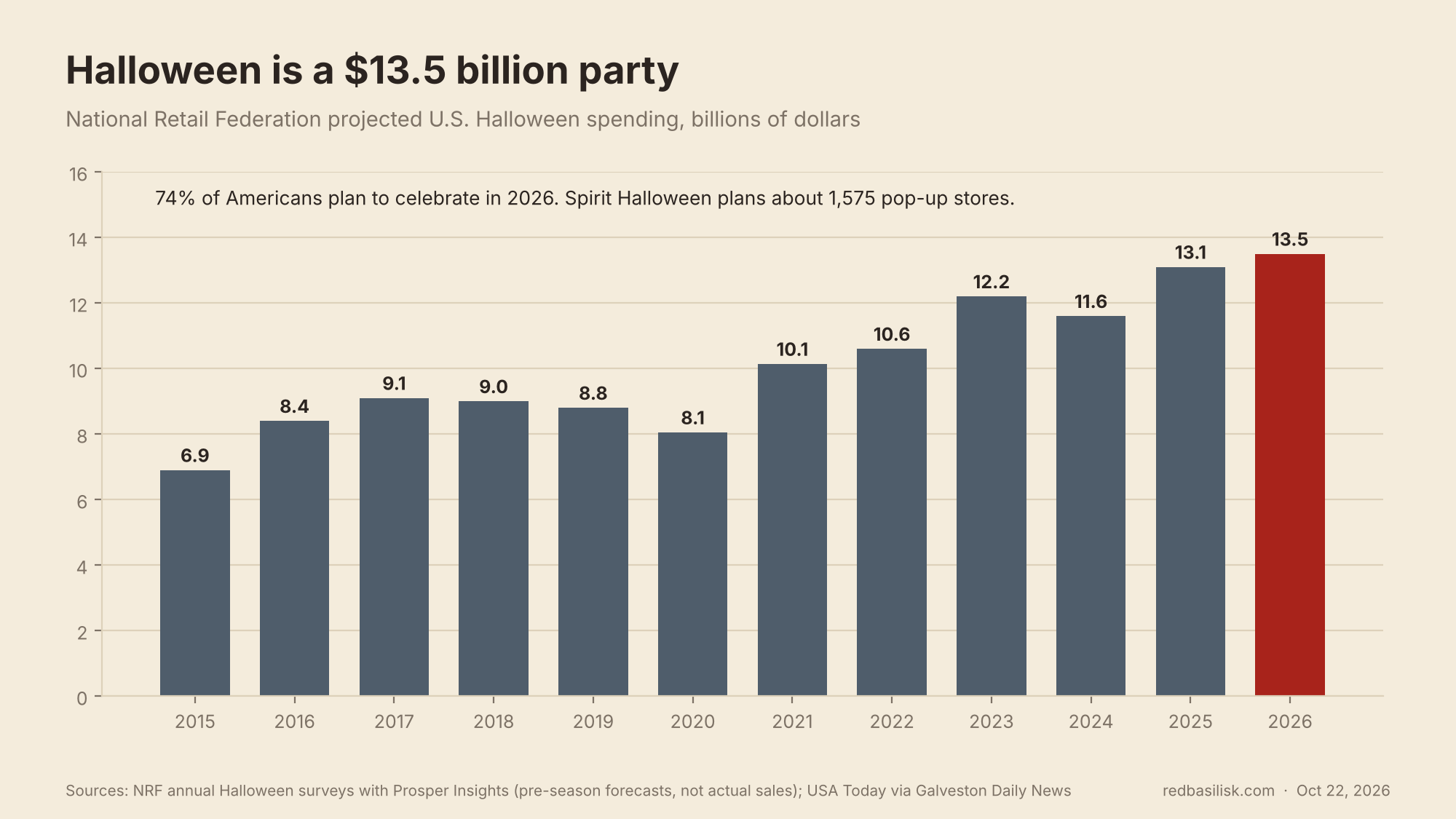
And then there's the commercial side. The National Retail Federation expects Americans to spend about $13.5 billion on Halloween this year, the highest forecast it has ever made, with 74% of us planning to celebrate. Spirit Halloween plans about 1,575 pop-up stores. Think about what that does to the occult's mystique. The sorcerer's robe is now polyester in a plastic bag, hanging next to an inflatable dinosaur costume. The spooky skull glows because it takes two AA batteries. If your closet looks like a Spirit Halloween, that's an insult for a reason. It means it looks cheap and silly.
I'll admit this next part is my own read, not a study. I'd bet a kid who has spent ten Halloweens laughing at plastic witches is harder to impress when someone tries to sell them the real thing. You don't fear what you've been mocking since you were five.
So take the night that people insist belongs to the darkness, and spend it dressing up as its monsters, laughing at them, and eating candy. What's more powerful than that?
Where the line is
Now, the fair objections. There are real verses on the other side, and an honest argument has to deal with them.
Paul tells the Ephesians: "Don't participate in the fruitless works of darkness, but instead expose them" (Ephesians 5:11). I'd say goofy Halloween does exactly what that verse asks. Mockery is exposure. It drags the thing into the light and shows how small it is.
But the same verse cuts the other way too. Don't participate. Deuteronomy 18 forbids anyone to "practice divination, tell fortunes, interpret omens, practice sorcery, cast spells, consult a medium or a spiritist, or inquire of the dead" (Deuteronomy 18:10–11). That's the line.
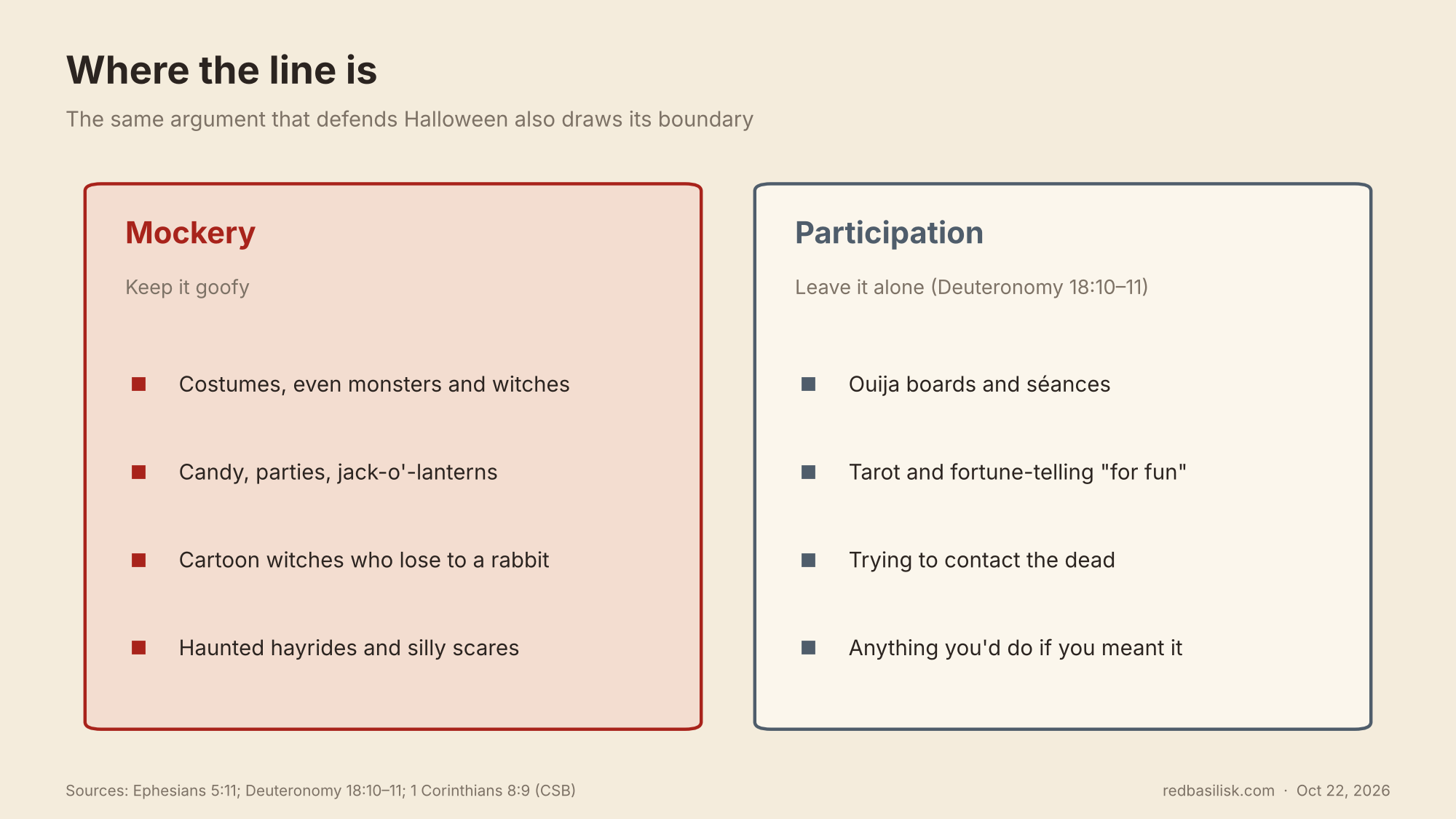
Mocking the darkness is one thing. Doing it is another. A witch costume is mockery. A Ouija board isn't. It's an attempt to contact something, even if you're giggling while you do it. Same for séances, and tarot "just for fun." The intention argument I made earlier works both ways: if you're actually reaching for something, God sees that too. My rule of thumb: don't do anything on Halloween you'd be doing if you meant it.
And one more limit. Paul, the same man who said an idol is nothing, also said to "be careful that this right of yours in no way becomes a stumbling block to the weak" (1 Corinthians 8:9). If a brother or sister in your church genuinely can't do Halloween with a clear conscience, don't mock them for it. Love comes before being right. They might have come out of the real thing, and the plastic version isn't funny to them. That's fair.
Can't touch this
So here's the case. Halloween is a Christian feast night. God judges the heart, and the heart of a kid in a costume is merry-making, not witchcraft. Scripture and the church have answered darkness with ridicule for nearly three thousand years. And fear is the fuel the occult runs on, so a culture that laughs at witches has a defense built in.
Keep it goofy. Keep it fun. Laugh at the devil. He can't stand it.
My take
That’s the theology. My real reason is simpler. Keep a kid home while all his friends trick-or-treat, and you haven’t taught him to fear the devil. You’ve taught him to resent the church.
How we dug into this
This piece was researched, written, and illustrated with AI tools. It argues a position. It grants two premises for the sake of argument (that Christianity is true and that the occult is real) and doesn't try to prove either one.
Bible quotations are from the Christian Standard Bible (CSB). Some CSB verses read slightly differently between the 2017 and 2020 printings, so we quoted only wording that matched across our sources. Where we describe a passage without quotation marks, that's our paraphrase.
The history draws on summaries of Ronald Hutton's The Stations of the Sun and Nicholas Rogers' work, Catholic and liturgical references, and newspaper archives. Several commonly repeated "facts" didn't hold up and were left out or corrected. Trick-or-treat language first appears in print in 1917, not 1927 as is often claimed. The year 998 for All Souls' Day is disputed, so we say "around 1000." The claim that Pope Gregory III set November 1 rests on later tradition, so we say "tradition credits." And the idea that Samhain was a witches' sabbath, or that it honored a god of the dead, has no medieval support.
Luther's line comes from his Table Talk. English translations vary, and we used the most widely cited wording. The Boniface account comes from Willibald's Life of Saint Boniface, written within a generation of his death. The Christmas-tree version comes from Henry van Dyke in 1891. Spending figures are the National Retail Federation's pre-season survey forecasts, not actual sales. Before publishing, a separate AI agent fact-checked every claim against its sources. It caught an outdated date for the first "trick or treat," an oversimplified line about murder and manslaughter, and an overstatement about the early Irish calendar, all corrected.
Sources
- [1 Kings 18 (Bible Hub, CSB)](
- [Isaiah 44 (Blue Letter Bible, CSB)](
- [Psalm 2 (Blue Letter Bible, CSB)](
- [Colossians 2:15 (Bible Hub)](
- [1 Corinthians 8 (Blue Letter Bible, CSB)](
- [1 Corinthians 10 (Blue Letter Bible, CSB)](
- [1 Samuel 16 (Blue Letter Bible, CSB)](
- [Jeremiah 17 (Blue Letter Bible, CSB)](
- [Matthew 5 (Bible Hub, CSB)](
- [1 John 4:4 (Bible Study Tools, CSB)](
- [2 Timothy 1 (Blue Letter Bible, CSB)](
- [Ephesians 5 (Blue Letter Bible, CSB)](
- [Deuteronomy 18 (bible.com, CSB)](
- [Samhain (Wikipedia)](
- [Catholic Answers: Is Halloween a pagan festival?](
- [Pravmir: Who stole Halloween? (summarizing Hutton)](
- [John Sanidopoulos: The Christian, not pagan, origins of Halloween](
- [UCD Cultural Heritage Collections: A season for saints and the supernatural](
- [Roger Pearse: Thinking about All Saints' Day](
- [Roger Pearse: The edict of Louis in 835](
- [Pope Boniface IV (Wikipedia)](
- [Catholic Culture: All Saints](
- [New Liturgical Movement: Liturgical notes for All Souls' Day](
- [Odilo of Cluny (Wikipedia)](
- [Irish Myths: Halloween's "satanic origins" and Vallancey](
- [OUPblog, Owen Davies: The origin of Halloween witches](
- [Etymonline: Halloween](
- [Weald & Downland Living Museum: All Hallows' Eve like a medieval](
- [Halloween (Wikipedia)](
- [University of Notre Dame, Rare Books: Jack-o'-lantern history](
- [Futurity: Reformation Day and Halloween](
- [SooToday: "Trick or treat" in print traced to the Sault (1917)](
- [Barry Popik: Trick or treat, early citations](
- [Edmonton Archives: Trick or treat](
- [Trick-or-treating (Wikipedia)](
- [Willibald, Life of Saint Boniface (Fordham Medieval Sourcebook)](
- [Donar's Oak (Wikipedia)](
- [Roger Pearse: St. Boniface and the Christmas tree, a modern myth](
- [Cornell LII: Mens rea](
- [Cornell LII: Malice aforethought](
- [The Riddle Ages: Augustine's mousetrap (Sermon 263)](
- [Heidelblog: The devil's mousetrap](
- [Catholic Culture dictionary: Risus paschalis](
- [Commonweal: Easter laughter](
- [The Conversation: Easter laughter, the medieval history of religious jokes](
- [Vice (character) (Wikipedia)](
- [Wist: Martin Luther on jeering the devil](
- [Luther, Table Talk, "Of the Devil and his Works" (CCEL)](
- [Wist: Thomas More on mocking the devil](
- [C.S. Lewis, The Screwtape Letters, 1942 printing (Internet Archive)](
- [National Catholic Register: Laughing at Lucifer in Lent](
- [Wicked Witch of the East (Wikipedia)](
- [Witch Hazel (Looney Tunes) (Wikipedia)](
- [U Can't Touch This (Wikipedia)](
- [NRF: Halloween spending expected to reach $13.5 billion (2026)](
- [NRF: Halloween spending to reach record $13.1 billion (2025)](
- [NRF: Halloween spending to reach record $12.2 billion (2023)](
- [Talk Business: 2018, 2019, and 2024 NRF forecasts](
- [NACS: 2020 and 2021 NRF forecasts](
- [Money: 2015 and 2016 NRF forecasts](
- [CNBC: 2017 NRF forecast](
- [Fox 5: 2022 NRF forecast](
- [Galveston Daily News (USA Today): Spirit Halloween store count, 2026](