




Read
Not Fighting Each Other: Who's Really For and Against AI
Three years ago Republicans were the party worried about AI. Now it's Democrats. But the real fight over AI isn't elephant vs. donkey. It's the people who own the machines vs. the people who live next to them.
Three years ago, Republicans were the party more worried about artificial intelligence. Today it's Democrats. If you picture the fight over AI as an elephant and a donkey squaring off, that flip is the headline.
But it's the wrong fight to watch. When you line up who says what, who actually uses the tools, who is spending money, and who is winning, the elephant and the donkey mostly aren't fighting each other. The real line runs between the top and the bottom: the people building and funding the machines on one side, and the people living next to them on the other. Both parties have people on both sides of that line.
Here's how we got there.
The flip
Pew Research has asked Americans the same question for years: does the growing use of AI in daily life make you more concerned or more excited? In 2023, Republicans were the more worried party. By 2025 the lines had crossed. In June 2026, 56% of Democrats said they were more concerned than excited, compared with 49% of Republicans.
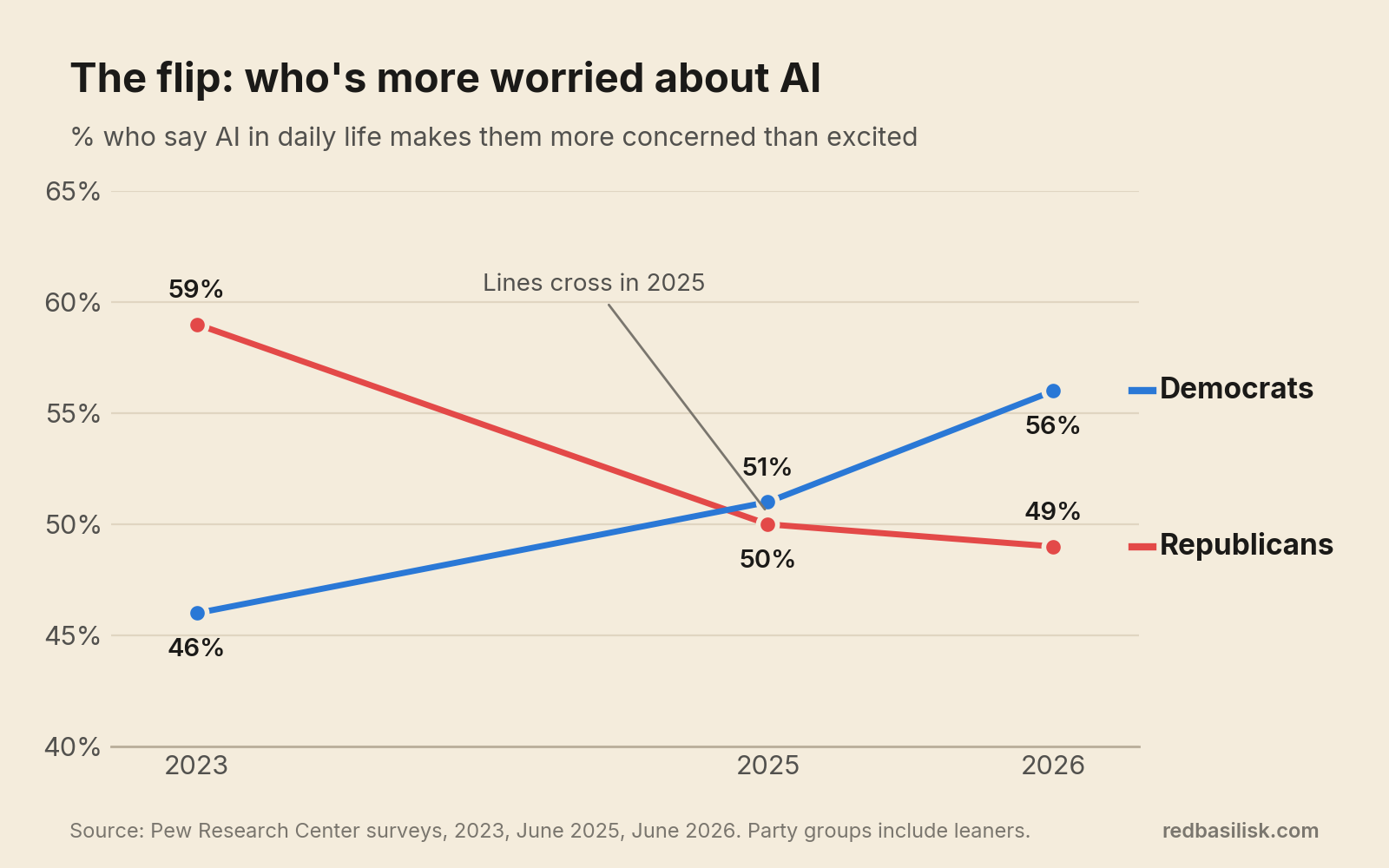
Most of the movement came from the edges. Among liberal Democrats, concern jumped from 45% in 2023 to 63%. Among conservative Republicans, it fell 14 points. The same thing happened with jobs. Two years ago, more Republicans than Democrats expected AI to cost Americans jobs. Now it's Democrats, 75% to 68%.
Opinions of the companies flipped too. In the 2024 Axios Harris reputation rankings, the two parties rated AI and tech companies about the same, with Democrats slightly warmer toward most of them. By 2026, Republicans rated all twelve more favorably, and OpenAI's partisan gap had grown from 1 point to 12.
Two forces drove the flip, and they reinforce each other.
AI came for the laptop class first. For a decade, the standard forecast (starting with a well-known 2013 Oxford study) said automation would hit routine, physical, lower-wage jobs first: trucking, warehouses, cashiers. Writers, artists, designers and coders were supposed to be the safe ones. Then image generators and ChatGPT arrived in 2022, and the order flipped. Writing and drawing turned out to be easier to automate than folding laundry or fixing a transmission. Self-driving trucks are still creeping along, while illustrators and copywriters got hit almost overnight. Brookings found that 62 of the 100 most AI-exposed counties in the country voted Democratic in 2024. The people closest to the technology are the ones most rattled by it, and right now they vote blue.
The tribes sorted around Trump. The second Trump administration embraced the AI industry: deregulation, fast-tracked data centers, and an executive order aimed at knocking down state AI laws. When your side's leader embraces something, you warm to it. When the other side's leader does, you cool on it. That explains why the biggest shifts came at the ideological edges, where people take their cues most closely from their own side.
The models themselves moved during the same stretch. The early chatbots had a reputation, backed by research, for leaning left. After heavy pressure from the right, including a 2025 federal order against "woke AI" in government contracts, newer models measure somewhat closer to the center, at least in the studies so far. They haven't switched sides, though. A 2026 study found newer versions of ChatGPT less left-leaning than earlier ones but still leaning libertarian-left, and a June 2026 comparison of six major models found four of them leaning left of center, with Gemini near the middle and Grok leaning right. The machines were pulled toward the middle along with everything else, but most of them still sit left of it.
What people say vs. what they do
On the ground, it can look like the left hates AI and the right loves it. Opinion polls partly back that up. Usage data mostly doesn't.
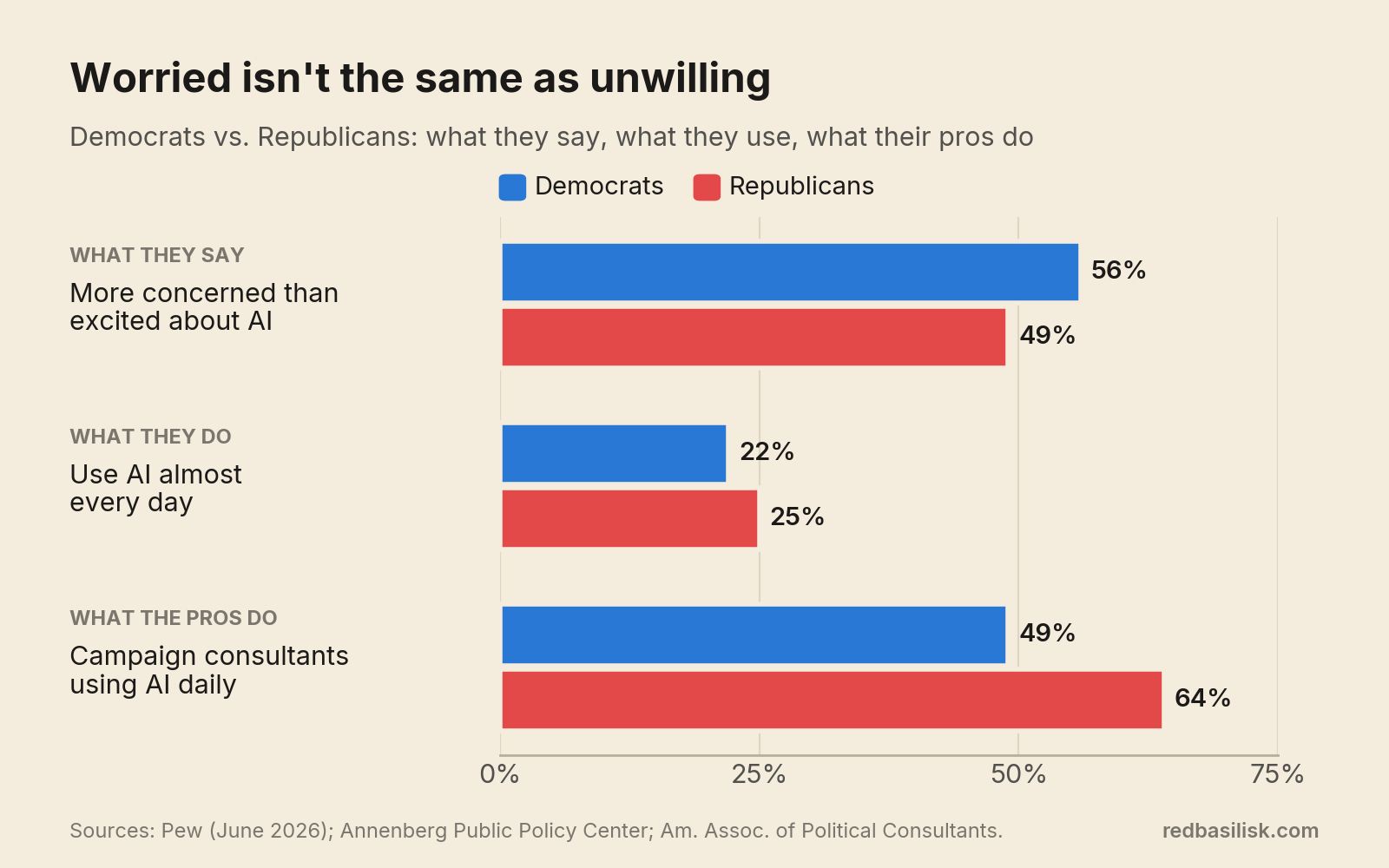
In one 2026 survey of likely voters, Democrats and Republicans reported using AI at about the same rates. The Annenberg Public Policy Center found almost the same thing: 25% of Republicans and 22% of Democrats interact with AI almost every day. The divides that matter for usage aren't about party at all:
- Education: College-educated voters are twice as likely to use AI daily as voters with a high school diploma or less (28% vs. 14%).
- Age: Voters aged 35 to 49 are the heaviest users. Nearly half of seniors hadn't used AI at all in the past month.
- Brand: Democrats and Republicans use ChatGPT, Gemini, Copilot and Claude at similar rates. Republicans are a bit more likely to use Grok and Meta AI.
Where the right really does lead is among the people who make political content. In a survey of political consultants, 64% of Republicans used AI daily in their work, compared with 49% of Democrats. Democratic strategists describe a lot of quiet skepticism on their side. Republican campaigns use AI for ads, polling and fundraising, and they talk about it openly.
So the ground-level impression is half right. The right uses AI out loud, and the left uses it quietly. Rank-and-file Democrats who tell pollsters they're worried are still opening the apps.
Follow the money
This is where the picture really breaks from the stereotype. People who work at AI labs lean left. The money trying to shape AI policy mostly doesn't.
The biggest player is Leading the Future, a super PAC network that has raised more than $125 million for the midterms. Its backers include Andreessen Horowitz founders Marc Andreessen and Ben Horowitz, OpenAI president Greg Brockman, and Palantir co-founder Joe Lonsdale. Its goal is a single national AI rulebook that overrides the states, and defeating politicians who push tougher rules. Big Tech corporate money has also gone to MAGA Inc., the main pro-Trump super PAC.
On the other side is Public First, a bipartisan network run by former congressmen Brad Carson (a Democrat) and Chris Stewart (a Republican). It pushes for AI guardrails. It has run ads supporting Republican senators Marsha Blackburn and Pete Ricketts, and its biggest known funder is the AI company Anthropic, which gave it $20 million.
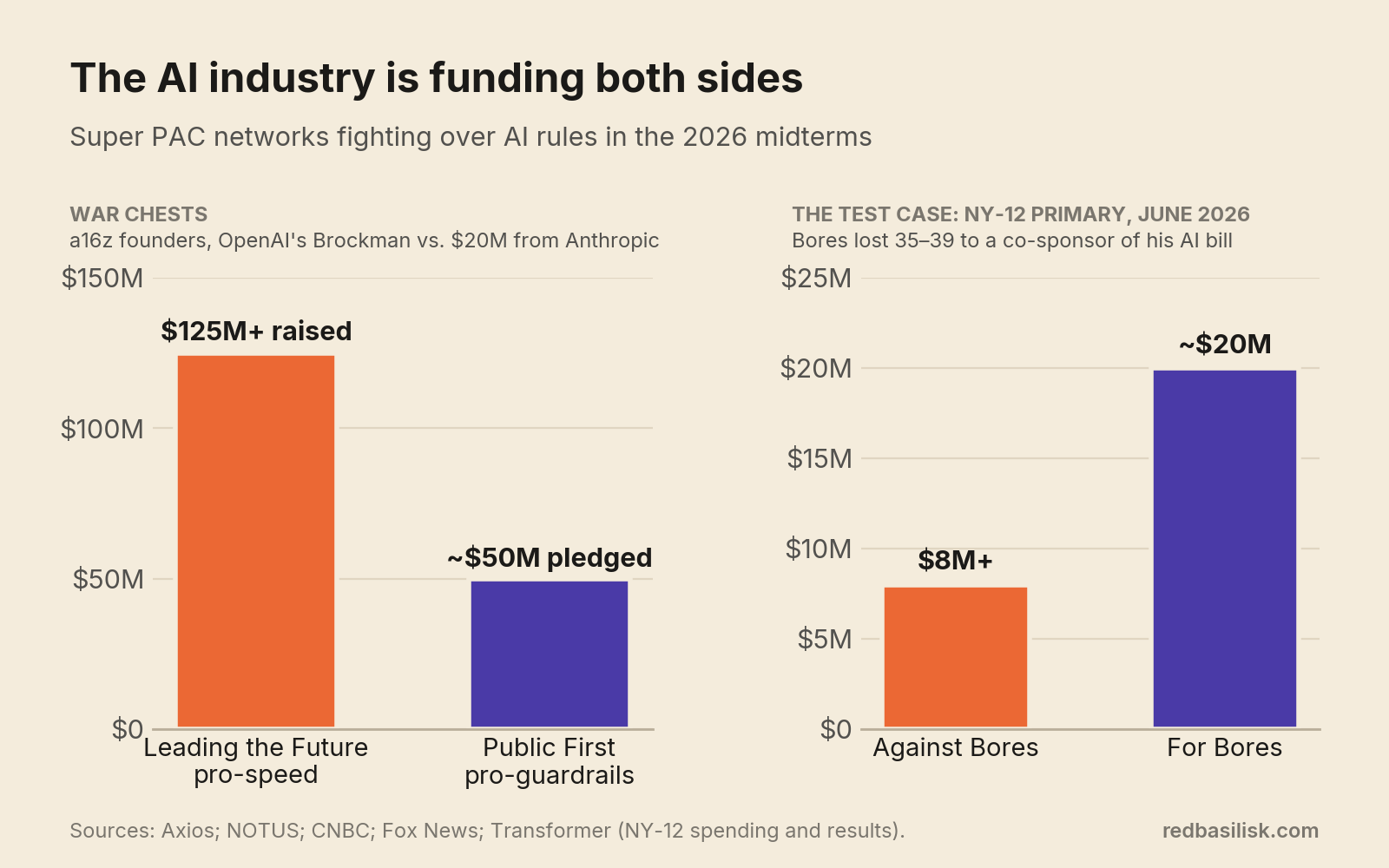
The biggest test so far came in June, in a Democratic primary for a Manhattan House seat. Alex Bores, the New York legislator who wrote the state's AI safety law, was running. Leading the Future spent more than $8 million trying to beat him, and safety-aligned groups spent about $20 million backing him. It became the second most expensive House primary on record.
Bores lost, 35% to 39%. But the winner, Micah Lasher, had co-sponsored Bores's AI bill, and he used his victory speech to tell "the two big AI companies" he wouldn't be taking cues from them. The industry beat the man but not the idea.
So the AI industry isn't one bloc with one politics. It's split, and the split doesn't follow party lines.
Who's actually winning
Talk is cheap. Here's who has actually changed outcomes.
Local data center fights are the most effective resistance by far. Data Center Watch, a research group that tracks these fights, counted 396 local opposition groups at the end of 2025. By June 2026 there were 843, in 49 states. In the first half of 2026, those groups blocked or delayed about 120 data center projects worth around $198 billion. A Gallup poll in March found that 7 in 10 Americans oppose building an AI data center in their area.
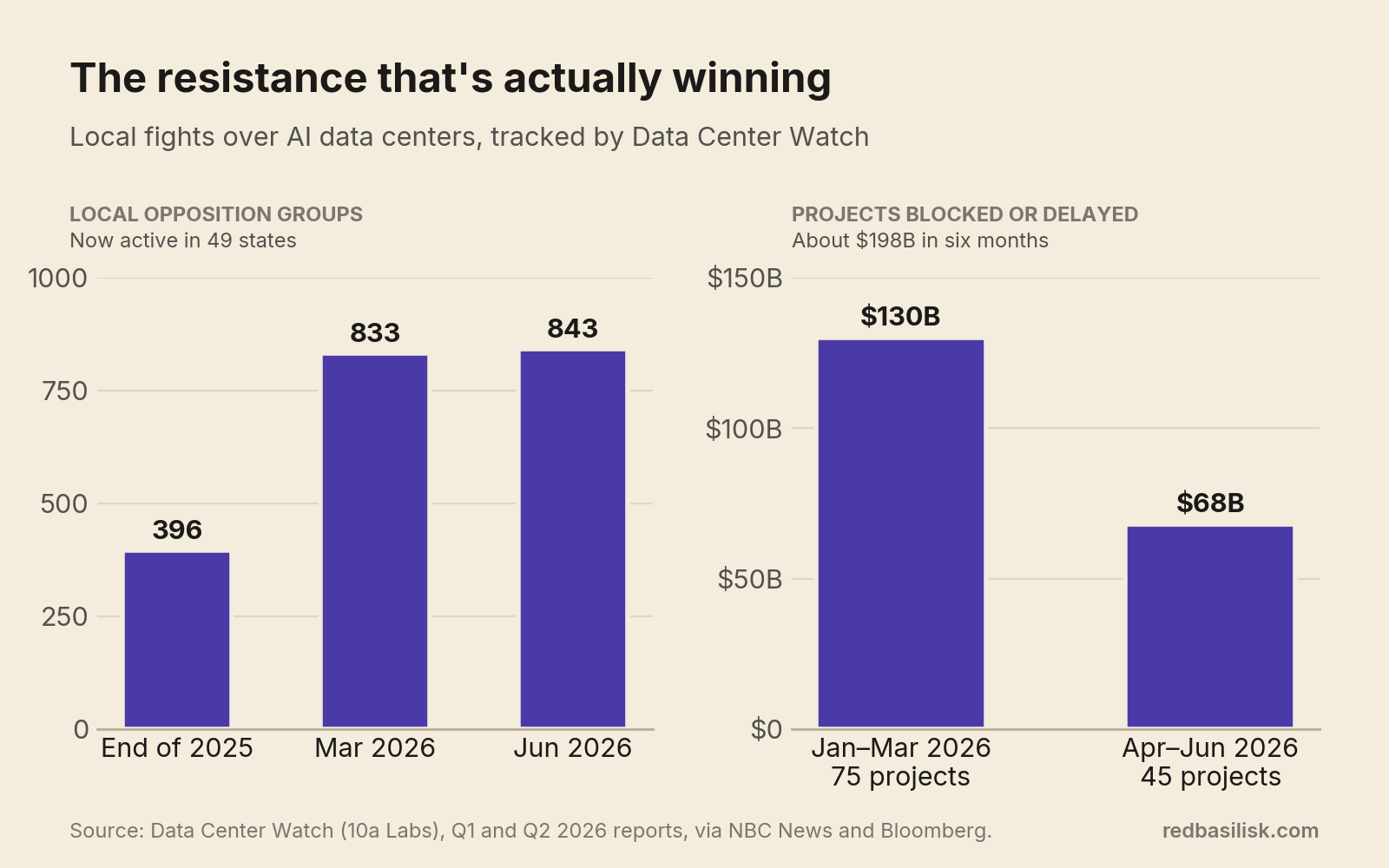
These fights are mostly about power bills, water, noise and land, not ideology. That's exactly why they work. A township board meeting doesn't care which party you vote for. As we covered in The Truth About Data Centers, a lot of the scary national numbers are "true locally, false nationally," and local is exactly where these fights happen. Either way, local opposition is the one force that has actually slowed the build-out.
The populist right is the loudest anti-AI voice in the Republican Party. Senator Josh Hawley has made opposition to unchecked AI a central part of his brand, arguing that AI is "working against the working man." Florida Governor Ron DeSantis called the White House push to override state AI laws "bad policy" and "even worse politics," and his attorney general sued OpenAI. Steve Bannon calls AI "the defining issue of our time." In September, Bannon and Bernie Sanders made nearly the same argument about unaccountable tech oligarchs, from opposite ends of the spectrum. So far this camp has done more to shape the 2028 race than to pass laws, but it's why the White House can't count on its own party.
The states have mostly beaten the push to override them. Congress tried to block state AI laws for ten years, and the Senate stripped that out 99 to 1. The White House then set up a Justice Department task force to sue states over their AI laws. As of September, it had yet to win a case. Meanwhile, states passed 109 AI laws and 28 data center laws in the first half of 2026, about a third with sponsors from both parties, mostly on child safety, data centers and consumer protection.
Unions win quietly, at the bargaining table. The International Longshoremen's Association won a ban on fully automated port technology. The Writers Guild won rules that AI can't be credited as a writer or used to cut writers' credit and pay. Culinary workers in Las Vegas won the right to bargain before any new AI rollout. These protections only cover union members, but they're enforceable today, while Congress is still arguing.
The real dividing line
Put it all on one map and the elephant-vs.-donkey fight mostly disappears.
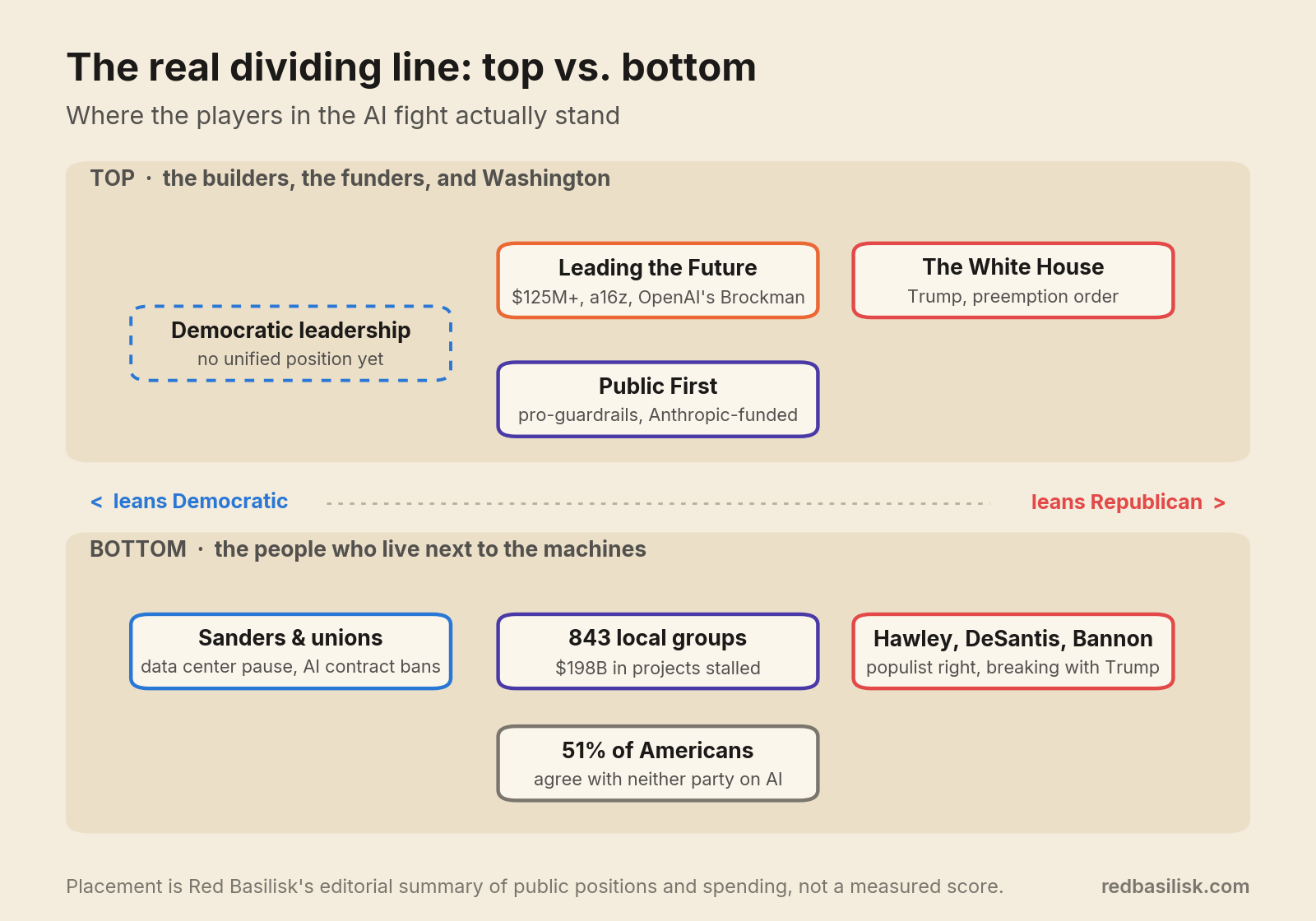
At the top: the White House, the venture capitalists, the labs, and more than $125 million in super PAC money pushing full speed and one national rulebook. There's a split up here too, with one lab funding the guardrails side, and the Democratic Party still hasn't settled on a position.
At the bottom: Bernie Sanders and Josh Hawley saying nearly the same thing, hundreds of local groups that don't care about party labels, unions writing AI limits into contracts, and red and blue states passing laws the White House is trying to kill.
The public mostly sits at the bottom. In a July Pew survey, 51% of Americans said they agree with neither party on AI. A Yale poll found that just 4% think AI shouldn't be regulated at all. Trump's own longtime pollster warned Republicans that more than 80% of voters want a national law protecting kids from AI harms. When voters are asked which party they trust on AI, it's nearly a tie: 42% Republican, 40% Democratic in a September New York Times/Siena poll. Voters under 30 favor Democrats by 32 points.
That's why the flip matters less than it looks. In party terms, 2023 and 2026 look like opposites. In top-vs.-bottom terms, they look the same. The parties just swapped jerseys. The fight to watch isn't elephant vs. donkey. It's whoever owns the machines vs. whoever lives next to them.
My take
I came into this thinking the left was against AI and the right was for it, because that's what it looks like from here. The loudest complaints online come from the left, and the people I see building and creating with AI lean right. That's true. The right does use it out loud. But the money shaping the rules isn't on either team, and the fights that are actually changing anything are happening at county board meetings, not on cable news.
Nobody at a township meeting asks your party before they ask what a data center will do to their power bill. The only way they win is by earning the trust of the people who live next to the machines, not by buying Congress. The people at the top should be listening to the people at the bottom, and right now the smartest politicians in both parties are figuring that out.
How we dug into this
We started with one question from the ground: why does it look like the left is against AI while the right is using it? We pulled 2026 polling from Pew, Yale, Data for Progress, the New York Times/Siena and others, FEC-based reporting on super PAC spending, Data Center Watch's quarterly reports, and coverage of the NY-12 primary.
A few of our starting assumptions didn't survive. We guessed older Americans had embraced AI faster than older generations took to past technology. The data says the opposite: seniors are the lightest users. We described the models as "less woke." The research supports "less left-leaning," but most still measure left of center (Grok is the exception). And the idea that the industry sides with the left fell apart once we followed the money.
One disclosure: the AI that did this research is Claude, made by Anthropic, the company that funds Public First. We've reported that funding the same way we reported everyone else's. We'd rather you know than find out.
Sources
- [Pew Research Center: Democrats are now more worried than Republicans about AI and its impact on jobs (Sept. 2026)](
- [Pew Research Center: Republicans, Democrats now equally concerned about AI in daily life (Nov. 2025)](
- [Pew Research Center: As the 2026 Midterms Approach, Economy Is Front and Center](
- [Washington Times: Republicans view AI more favorably than Democrats, poll finds (Axios Harris Poll 100)](
- [Yale Youth Poll: Spring 2026 Results](
- [Axios: Voters give edge to GOP over Dems on AI](
- [Yahoo News: Longtime Trump pollster reveals ugly forecast for Republicans](
- [CBS12: AI's red-blue divide (Brookings county research)](
- [Caucus AI: Who's using which chatbots](
- [Axios: GOP campaigns go all-in on AI, Dems not so much](
- [Issues & Insights: The political falsehoods of leading AIs (cites 2026 ChatGPT bias study)](
- [Trakkr: Political bias in AI, where the models stand (June 2026)](
- [Axios AI+ Government: Leading the Future fundraising](
- [NOTUS: The AI super PAC fight that might shape the midterms](
- [Public Citizen: Corporate super PACs drive $500 million midterm spending surge](
- [Yahoo News: The AI spending war heads to the 2026 campaign trail](
- [Fox News: New York congressional primary becomes second most expensive House race ever](
- [Transformer: What Alex Bores' defeat tells us about AI politics](
- [Gizmodo: Nearly $200 billion worth of data center projects blocked or delayed](
- [NBC News: Data center opposition sharply rising in 2026](
- [Trending Topics: US data center opposition stalls 120 projects in 2026](
- [TIME: A populist backlash over AI is brewing in America](
- [Politico Pro: A GOP revolt over AI is taking shape](
- [Boston Globe: "A deep unease with AI right now"](
- [CASRAI: Federal AI preemption fight, where it stands](
- [TechPolicy.Press: Where state AI legislation stands halfway into 2026](
- [Curionic: AI and labor relations in 2026](