




Read
The Real Genocides
The word genocide has been stretched to cover diet drugs and policy fights, while the real thing happened in Sudan and almost nobody watched.
Every dispatch is also a podcast. Follow on Spotify ↗
On October 26, 2025, a paramilitary army called the Rapid Support Forces took the city of El Fasher in western Sudan. It had surrounded the city for eighteen months and starved it. When it got in, its fighters went building to building. Survivors told United Nations investigators the fighters said they would kill every Zaghawa they found, and that they wanted to rid Darfur of "anything black." At least 6,000 people were killed in the first three days. The UN says the real number is likely much higher.
This September, at a socialist conference in Chicago, an author was reported telling a panel audience that the world is "fixated on genociding fat people," in remarks about weight-loss drugs. A genocide-prevention group called the Lemkin Institute has issued "red flag alerts" since early 2025 describing American and British policies toward trans people, including limits on gender-transition care, as part of a genocidal process.
You don't have to dismiss anyone's concerns to see the problem. If genocide covers weight-loss drugs and health policy, there's no word left for what happened in El Fasher. And the world's response to El Fasher suggests that's roughly where we are.
This piece goes back to what the word actually means, takes the most fought-over claim of the last three years head-on, and then lays out the cases that meet the bar: who did them, why, how many died, and what they have in common. That last part matters most. Genocide follows patterns, and the patterns can be seen coming.
What the word actually means
Genocide is not a feeling or a figure of speech. It has a fixed legal definition, written into the 1948 Genocide Convention after the Holocaust. It means any of five acts, committed "with intent to destroy, in whole or in part, a national, ethnical, racial or religious group, as such." The five acts are killing members of the group, seriously harming them in body or mind, deliberately imposing conditions meant to physically destroy the group, preventing births within it, and forcibly taking its children.
Three things follow from that.
First, only four kinds of groups count: national, ethnic, racial and religious. Body size is not one of them. Neither is gender identity, political belief or social class. Some scholars, including some of the people quoted above, argue the definition should be wider, and atrocities against other groups can still be crimes against humanity. But under the treaty as written, they are not genocide.
Second, intent is the whole fight. War kills enormous numbers of people, and mass death alone is not genocide. Courts set a high bar for proving intent. In a 2015 ruling, the International Court of Justice said that when intent has to be inferred from a pattern of conduct, it must be the only reasonable explanation for that conduct.
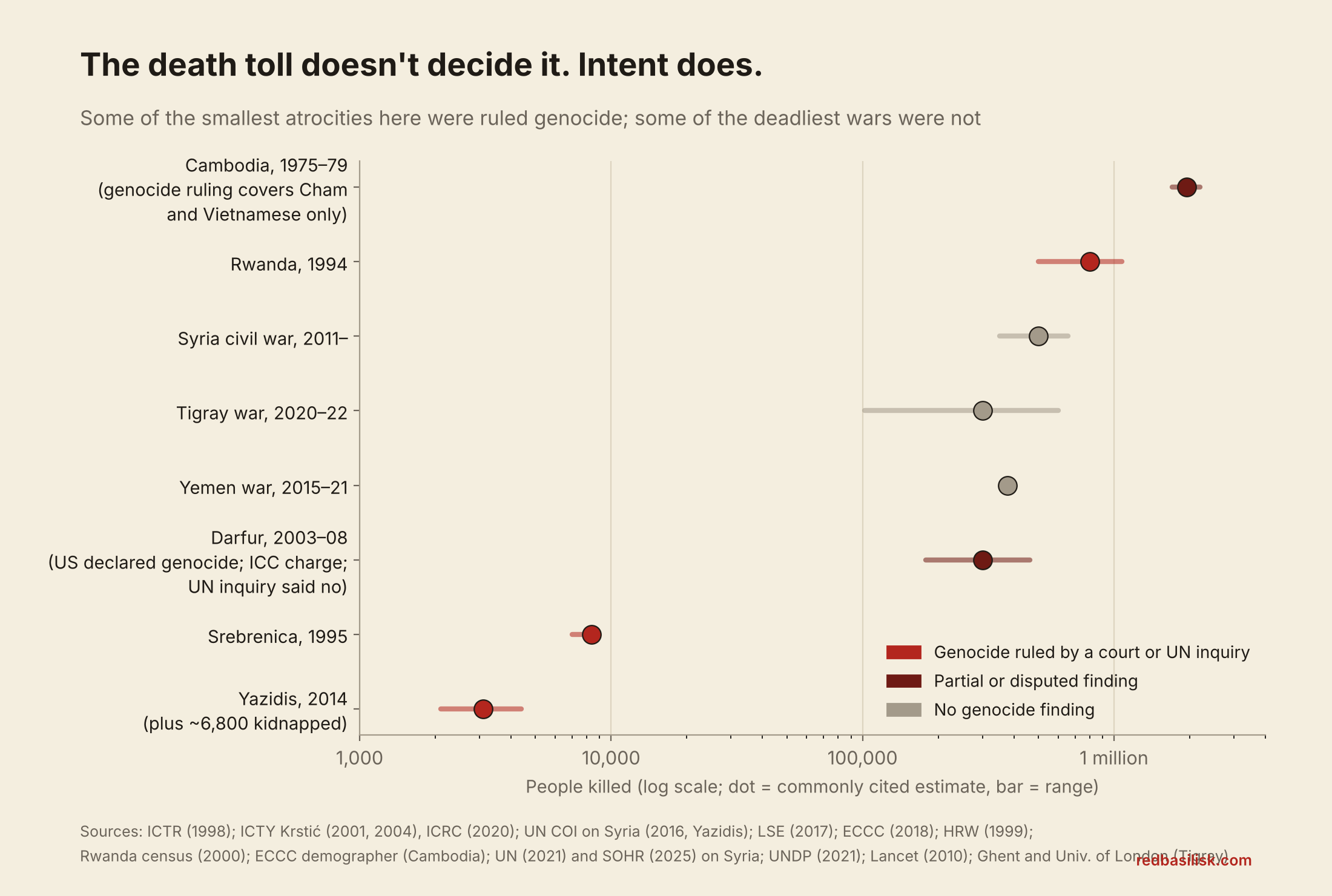
Third, "in part" is real. A killer doesn't have to try to wipe out every member of a group. At Srebrenica in 1995, Bosnian Serb forces killed about 8,000 Bosniak men and boys. Two international courts ruled it genocide.
That's why the size of the death toll doesn't settle the question. Some of the deadliest wars of the last fifty years never produced a genocide ruling, and some much smaller atrocities did.
Gaza: the fight over the word
Gaza is where the current fight over the word is fiercest, and no court has ruled on it. South Africa's genocide case against Israel at the International Court of Justice won't reach a verdict for years; the court has scheduled written filings out to May 2029. A ceasefire took hold in October 2025, and the last living hostages came home that month, though Israeli strikes have continued since.
Here is the strongest case that Gaza does not meet the legal bar. The war began on October 7, 2023, when Hamas killed about 1,200 people, most of them civilians, and took 251 hostages. Israel says its target is Hamas, which fought from inside homes and hospitals and from tunnels under civilian neighborhoods. Israel issued evacuation warnings, opened humanitarian corridors, paused fighting, and cooperated with polio vaccination campaigns, however imperfectly. Legal scholars such as David Bernstein of George Mason University argue that those steps make an intent to destroy Palestinians difficult to infer at all, let alone as the only reasonable explanation the court requires. Israel's defenders also point out that it had the military power to kill far more people than it did.
Two claims made on the other side don't hold up. The International Court of Justice never said genocide was "plausible" in Gaza. Its former president, Joan Donoghue, said in 2024 that the court found Palestinians had a plausible right to be protected from genocide, which is a different thing. And the International Criminal Court's arrest warrants for Benjamin Netanyahu and his former defense minister, Yoav Gallant, do not charge genocide. They charge starvation as a war crime, and murder and persecution as crimes against humanity.
Here is the strongest case that it does meet the bar. In September 2025, a UN Commission of Inquiry chaired by Navi Pillay, a former judge on the Rwanda tribunal, concluded that Israel committed genocide. It applied the same "only reasonable explanation" test and pointed to statements by Netanyahu, President Isaac Herzog and Gallant as evidence of intent. The International Association of Genocide Scholars, Amnesty International, and two Israeli human rights groups, B'Tselem and Physicians for Human Rights Israel, reached the same conclusion. Gaza's Health Ministry counts more than 70,000 dead. In January 2026, a senior Israeli military official said that total was largely accurate, while saying the split between civilians and fighters was unclear.
Israel rejects every one of those findings, and so does the US government.
What the evidence does show is this: while the world argued about Gaza, a genocide that few outside its perpetrators and their backers dispute was happening a few hundred miles south.
Sudan: the same killers, twice
Sudan is one of the best-documented atrocities of this decade, with both a US government genocide determination and UN investigators' findings behind it. It's also the second round of mass killing in Darfur in twenty years, by the successor to the same militias.
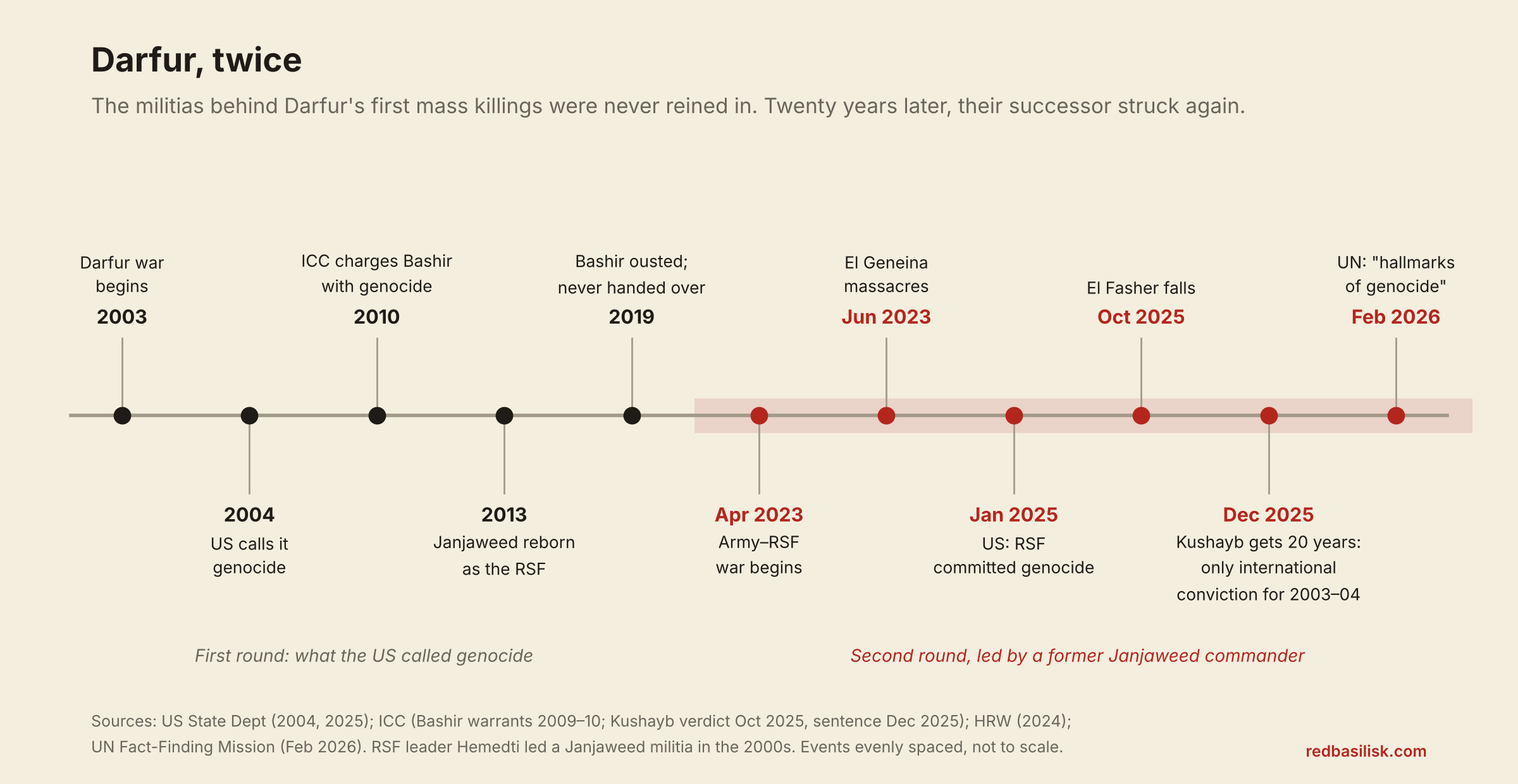
In 2003, Sudan's government armed Arab militias known as the Janjaweed to crush a rebellion in Darfur, in the country's far west. The militias burned villages belonging to non-Arab groups, mainly the Fur, Masalit and Zaghawa. The UN estimates around 300,000 people died. The United States called it genocide in 2004. A UN inquiry the next year found war crimes and crimes against humanity but stopped short of finding a government genocide policy. The International Criminal Court later charged Sudan's president, Omar al-Bashir, with genocide.
Almost nobody paid for it. Bashir was ousted in 2019 but has never been handed over to the court. In 2013, Bashir's government reorganized the Janjaweed into an official paramilitary called the Rapid Support Forces, the RSF. Its commander, Mohamed Hamdan Dagalo, known as Hemedti, had led a Janjaweed militia in Darfur in the 2000s. In April 2023, the RSF went to war with Sudan's army for control of the country. Within weeks, it turned on the Masalit again.
The only person convicted by an international court over the 2003–04 atrocities is a militia leader named Ali Kushayb. The International Criminal Court sentenced him to 20 years in December 2025, for war crimes and crimes against humanity. By then, the second round had already happened.
El Geneina, 2023
El Geneina is the capital of West Darfur, a city of about half a million people near the border with Chad. It was the heart of Masalit country.
Starting in late April 2023, the RSF and allied Arab militias attacked Masalit neighborhoods over and over for months. Human Rights Watch documented men and boys being singled out and killed. A Doctors Without Borders survey found the death rate rose about twentyfold, and 83 percent of those killed were men. On June 15, a column of fleeing civilians was attacked, and many were killed trying to swim across a river to escape. Masalit neighborhoods were bulldozed so no one could come back. West Darfur's governor, Khamis Abakar, a Masalit, publicly condemned the violence and was killed the same day after being seized by men in RSF uniform.
The attackers said why. Survivors told Human Rights Watch they heard fighters say the land would become "the land of the Arabs," and that no Masalit would live there anymore.
A UN panel of experts estimated 10,000 to 15,000 people were killed in El Geneina in 2023. That figure is an estimate based on intelligence sources, and Human Rights Watch says any count is likely too low. More than 570,000 people, mostly Masalit, fled into Chad.
In January 2025, the US Secretary of State formally determined that the RSF and its allied militias had committed genocide, finding they murdered men, boys and even infants on the basis of ethnicity. The United States sanctioned Hemedti. In May 2026, the House Foreign Affairs Committee voted 44 to 2 for a resolution naming the genocide.
El Fasher, 2024 to 2025
El Fasher, the capital of North Darfur, was the last major city in Darfur the RSF didn't hold. Its people were mostly Zaghawa, and the camps around it were full of Fur, Masalit and other non-Arab families who had already fled once.
The RSF surrounded the city for eighteen months and squeezed it. In April 2025, it overran the nearby Zamzam displacement camp, which had sheltered half a million people, and killed more than 1,000. Then, on October 26, it took the city itself.
The UN human rights office says at least 6,000 people were killed in the first three days. About 500 were killed at a university dormitory, and more than 460 patients and companions at the Saudi Maternity Hospital. Zaghawa and Fur women and girls were singled out for gang rape; survivors said attackers told them they were being exterminated like the Masalit. Afterward, researchers at Yale found satellite images of clusters consistent with human remains being burned and buried, which they concluded was a cover-up.
The number that haunts El Fasher is not the dead. It's the missing.
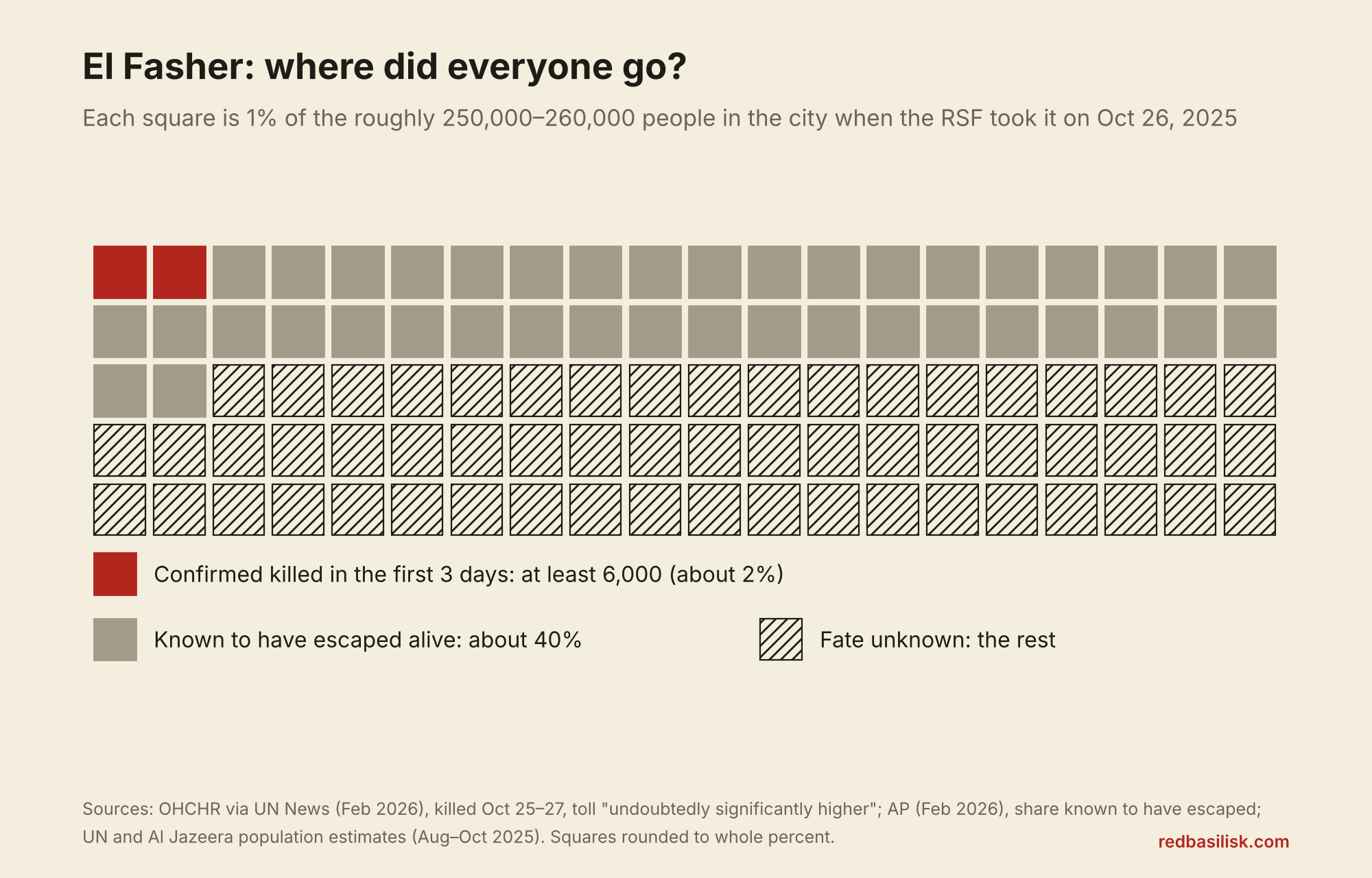
Of the roughly quarter-million people in the city when it fell, only about 40 percent are known to have escaped alive. Nobody can say what happened to most of the rest.
In February 2026, an independent UN fact-finding mission found that at least three of the five genocidal acts had been committed in El Fasher against the Zaghawa and Fur. It said genocidal intent was the only reasonable explanation for the RSF's conduct. Its formal wording was "indications pointing to genocide." That's a fact-finding conclusion, not a court verdict, but it's as close as UN investigators get. Hemedti has acknowledged that "violations" happened in El Fasher and promised an investigation.
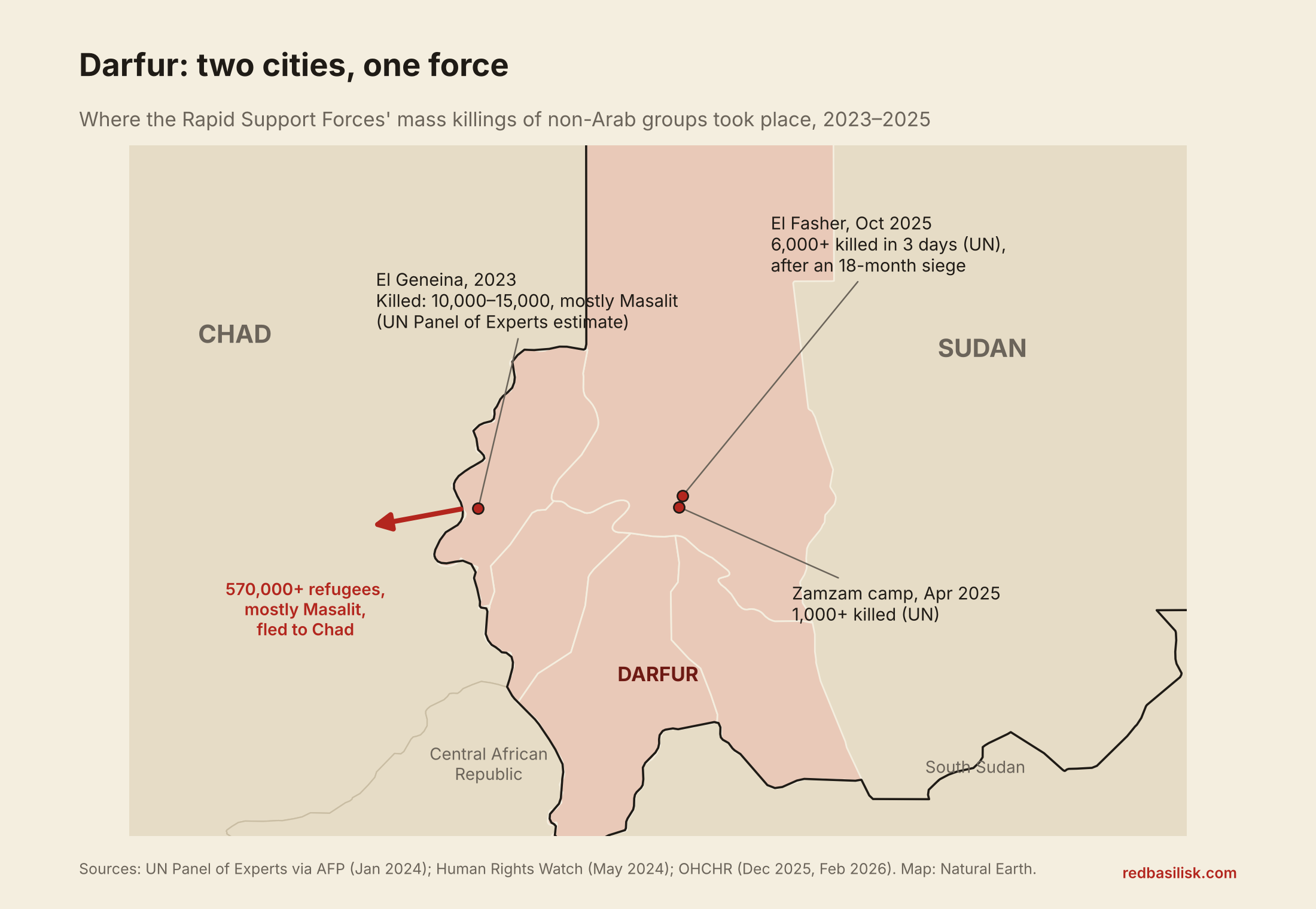
Across the whole war, the UN counts more than 40,000 dead, which aid groups call a small fraction of the truth. Between 13 and 14 million people have been driven from their homes, which the UN calls the largest displacement crisis in the world.
The RSF didn't do this alone. UN experts called reports that the United Arab Emirates armed the RSF "credible," and Amnesty International found the RSF using Chinese-made howitzers whose only known buyer is the UAE. The UAE denies it. Sudan sued the UAE at the International Court of Justice for complicity in genocide. The court dismissed the case in 2025 because the UAE had opted out of the treaty clause that lets countries sue, so it never ruled on the facts.
And it isn't over. In July 2026, the UN Human Rights Council ordered the same mission to open an urgent inquiry into the RSF's siege of El Obeid, a city of more than half a million people in central Sudan.
The older genocides still running
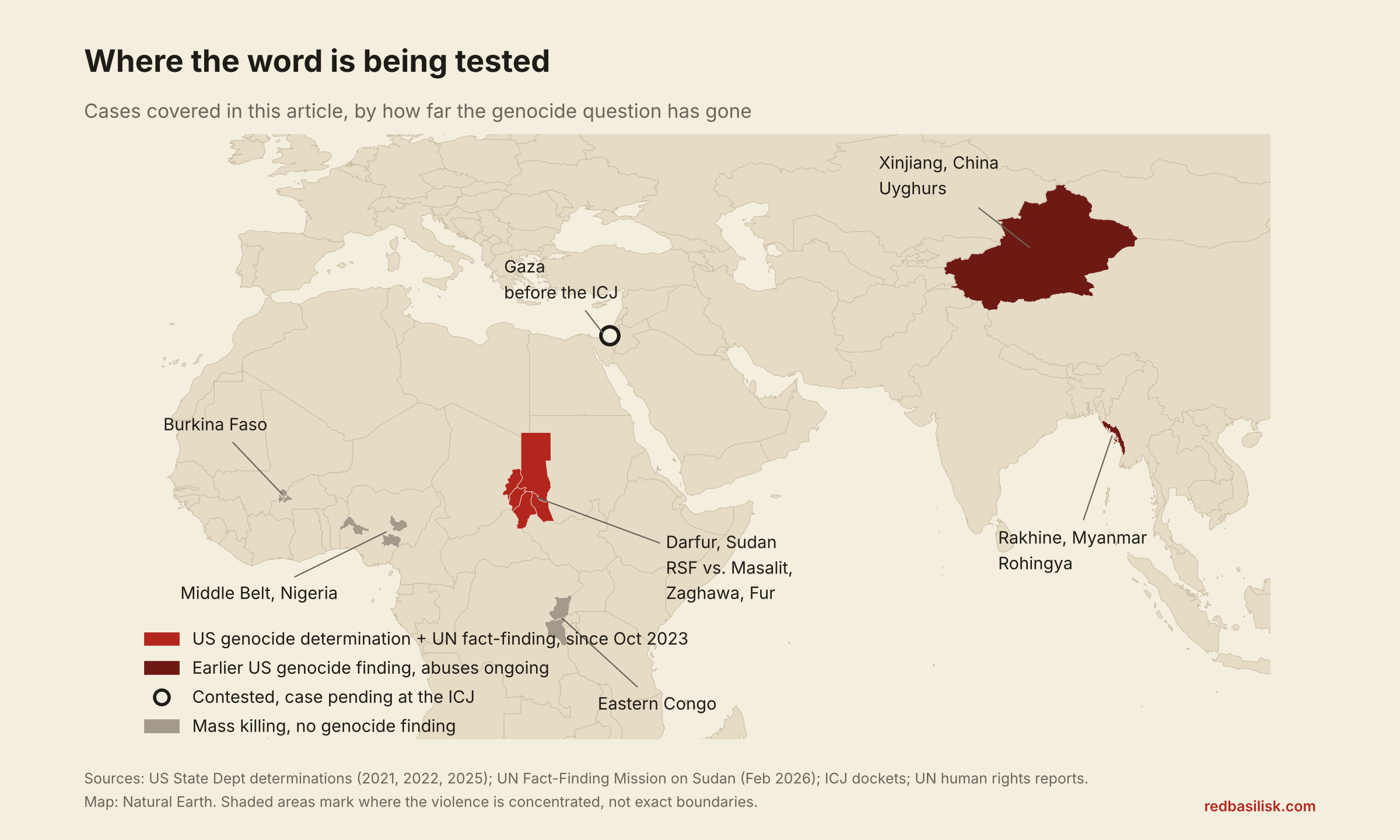
Two other cases have formal US genocide findings behind them. Both began before the Gaza war, and neither has stopped.
The Rohingya of Myanmar
The Rohingya are a Muslim minority in Buddhist-majority Myanmar, denied citizenship for decades and treated by the state as foreign intruders. In August 2017, after a Rohingya armed group attacked police posts, Myanmar's military swept through Rakhine State. It burned villages, killed families and raped women. Doctors Without Borders estimated at least 6,700 Rohingya were killed in the first month alone, including 730 children under five. More than 740,000 fled to Bangladesh. Myanmar's official death count was in the hundreds, and it says the operation was counterterrorism.
A UN fact-finding mission concluded in 2018 that there was enough evidence to infer genocidal intent. The United States formally determined in March 2022 that Myanmar's military committed genocide. The Gambia sued Myanmar at the International Court of Justice. Hearings ended in January 2026, and Gambia's attorney general said in August that he expects a verdict this month.
The persecution didn't end in 2017. Since 2024, the junta has forcibly drafted thousands of Rohingya men and boys to fight for the same army that drove their families out. An ethnic Rakhine rebel force, the Arakan Army, has also been accused of burning the Rohingya town of Buthidaung, displacing about 70,000 people; it denies responsibility. About 1.1 million Rohingya now live in refugee camps in Bangladesh. And the general who ran the military, Min Aung Hlaing, became Myanmar's president in April 2026.
The Uyghurs of China
China's case is different, and it shows why the definition matters. In Xinjiang, the Chinese government has held more than a million Uyghurs and other Turkic Muslims in internment camps since 2017, by US State Department estimates. Human Rights Watch says several hundred thousand remain imprisoned. Beijing says it's fighting terrorism and extremism.
This is not mass killing. The genocide case rests on act four: preventing births. Xinjiang's own government reported that its birth rate fell by about a third between 2017 and 2018, and credited "family planning." Researchers documented forced sterilizations and IUD placements alongside mass detention, forced labor and bans on religious practice.
The United States formally called it genocide in January 2021, and a State Department spokesperson reaffirmed that in September 2026. The UN human rights office found possible crimes against humanity but did not use the word genocide. China's embassy in London called it "the most preposterous lie of the century."
Killing without a genocide finding
Some of the worst violence of the last three years has no genocide finding, and honesty means saying so.
In Nigeria, gunmen killed at least 100 people in the mostly Christian village of Yelwata in June 2025. The US named Nigeria a religious-freedom violator that October and has since carried out airstrikes there against Islamic State fighters. But conflict data from the monitoring group ACLED shows Muslims and Christians have been targeted at similar rates over the past five years, and in February 2026 jihadists killed at least 162 mostly Muslim villagers in Kwara State. Most analysts describe several overlapping conflicts: a jihadist insurgency, banditry, and land wars between herders and farmers. The killing is real. A single campaign to destroy one religious group has not been established.
In eastern Congo, the M23 rebel group, backed by about 4,000 Rwandan troops according to UN experts, seized the city of Goma in early 2025. Congo's government says more than 7,000 people died in two months. An Islamic State-linked group has massacred churchgoers and mourners. A UN fact-finding mission found possible war crimes and crimes against humanity by every side, including Congo's own army, but not genocide.
Burkina Faso is the case to watch. In March 2025, the army and allied militias killed Fulani civilians around the town of Solenzo. Human Rights Watch counted 130 named victims, a local religious leader puts the toll above 300, and militiamen were recorded on video calling for the Fulani's extermination. Human Rights Watch calls it war crimes. The government says it fought terrorists. Of the cases with no genocide finding, it's the closest to the line, and almost nobody outside West Africa has heard of it.
The pattern
Here's what the cases have in common, and it isn't religion or race. The killers in this piece include an Arab Muslim militia killing fellow Muslims of other ethnic groups, a Buddhist military, a one-party state whose ruling Communist Party is officially atheist, and a West African army.
Genocide researchers mapped those circumstances long ago. In a model built for a CIA-funded US government task force, political scientist Barbara Harff identified six factors that correctly sorted about three in four wars and collapses into those that turned genocidal and those that didn't: an earlier genocide, political upheaval, an ideology that excludes a group, autocracy, a ruling elite drawn from one ethnic group, and a closed economy. Line up four of the cases in this piece, and the same signs show up again and again.
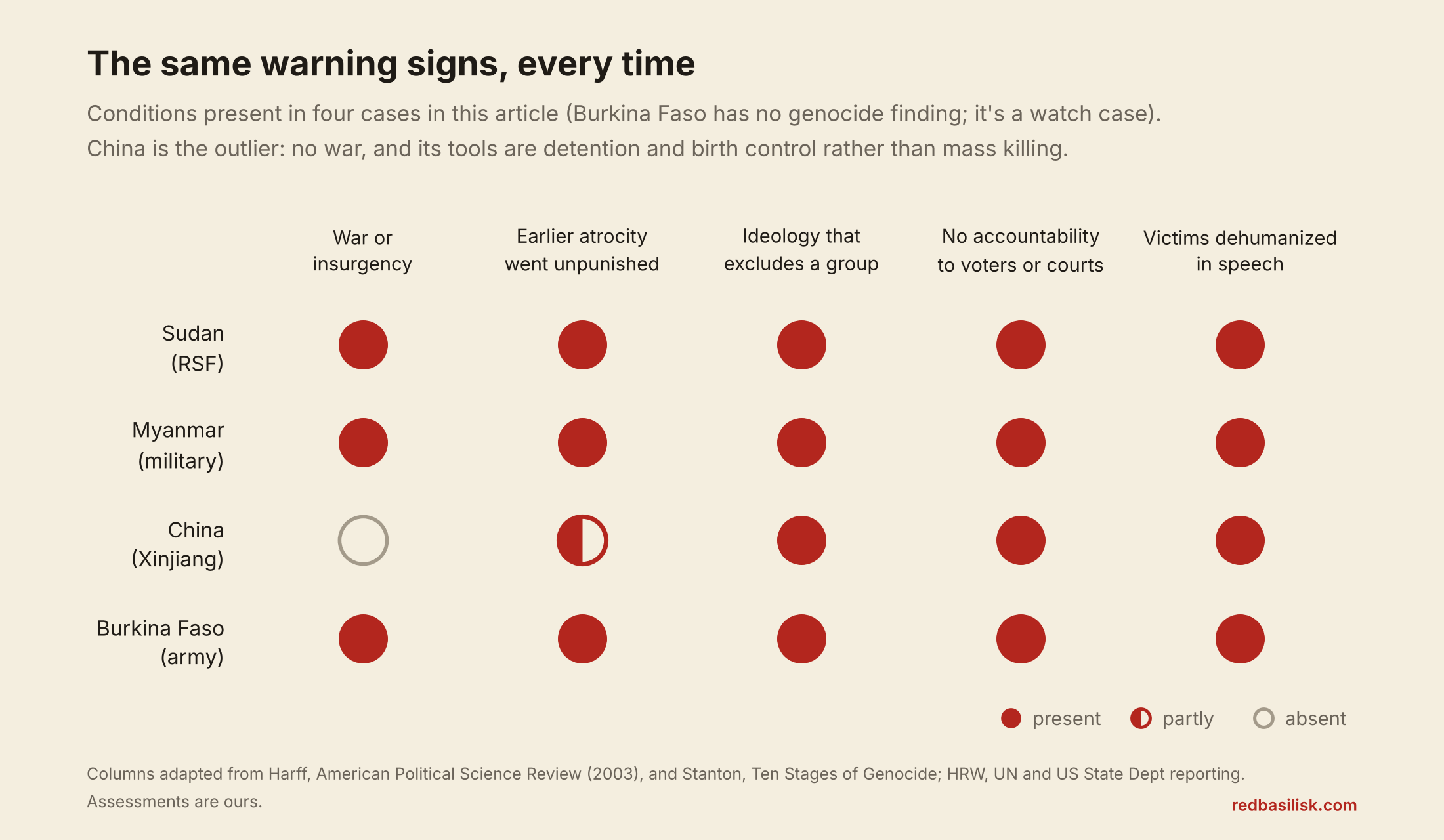
Three lessons stand out.
Impunity breeds repeat offenders. The RSF is the Janjaweed under a new name, led by a man who commanded Janjaweed fighters the first time. When 2003 went unpunished, the same militia network did it again twenty years later, with the same tactics against the same groups.
War is the cover. Almost every case happens inside a war or an insurgency, where killing can be relabeled as fighting. The warning sign is an armed force that treats an entire ethnic group as the enemy's supporters.
They tell you first. In El Geneina and El Fasher, the killers said what they were doing while they did it. The genocide scholar Gregory Stanton describes ten stages that run from classifying a group as separate, through dehumanizing it and organizing armed units, to extermination and finally denial. The speech comes long before the killing.
Nobody's watching
If the warning signs are that clear, why did El Fasher fall with so little outcry? The answer is attention, and it's measurable.
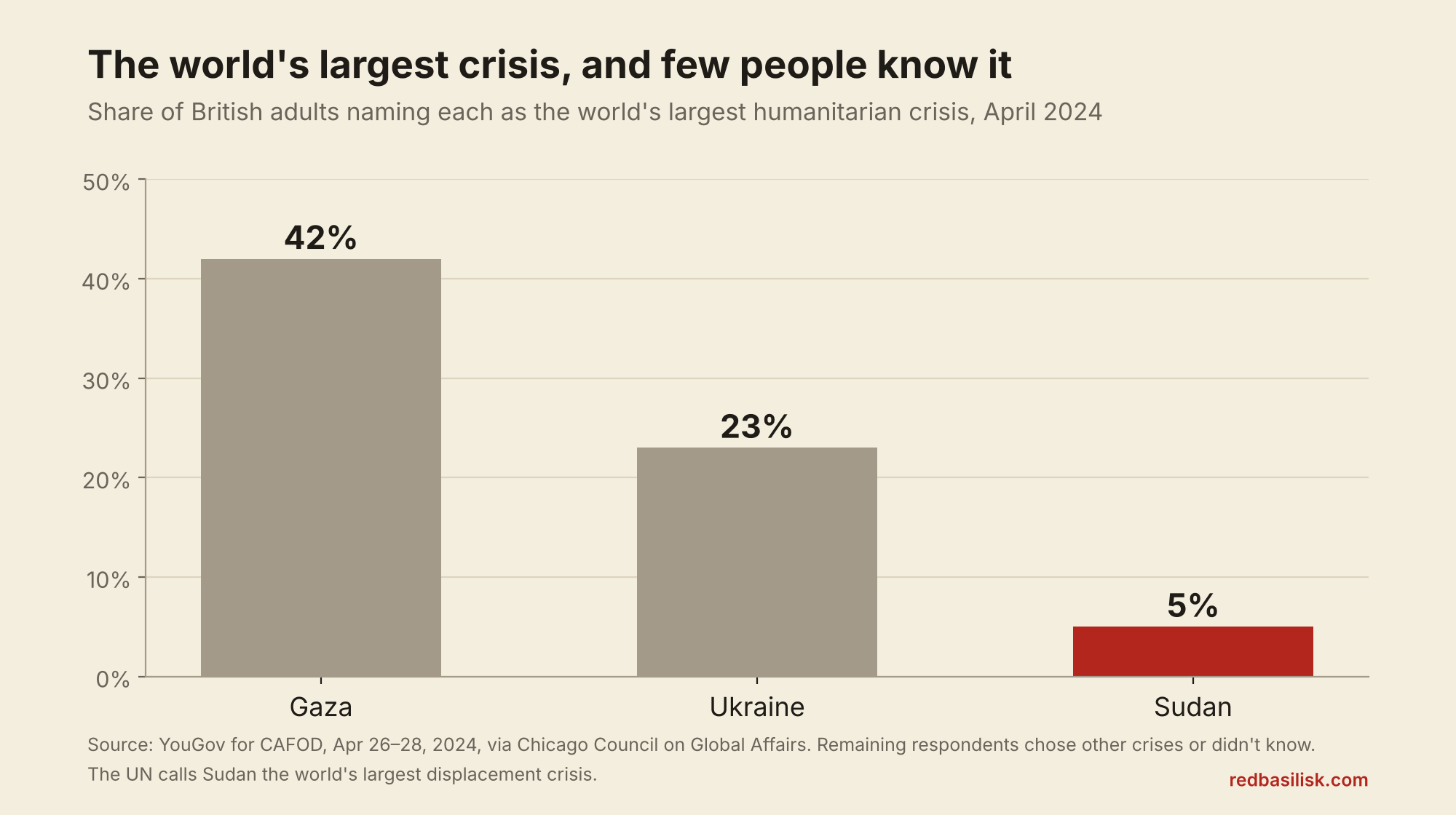
In April 2024, a year into Sudan's war, YouGov asked British adults to name the world's largest humanitarian crisis. Forty-two percent said Gaza and 23 percent said Ukraine. Five percent said Sudan. News coverage tracks the same way: when the aid group CARE counted about five million online news articles on major humanitarian crises in 2025, nearly half were about Gaza.
The money follows the attention.
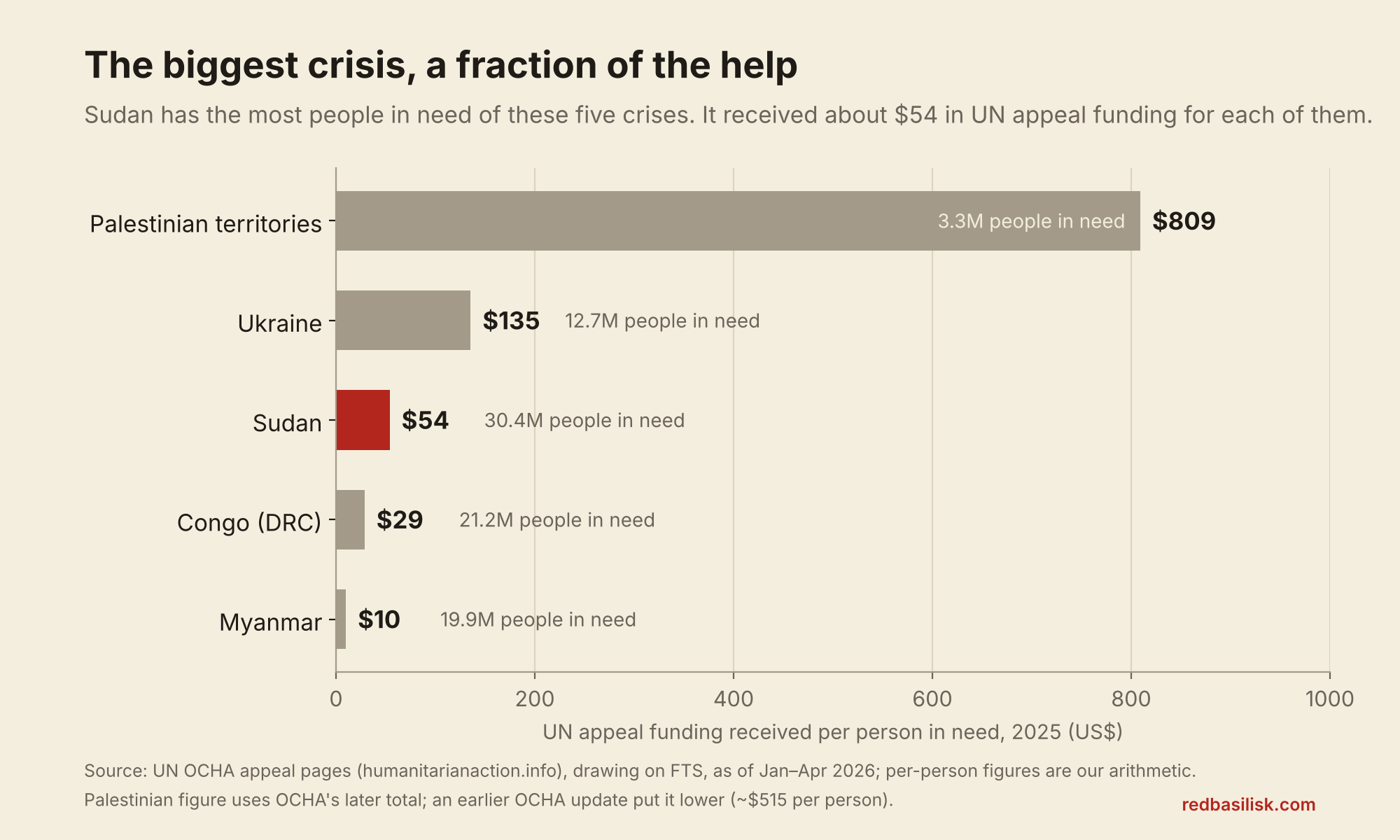
In 2025, the UN's appeal for Sudan received about 54 dollars for each person in need. Ukraine's received about 135. The appeal for the Palestinian territories received roughly 500 to 800, depending on which UN count you use. Congo and Myanmar received even less than Sudan, which says something too: the crises that don't touch our own politics get the least of everything.
The world's attention follows the arguments people are already having at home, not the body count. A genocide that doesn't fit anyone's domestic fight doesn't get a hashtag, and a word that has been spent on everything else has nothing left to sound the alarm with.
Taking the word seriously
If you actually care about genocide, the evidence says where to look: armed groups with a record of getting away with mass killing, operating inside a war, talking about an ethnic or religious group as animals or vermin. The RSF fit that description for years before El Fasher, and the world watched an eighteen-month siege and did little that worked.
The US Holocaust Memorial Museum's Early Warning Project ranks the countries at highest risk of new mass killing. Its 2025–26 list starts with Myanmar, Chad, Sudan, India and Burkina Faso, followed by Pakistan, Afghanistan, Nigeria, Yemen and Guinea. That's where the next one is most likely to come from.
Three things to watch in the coming months. The International Court of Justice may rule on the Rohingya case. The International Criminal Court says it has new evidence linking RSF leaders to the Darfur killings, and no one has been arrested. And the RSF was still besieging El Obeid as of this summer.
Genocide is the one crime that was given its own word so the world couldn't look away. The Masalit, the Zaghawa and the Fur needed that word to mean something. For the most part, it didn't.
My take
I’ll be honest: the research shocked me. I went in annoyed about a word and came out knowing what happened in El Fasher.
What set me off in the first place was the drift. I’ve watched it happen to “intelligence,” to “woman,” to “Nazi,” to “grift,” and now to “genocide.” Every time a word gets stretched to win an argument, it means a little less, and the people who need it most are the first to lose it.
That’s the Tower of Babel problem. Nobody had to tear that tower down. People just stopped understanding each other. When we stop meaning the same things by the same words, we can’t talk each other out of anything, and things fall apart that never had to.
How we dug into this
This piece started with a question: if the word genocide is being thrown around so loosely, what does the real thing look like right now? The research was done with AI tools. Separate research passes pulled from UN fact-finding and inquiry reports, US State Department determinations, International Court of Justice and International Criminal Court records, Human Rights Watch and Amnesty International investigations, OCHA appeal data, and reputable news reporting. A separate AI fact-check pass then checked every figure against its source before publishing.
A few notes on the numbers:
- Death tolls in active wars are estimates, and we give the source for each one. The El Geneina figure is a UN panel estimate based on intelligence sources. The El Fasher figure is a confirmed minimum for three days only.
- The El Fasher chart rounds to whole percent. The city's population when it fell is itself an estimate, between about 250,000 and 260,000.
- The aid-per-person figures are our own arithmetic: UN appeal funding received in 2025, divided by people in need, from OCHA's appeal pages as of early 2026. OCHA's figures for the Palestinian appeal changed over time, so we give a range in the text.
- The "Darfur, 2003–08" row in the death-toll chart is marked partial because the US declared genocide and the ICC charged Bashir with it, but a 2005 UN inquiry found no government genocide policy.
- The warning-signs chart is our own assessment, with columns adapted from Harff's risk factors and Stanton's stages. Burkina Faso is included as a watch case; it has no genocide finding.
- The Darfur timeline is evenly spaced, not drawn to scale.
- The reported "genociding fat people" remark, from author Da'Shaun L. Harrison at Socialism 2026, comes from coverage in outlets critical of the speaker.
Sources
- UN Office on Genocide Prevention, definition of genocide.
- spiked, coverage of Socialism 2026 (Sept 8, 2026).
- Lemkin Institute for Genocide Prevention, Red Flag Alert on US anti-trans agenda (Feb 28, 2025).
- ICTY, Krstić case information sheet (Srebrenica).
- ICRC, Srebrenica: 8,372 lives remembered (2020).
- Joshua Rozenberg, former ICJ president on "plausible" (Apr 2024).
- Lawfare, ICC arrest warrants for Netanyahu and Gallant (Nov 2024).
- SA News, ICJ filing schedule in South Africa v. Israel (June 2026).
- UN, Commission of Inquiry finds genocide in Gaza (Sept 16, 2025).
- JTA, International Association of Genocide Scholars resolution (Sept 2025).
- FIDH, B'Tselem and Physicians for Human Rights Israel findings (July 2025).
- David Bernstein, George Mason University law working paper (May 2026).
- Times of Israel, IDF view of Gaza death toll (Jan 2026).
- UN News, Darfur death toll estimate (Apr 2008).
- Al Jazeera, ICC sentences Ali Kushayb (Dec 2025).
- Human Rights Watch, "The Massalit Will Not Come Home" (May 2024).
- MSF, West Darfur mortality survey.
- JusticeInfo/AFP, UN panel of experts El Geneina estimate (Jan 2024).
- ASIL, US declares genocide in Sudan (Jan 2025).
- Sudan Tribune, House Foreign Affairs Committee resolution (May 2026).
- ASIL, UN documents atrocities at Zamzam camp (Dec 2025).
- UN News, El Fasher death toll (Feb 2026).
- AP via CP24, El Fasher bears hallmarks of genocide (Feb 19, 2026).
- UN News via AllAfrica, fact-finding mission report on El Fasher (Feb 2026).
- Sudan Tribune, UN mission on El Fasher (Feb 2026).
- Dabanga, Yale lab confirms mass killings and cover-up (Dec 2025).
- Africanews, Hemedti acknowledges violations (Oct 2025).
- Amnesty International, Chinese weaponry supplied via the UAE (May 2025).
- Oxford Human Rights Hub, Sudan v. UAE at the ICJ (May 2025).
- Sudan Tribune, UN mission follow-up and El Obeid inquiry (July 2026).
- Dhaka Tribune, Gambia expects ICJ verdict in October (Aug 2026).
- CNN, MSF estimate of Rohingya deaths (Dec 2017).
- UNHCR, Rohingya emergency.
- Malay Mail, US declares Myanmar army committed genocide (Mar 21, 2022).
- ICJ, The Gambia v. Myanmar case page.
- Human Rights Watch, armies target Rohingya (Aug 2024).
- QDND, Min Aung Hlaing elected president (Apr 2026).
- Human Rights Watch, World Report 2026: China.
- Catholic News Agency, Xinjiang birth-rate drop (Sept 2020).
- Daily Signal, State Department spokesperson on Uyghur genocide (Sept 2026).
- GlobalSecurity/Press TV, Chinese embassy in London on genocide charge (Apr 23, 2021).
- Al Jazeera, Yelwata attack (June 2025).
- Africanews, ACLED data on Nigeria (Nov 2025).
- AP via News4Jax, Kwara State massacre (Feb 2026).
- JURIST, UN report on eastern Congo (Sept 2025).
- EWN, eastern Congo death toll (Feb 2025).
- Human Rights Watch, Burkina Faso ethnic massacres (May 2025).
- Barbara Harff, American Political Science Review (2003).
- Genocide Watch, Ten Stages of Genocide.
- Chicago Council on Global Affairs, YouGov/CAFOD poll on Sudan (2024).
- CARE, the 10 most under-reported humanitarian crises of 2025 (Jan 2026).
- OCHA, Sudan 2025 appeal.
- OCHA, Palestinian territories 2025 Flash Appeal financials.
- OCHA, Ukraine 2025 appeal.
- OCHA, Myanmar 2025 appeal.
- OCHA, Democratic Republic of the Congo.
- OCHA, Gaza humanitarian situation update #353 (Jan 2026).
- US Holocaust Memorial Museum, Early Warning Project 2025–26 risk assessment (Dec 2025).