




Read
The Truth About Data Centers
Where they are, what they burn, and which of the scary numbers are real

"Data centers now use nearly 5% of America's electricity and could hit 12% by 2030. Here's where they are, why they're there, how much power and water they really use, and which viral claims hold up."
Everyone has an opinion about data centers now. Your cousin shares a video saying every ChatGPT question drinks a bottle of water. A senator says they're why your power bill jumped. A tech CEO says they're the foundation of the next industrial revolution. The county commission down the road is arguing about one right now.
Most of what gets said is half right. That's the problem with half-right things: you can't tell which half.
So we went looking. Where are these buildings, how big are they, why are they where they are, and how much power and water do they actually use? Then we took the popular claims one at a time and checked them.
The short version: the national numbers are smaller than the memes, and the local numbers can be bigger than anyone expected. True locally, false nationally comes up again and again. Keep it in mind.
Where they are
The US has somewhere north of 3,000 operating data centers, with another 1,500+ in development, according to a Pew Research count published this April. Virginia leads by a mile, followed by Texas, California, Illinois and Georgia.
Counting buildings only gets you so far, because a data center can be a closet of servers or a campus the size of a small town. The better measure is power. By that measure, the capital of the data center world is still Northern Virginia, mostly Loudoun County, just outside Washington, D.C.
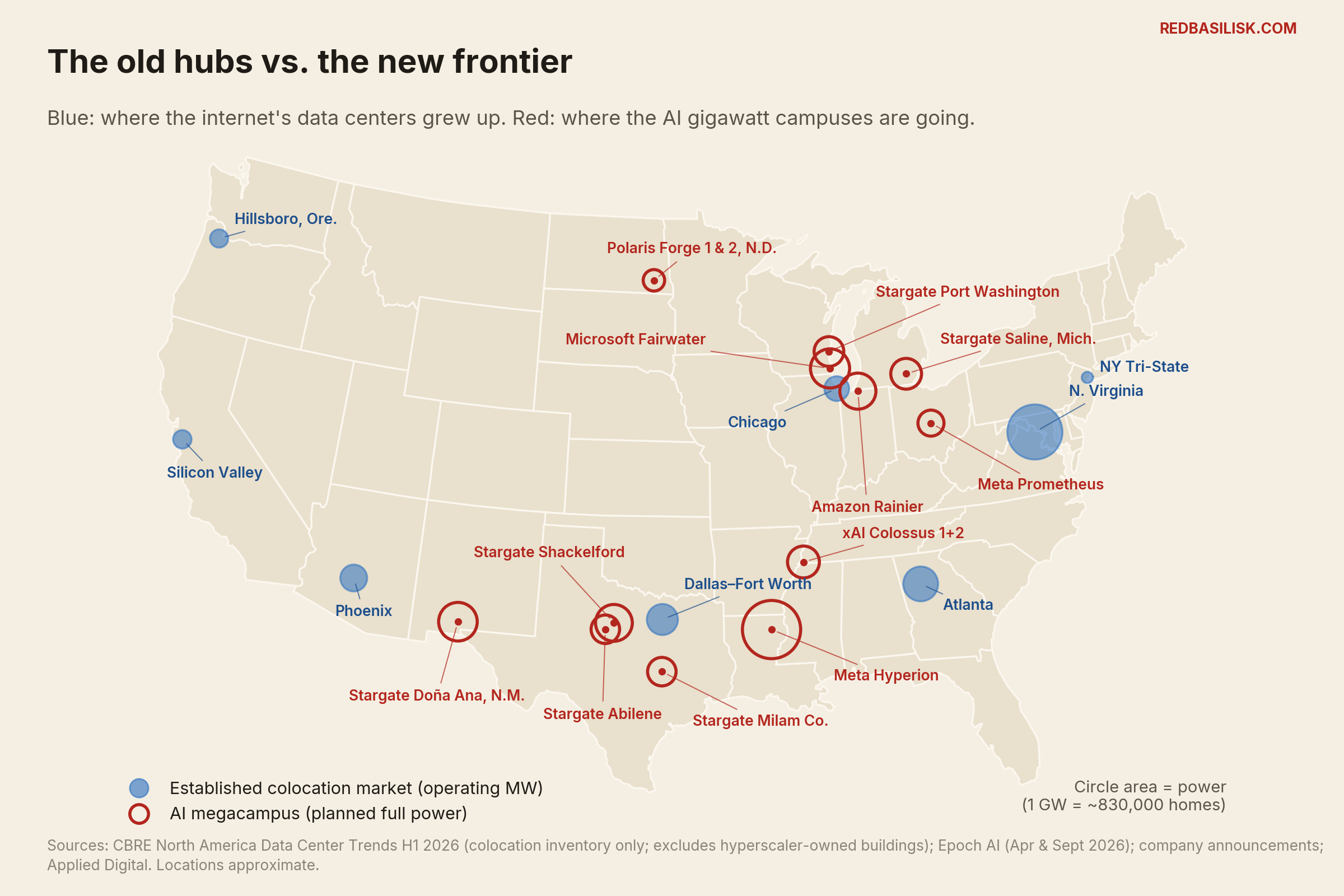
Loudoun alone has 233 data center buildings, with another 35 million square feet approved but not built. Data centers now pay about $1.2 billion a year in local taxes there, roughly 39% of the county's budget. Vacancy in the Northern Virginia market is about 0.2%. Essentially every rack that exists is spoken for.
Why Virginia? History. In 1992 one of the first commercial internet exchange points, MAE-East, opened in the D.C. suburbs, famously in a parking garage. AOL moved its headquarters to Ashburn in 1996, and UUNET followed. The networks met there, so the servers followed the networks, and fiber followed the servers. From 2000 on, Loudoun let data centers be built by right, the same as office buildings. Thirty years of that compounding makes a hub.
But the map is changing fast. The real estate firm JLL counts 66 gigawatts of data center capacity under construction in North America as of mid-2026. 77% of it is in what the industry calls "frontier" markets like West Texas, Ohio, Louisiana and the Carolinas, places that barely registered on a data center map ten years ago. Pew found that two-thirds of planned data centers are in rural areas, while nearly 90% of existing ones are in cities.
That's the red circles on the map: the AI megacampuses. None of them look like the old hubs.
In some states, data centers are already a big slice of the whole grid:
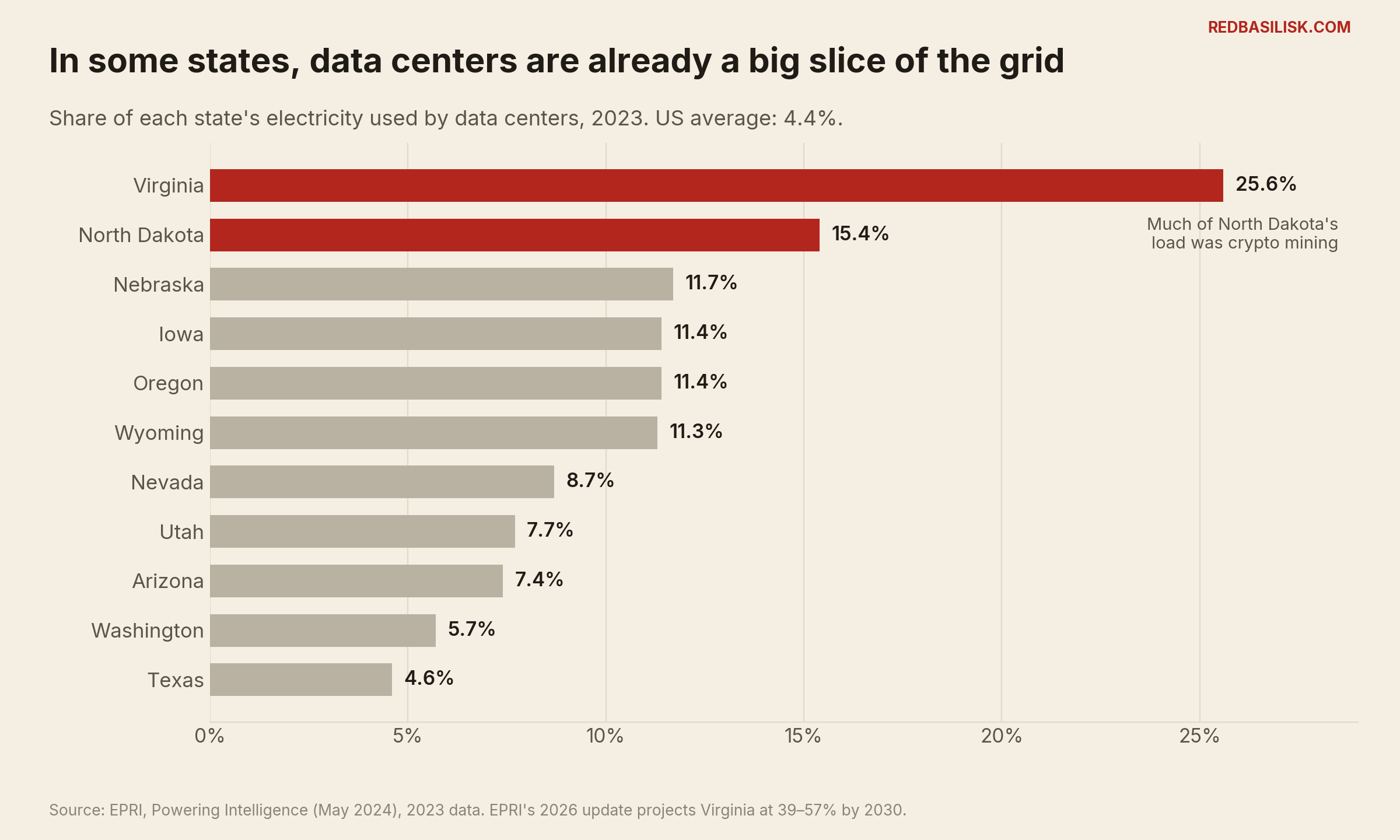
Virginia's data centers used about a quarter of the state's electricity in 2023. EPRI, the utility industry's research arm, projects 39–57% by 2030. It also expects seven more states to pass 20% by then.
Yes, that's North Dakota in second place. We'll come back to it.
How big they are
There's no official size standard, but in practice there are three tiers:
- Enterprise and colocation: a server room or a rented building, from under 1 megawatt up to about 10.
- Hyperscale: the cloud giants' campuses, tens to hundreds of megawatts.
- AI "gigawatt" campuses: the new thing, 1 to 5 gigawatts.
To make those numbers mean something: the average American home uses about 10,800 kWh a year, which works out to about 1.2 kilowatts of steady draw. So 1 megawatt is roughly 830 homes, and 1 gigawatt is roughly 830,000 homes. (That compares a facility running full tilt with an average home, so treat it as the high end.)
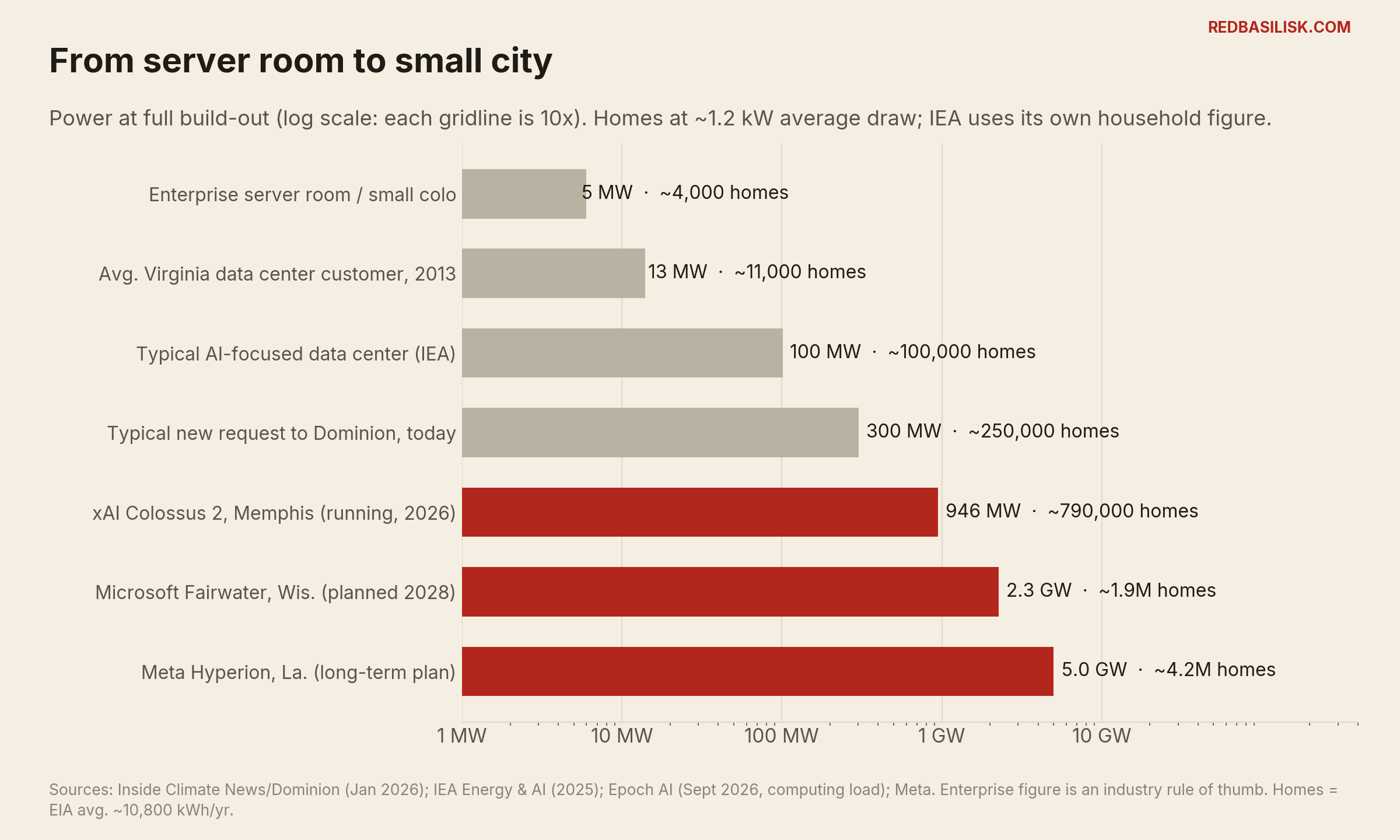
The growth is the story. In 2013, Dominion Energy's average data center customer in Virginia drew 13 MW. Today a typical new request is about 300 MW, and the largest single request Dominion has received is 7,000 MW, more than many states use.
A few of the giants, as of this fall:
- xAI's Colossus 2 (Memphis area): Epoch AI estimates about 950 MW of computing load, the largest AI data center it tracks.
- Amazon's Project Rainier (New Carlisle, Ind.): an $11 billion first phase, running since late 2025 on nearly half a million of Amazon's own AI chips.
- Microsoft Fairwater (Mount Pleasant, Wis.): the first building was finished this spring; Epoch estimates the site reaches 2.3 GW by 2028.
- OpenAI/Oracle Stargate: seven US sites totaling about 9 GW planned. So far only the Abilene, Texas site is running, at roughly 420 MW by Epoch's latest estimate.
- Meta Hyperion (Richland Parish, La.): about 3,650 acres, with a long-term target of 5 GW. Entergy has three new gas plants approved to power it and has proposed seven more.
Inside the buildings, things are getting denser just as fast. The average server rack in 2024 drew about 8 kW. One of Nvidia's current GB200 racks draws about 120–130 kW. The Rubin Ultra rack planned for 2027 is rated at 600 kW. That's one rack, in a space about the size of a refrigerator, drawing what 500 homes do.
Why they go where they go
Old-school data centers chased customers and fiber: you wanted to be close to the internet exchange and close to users, so pages loaded fast. That's still true for the servers that answer your questions (called "inference").
Training a big AI model is different. It can run for months and doesn't care if it's 100 milliseconds from New York. So for training campuses the checklist has been reordered, and power moved to the top:
- Power, now. In the old hubs, the wait for a large grid connection is running five to seven years. In second- and third-tier markets, power can arrive one to two years sooner. That gap, more than anything, is why the red circles are in Abilene and Richland Parish instead of Ashburn.
- Build your own power. More and more campuses skip the queue by generating their own electricity, mostly from natural gas turbines on site. The International Energy Agency expects 15–27 GW of on-site gas serving data centers by 2030, mostly in the US.
- Land. Gigawatt campuses need hundreds or thousands of flat acres near transmission lines.
- Tax breaks. Most states exempt data center equipment from sales tax. Virginia's exemption cost the state $928.6 million in fiscal 2023 and nearly $1.94 billion in fiscal 2025. Virginia's legislative auditors found the state gets back about 48 cents in tax revenue per dollar exempted, but it also generates about $6 of income for workers per dollar.
- Cold air and water. Cold places can cool with outside air for much of the year. Hot, dry places often cool by evaporating water. More on that below.
- Speed of permits and friendly locals. This one is shrinking. One tracker counted $68 billion of projects blocked or delayed by local opposition in the second quarter of 2026 alone.
How much power they actually use
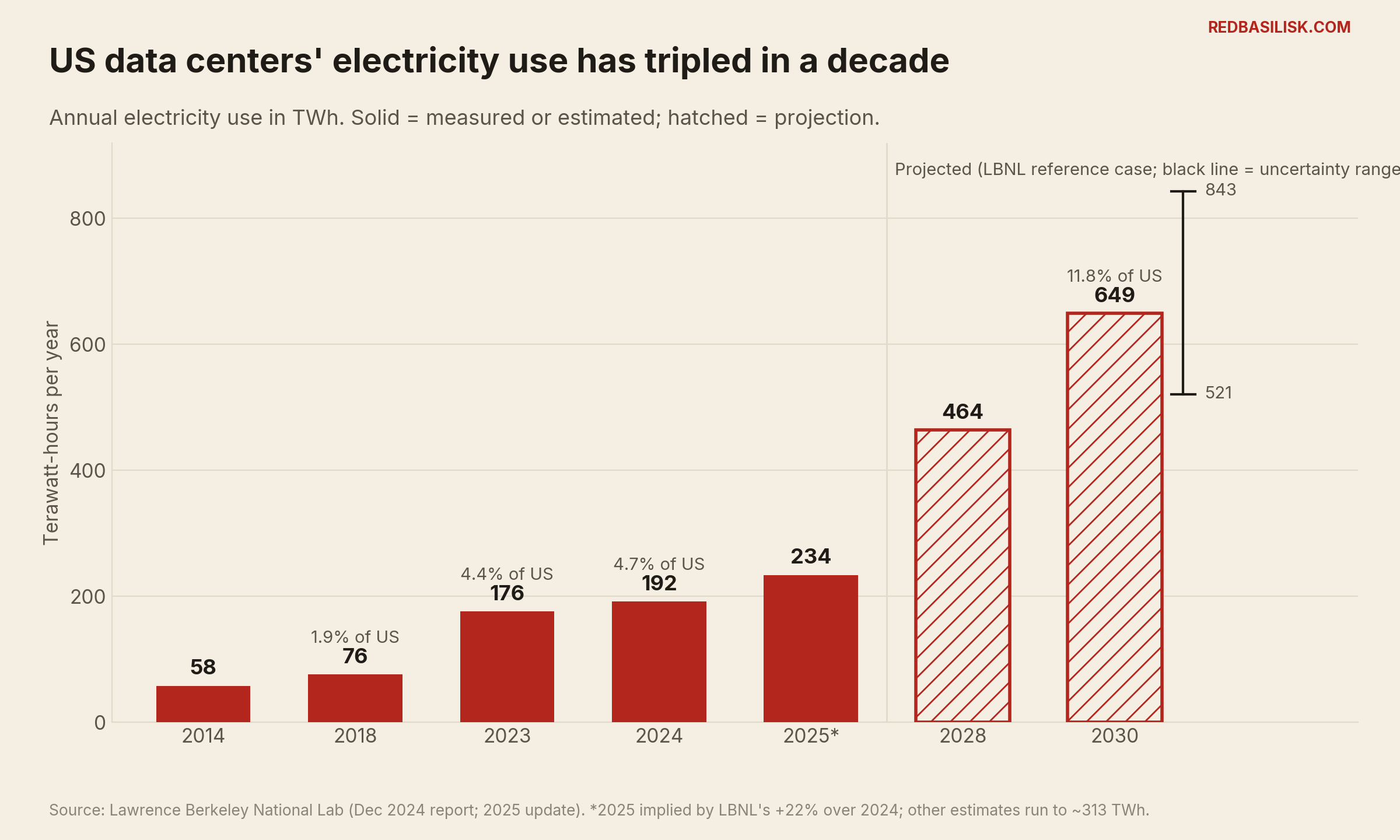
Lawrence Berkeley National Lab, which does the Department of Energy's official counting, found US data centers used 176 terawatt-hours in 2023, about 4.4% of all US electricity. That's up from 58 TWh in 2014. Its latest update puts 2024 at 192 TWh (4.7%) and implies about 234 TWh for 2025.
Where it's headed depends on who you ask:
- LBNL's reference case reaches 649 TWh by 2030, or 11.8% of US electricity, with an uncertainty range of 9.5% to 15.3%.
- EPRI projects 9% to 17% by 2030.
- The IEA expects US data centers to use more electricity by 2030 than all US energy-intensive manufacturing combined: aluminum, steel, cement, chemicals, everything.
Estimates for 2025 alone run from about 234 TWh (Berkeley Lab) to 313 TWh (the Energy Institute). Nobody measures this cleanly, because many operators don't report their use, so every number here is an estimate. The direction isn't in dispute.
For perspective: 4–5% of US electricity is a lot, but it's not most. Data centers are, however, a huge share of the growth: Berkeley Lab expects them to be nearly a third of new US demand through 2030, and the IEA puts it closer to half. After roughly twenty years of flat demand, utilities are building again, and data centers are the main reason.
How much water they actually use
This is where the memes and the facts drift furthest apart.
Data centers use water mostly for cooling. The common method is an evaporative cooling tower: warm water gets cooled by evaporating some of it into the air, like sweat. About 80% of the water withdrawn this way evaporates and is gone. There's also indirect water: the water power plants use to generate the data center's electricity. That's usually the bigger share.
LBNL's numbers for 2023:
- Direct (on-site cooling): about 17.4 billion gallons.
- Indirect (at power plants): roughly 200+ billion gallons, about 12 times the direct figure.
That sounds enormous until you line it up with everything else:
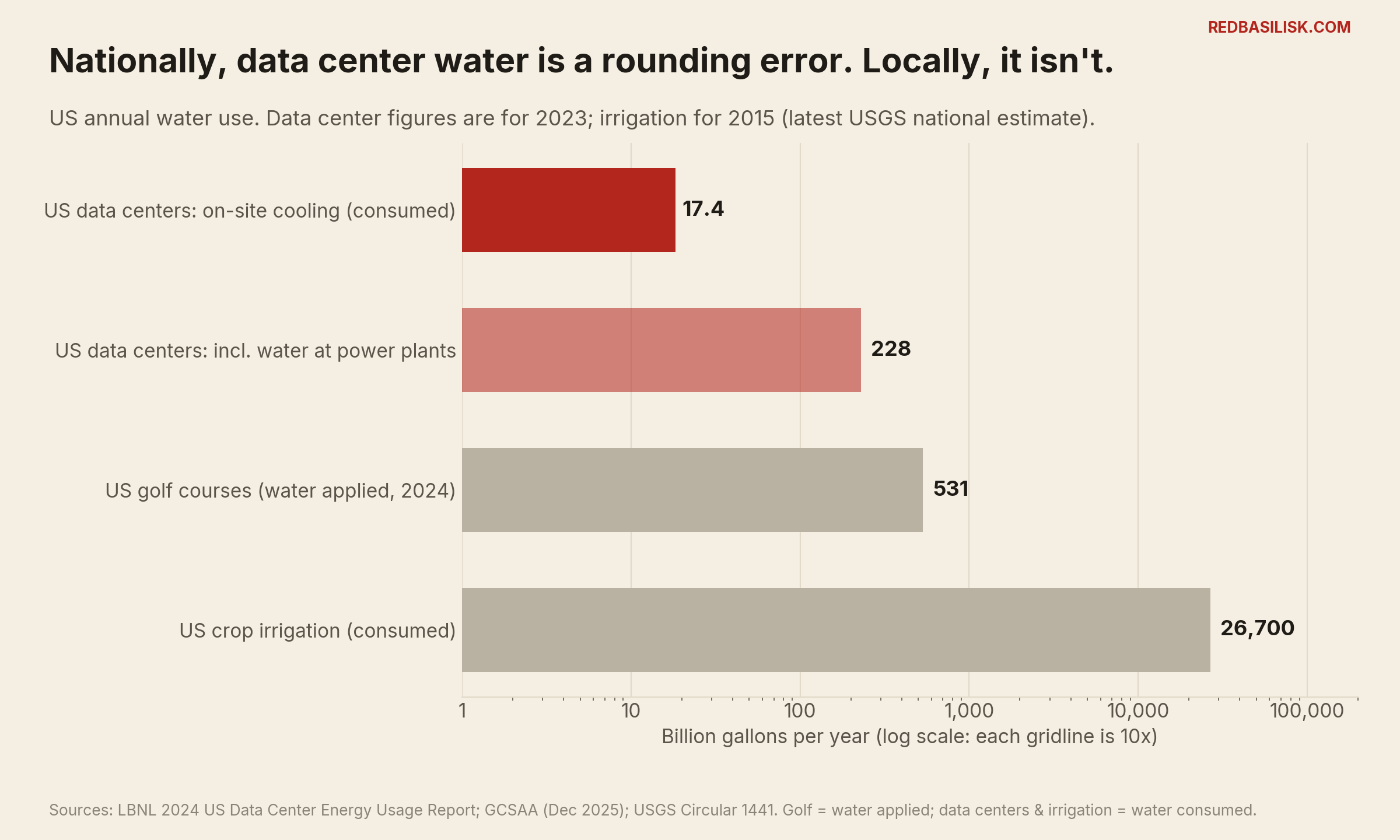
US golf courses applied about 531 billion gallons in 2024. Crop irrigation consumes roughly 27 trillion gallons a year. The on-site cooling water for every data center in America is about what 580,000 people use at home. Nationally, it's a rounding error.
Locally, it isn't. Water isn't a national pool. It's a well, an aquifer, a town's treatment plant. And a single large facility can use millions of gallons a day.
- The Dalles, Oregon: Google's data centers used 29% of the city's water in 2021, and about a third by 2024. The city went to court to keep that number secret before settling in 2022.
- Newton County, Georgia: Meta's campus uses about 500,000 gallons a day, roughly 10% of the county's water. Other developers have asked for up to 6 million gallons a day, and the county projects a water deficit by 2030. (More on the famous well story below.)
- Texas: a Houston research group estimates data centers used 25 billion gallons in 2025 and could use up to 161 billion by 2030. The state water plan doesn't account for them.
- Bloomberg found that about two-thirds of US data centers built or planned since 2022 are in high water-stress areas.
So both "data centers use a trivial amount of water" and "data centers are draining the country" are wrong. Where the water comes from matters more than how much.
What's being done about it
Some of this is real engineering, some is pledges, and some is new rules forcing data centers to pay their own way.
On water:
- Closed-loop and "zero-water" cooling. Since August 2024, Microsoft designs all new data centers so no cooling water evaporates. It says that saves about 33 million gallons per site per year, at the cost of slightly more electricity. Meta is moving new AI buildings to closed-loop liquid cooling. Applied Digital's North Dakota campuses advertise waterless cooling.
- Liquid cooling at the chip. A peer-reviewed study in Nature co-authored by Microsoft found that direct-to-chip and immersion cooling cut water use 31–52% over the whole life cycle compared with air cooling.
- Recycled water. Amazon uses treated wastewater at 24 data centers and plans more than 120 US sites by 2030. Microsoft's San Antonio site runs about 79% on recycled water.
- Efficiency is improving. Microsoft's water use per unit of electricity has fallen from 2.3 liters per kWh in the early 2000s to about 0.27 today. Amazon reports 0.12.
On power:
- Nuclear. Microsoft is paying to restart Three Mile Island Unit 1, renamed Crane (835 MW). Amazon signed for 1.9 GW from Pennsylvania's Susquehanna plant. Meta signed for Illinois's Clinton plant plus up to 6.6 GW more from Vistra, Oklo and TerraPower. Google is backing a restart of Iowa's Duane Arnold plant and small reactors from Kairos. Most of the new nuclear is scheduled for 2030 or later.
- Geothermal. Google signed a 396 MW deal with Fervo Energy in Utah this month.
- Gas, lots of it. The honest near-term answer is natural gas. Meta's Louisiana campus, xAI's Memphis sites, and several Stargate sites run on or are planning new gas plants.
- Flexibility. A Duke University study found the existing grid could absorb about 76 GW of new load if those loads agreed to cut back 0.25% of the time, about 85 hours a year. Google has started signing deals with utilities to throttle its data centers during peak demand.
- Making them pay. This may matter most for your bill. Ohio's AEP now requires big data centers to pay for at least 85% of the power they reserve for up to 12 years, whether they use it or not. Before the rule, AEP had requests for more than 30 GW. Once developers had to put money down, only about 13 GW paid for studies. That's how much of the "demand" was speculative. Virginia's Dominion will require 14-year contracts and collateral starting in 2027. Texas passed a law letting the grid operator disconnect big data centers in an emergency. A Brattle and Berkeley Lab review examined 55 of these large-load tariffs across the country.
The memes, checked
Here are the claims you're most likely to hear, with where each came from and what the evidence says.
"Every ChatGPT prompt drinks a bottle of water."
Mostly false.
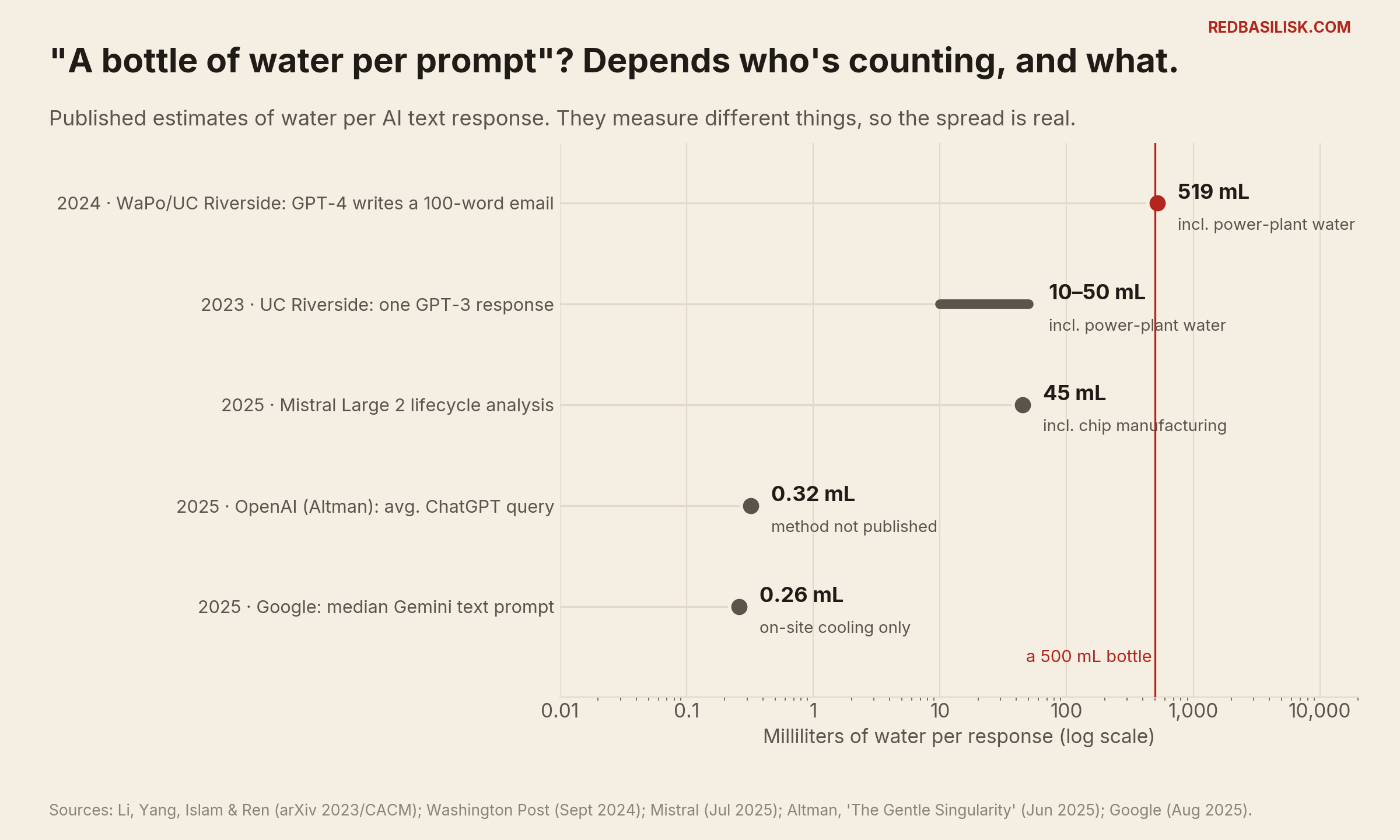
It started with a 2023 UC Riverside paper estimating that GPT-3 "drinks" a 500 mL bottle for every 10–50 responses, counting power-plant water, which is most of it. In 2024, the Washington Post worked with the same researcher on a scenario where GPT-4 writing one 100-word email used 519 mL. The internet dropped the context and kept the bottle.
Newer company figures are hundreds of times lower. Google says a median Gemini prompt uses 0.26 mL, about five drops. OpenAI's Sam Altman gave 0.32 mL for an average ChatGPT query. But be careful with both: Google's number counts only on-site cooling, and Altman didn't publish his method. Mistral's full life-cycle study, which includes manufacturing the chips, came in at 45 mL. The honest range for one ordinary text prompt is a fraction of a milliliter to a few tablespoons. It's not a bottle.
"One AI query uses 10x the energy of a Google search."
Outdated. It comes from a 2023 estimate of about 3 Wh per ChatGPT query, compared against a Google search figure from 2009. Current estimates for a typical text prompt are about 0.24–0.34 Wh, roughly the same as that old search number. Long documents, "reasoning" models and AI video still cost many times more.
"AI uses more electricity than entire countries."
Technically true, misleading framing. All the world's data centers used about 415 TWh in 2024, about 1.5% of global electricity, and are headed toward ~945 TWh by 2030. That's more than many countries, but most countries are small, so plenty of industries beat them. Posts also usually lump all data centers under "AI." The real point is concentration, not total size.
"Data centers are why your electric bill went up."
True in some regions, mostly false nationally so far.
Nationally, a Berkeley Lab/Brattle study found inflation-adjusted electricity prices were roughly flat from 2019 to 2024. The biggest drivers were wildfire costs, poles and wires, and natural gas prices. States with more load growth actually saw prices fall slightly, because fixed costs were spread over more customers.
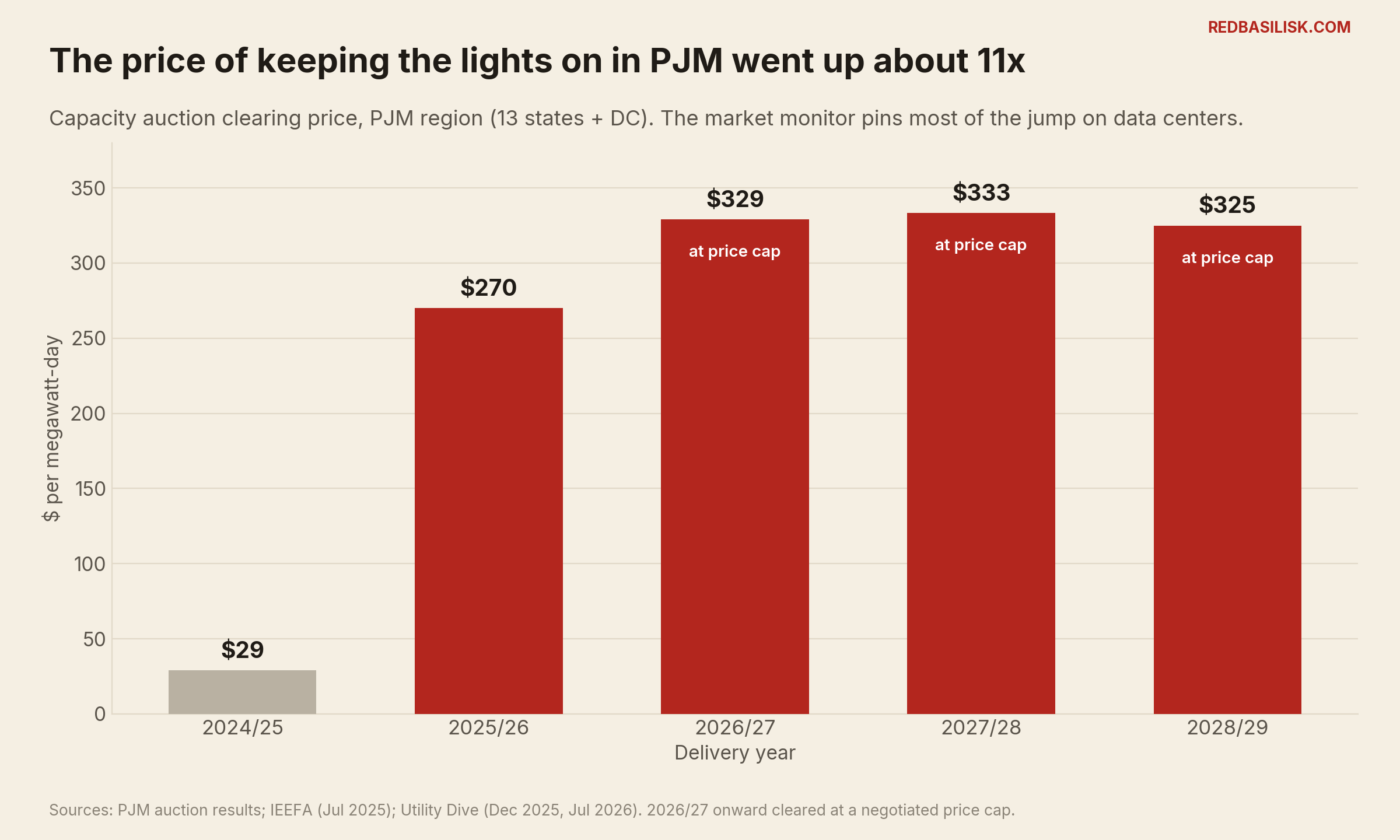
PJM is where that changes. It's the grid covering 13 states from Illinois to Virginia, plus D.C. Its capacity auction, which pays power plants to be available, jumped from $29 to $270 per megawatt-day in one year, then hit the price cap. PJM's independent market monitor attributed $9.3 billion, or 63%, of that first increase to data centers. For the 2027/28 year it put 40% of all capacity costs on data centers, most of them not yet built. Capacity is only part of a bill, but PJM said the results alone add 1.5–5% to some bills. A 2025 Carnegie Mellon study projected that data centers and crypto mining could push generation costs up 8% nationally and 25%+ in parts of Virginia by 2030.
Watch for the viral "bills up 267% near data centers." That's wholesale prices at specific grid points, not household bills. PolitiFact rated the residential version Mostly False.
"Data centers are drinking towns dry."
True locally, false nationally. See the water section. The famous New York Times story was about a Georgia couple whose well went bad near Meta's campus. It's real hardship, but Meta's study found no link, and no one tested the well before construction began. Families sued this month. The honest verdict is unproven.
"Data centers create tons of jobs" vs. "Data centers create no jobs."
The skeptics are closer. Virginia's auditors found a typical large data center employs about 50 full-time people, with around 1,500 at peak construction. A 1.1 million sq ft campus near Reno projected 73 permanent jobs over a decade, against 4,000+ construction jobs. The real local payoff is property tax. Loudoun's budget runs on it.
"Generating an AI image uses as much energy as charging your phone."
Mostly false. From a 2023 study. The least efficient model it tested used about half a phone charge per image; the average was about 13%. Newer models tested in 2025 used about 0.6 Wh per image. AI video, on the other hand, can use hundreds of times more.
"It's a bubble. They'll be empty."
Empty: false, for now. Bubble: an open question. Vacancy in the major North American markets hit a record low of 1.4% this summer, and 80% of what's under construction is already leased. The real bottleneck is getting power hooked up: an estimated 30–50% of projects planned for 2026 are delayed, mostly for power and transformers, not lack of tenants. Whether the money holds up is a different question, and a fair one.
"Data centers get huge tax breaks and pay nothing."
Half true. The breaks are real and growing: Virginia is near $2 billion a year, and the Texas comptroller's office calls its own $3.2B two-year estimate "almost certainly an underestimate." But "pay nothing" is wrong. Property taxes from data centers fund over a third of Loudoun County's budget.
"Data centers are killing a Memphis neighborhood with gas turbines."
Mostly true on the facts; health impact contested. An environmental law group's aerial imaging showed about 35 gas turbines at xAI's first Memphis site in 2025, far more than had permits. The county later permitted 15. Mississippi regulators have since permitted 41 more turbines at xAI's site across the state line in Southaven, and the NAACP has sued under the Clean Air Act. Air-quality harm claims come mostly from advocacy research, not regulators, so far.
"Saying please and thank you costs OpenAI tens of millions."
A joke. Sam Altman said it in a reply on X. Nobody calculated it.
The North Dakota angle
North Dakota's 15.4% in 2023 surprises people. A big part of it was crypto mining: Applied Digital alone runs nearly 300 MW of crypto hosting in the state. Crypto came for the same reasons the AI builders are coming now: cheap power, open land and cold air.
It isn't only crypto anymore:
- Applied Digital has leased roughly 900 MW of AI capacity across its three "Polaris Forge" campuses. 175 MW is already live at Ellendale, and a 280 MW campus is going up at Harwood near Fargo. Both advertise waterless cooling and lean on the climate.
- In Mercer County, Basin Electric and NextEra have proposed a 1,450 MW gas plant to anchor a multi-gigawatt data center campus. The county responded in March with a one-year moratorium on data centers while it writes rules.
That's the whole national story in one state: the energy is here, the land is here, the builders are coming, and the locals want terms before they say yes.
My take
The loudest claims on both sides are wrong in the same way: they use national averages to argue about local problems, or local horror stories to argue about national ones. Nationally, data centers are a real but manageable share of power and a tiny share of water. Locally, one campus can double a town's water draw or reshape a utility's whole plan.
The thing that decides whether a data center is a good neighbor isn't the technology. It's the terms: who pays for the new power lines, where the water comes from, and whether the locals got a real say before the ground was broken. The states writing those rules now, like Ohio, Virginia and Texas, are doing the right thing. The places that hand out tax breaks and ask questions later are going to have fights.
And the real bottleneck isn't chips, water or even money. It's power, and how fast we can build it. That's the question for the next piece.
How we dug into this
We ran four research passes with AI tools: locations and scale, power and water, the viral claims, and the international picture for our next piece. We then checked the key figures against primary sources: LBNL, EPRI, the IEA, PJM and its market monitor, company environmental reports, and state audits.
What changed our minds, or the AI's:
- Measuring capacity is a mess. "How much capacity does the US have?" gets answers from 11 GW to 50 GW depending on whether you count only rented space, include the tech giants' own buildings, or include all of the Americas. We labeled every number with what it measures.
- Estimates for 2025 power use ranged from 234 to 313 TWh. We used the government lab's number and flagged the spread.
- Per-prompt water numbers differ by 1,000x mostly because they measure different things: on-site cooling only, including power plants, or including chip manufacturing. The meme picked the biggest one.
- We dropped a widely repeated claim that "70% of the world's internet traffic flows through Loudoun County." We couldn't find a primary source for it.
Sources
- [Pew Research: Most new data centers in the US are coming to rural areas (Apr 2026)](
- [CBRE: North America Data Center Trends H1 2026 (Aug 2026)](
- [JLL: Data center demand exceeds expectations in H1 2026 (Aug 2026)](
- [Loudoun County: Data Centers, The Loudoun Story](
- [Inside Climate News: Virginia regulators approve new Dominion rates (Jan 2026)](
- [Epoch AI: Largest AI data centers by power capacity (Sept 2026)](
- [Epoch AI: OpenAI Stargate, where the US sites stand (Apr 2026)](
- [Fortune: Meta Hyperion and Entergy gas plants (Mar 2026)](
- [Microsoft: First Mount Pleasant datacenter completed (Jun 2026)](
- [DCD: AWS activates Project Rainier (Oct 2025)](
- [DCD: Nvidia Rubin Ultra rack expected to be 600 kW (Mar 2025)](
- [Uptime Institute Global Data Center Survey 2025](
- [JLARC: Data Centers in Virginia (Dec 2024)](
- [Virginia report RD40 on the data center sales tax exemption (Jan 2026)](
- [DCD: Training built the campuses, inference will choose the markets (Mar 2026)](
- [IEA: Key Questions on Energy and AI (2026)](
- [Tom's Hardware: Local opposition blocked $68B of data center projects in Q2 2026 (Sept 2026)](
- [LBNL: 2024 United States Data Center Energy Usage Report (Dec 2024)](
- [LBNL: United States Data Center Energy 2025 update](
- [EPRI: Data centers could consume up to 17% of US electricity by 2030 (Feb 2026)](
- [EPRI: Powering Intelligence (May 2024)](
- [IEA: Energy and AI (Apr 2025)](
- [Forbes: The US now uses nearly 40% of the world's data center electricity (Aug 2026)](
- [EIA: Average residential electricity use (FAQ)](
- [EESI: Data centers and water consumption (Jun 2025)](
- [Latitude Media: Data centers' hidden water footprint](
- [GCSAA: Golf courses reduce water usage by 31% (Dec 2025)](
- [USGS Circular 1441: Estimated Use of Water in the US in 2015](
- [DCD: Google's Oregon data center water use revealed (Dec 2022)](
- [OPB: The Dalles and Google's water demands (Jan 2026)](
- [HARC: Texas data center water use (Jan 2026)](
- [Bloomberg: AI data centers and water stress (2025)](
- [Microsoft: Next-generation datacenters consume zero water for cooling (Dec 2024)](
- [Microsoft: Two-decade push to cut water intensity (Jun 2026)](
- [Microsoft/Nature: Datacenter cooling life-cycle study (May 2025)](
- [Amazon: Water stewardship](
- [Utility Dive: Talen–Amazon Susquehanna deal (Jun 2025)](
- [Utility Dive: Meta nuclear deals with Oklo, Vistra, TerraPower (Jan 2026)](
- [World Nuclear News: Crane restart (Apr 2026)](
- [ANS: NextEra and Google to restart Duane Arnold (Oct 2025)](
- [Fervo Energy: 396 MW PPA with Google (Sept 2026)](
- [Utility Dive: Duke study on flexible load (Feb 2025)](
- [POWER: Regulator approves AEP Ohio data center tariff (Jul 2025)](
- [Ohio Capital Journal: AEP Ohio says tariff is working (Feb 2026)](
- [Utility Dive: Texas SB 6 (Jun 2025)](
- [APPA: Analysis of large-load rate designs (Aug 2026)](
- [Li, Yang, Islam & Ren: Making AI Less "Thirsty" (arXiv)](
- [TechRepublic on the Washington Post 519 mL estimate (Sept 2024)](
- [Google Cloud: Measuring the environmental impact of AI inference (Aug 2025)](
- [Sam Altman: The Gentle Singularity (Jun 2025)](
- [The Batch: Mistral Large 2 life-cycle analysis (Aug 2025)](
- [Epoch AI: How much energy does ChatGPT use? (Feb 2025)](
- [de Vries: The growing energy footprint of AI, Joule (Oct 2023)](
- [MIT Technology Review: We did the math on AI's energy footprint (May 2025)](
- [LBNL/Brattle: Retail electricity price trends and drivers (Oct 2025)](
- [IEEFA: Data center growth spurs PJM capacity prices (Jul 2025)](
- [Utility Dive: Data centers and the PJM capacity auction (Jan 2026)](
- [PJM: 2028/29 auction results (Jul 2026)](
- [PJM: 2026/27 auction results (Jul 2025)](
- [Carnegie Mellon: Data center growth could increase electricity bills (Jul 2025)](
- [PolitiFact: Warren on data centers and electricity costs (Jun 2026)](
- [NYT story on Meta and Georgia wells, via Press Democrat (Jul 2025)](
- [AJC: Georgia families sue Meta (Sept 2026)](
- [Gigafact: Do data centers create few permanent jobs? (Jan 2026)](
- [Luccioni, Jernite & Strubell: Power Hungry Processing (2023)](
- [Tech Insider on Sightline/Bloomberg project delays (2026)](
- [Texas Tribune: Texas data center sales tax break (Jul 2026)](
- [SELC: Inside Memphis' fight against xAI](
- [TechCrunch: Your politeness could be costly for OpenAI (Apr 2025)](
- [Applied Digital: Fiscal 2026 results (Jul 2026)](
- [Applied Digital: Polaris Forge 3 announcement (May 2026)](
- [Valley News Live: Applied Digital closes Harwood financing (Mar 2026)](
- [Compute Atlas: River Run Energy Center](