




Read
Whiskey, Whey, and Wheat: Who the Canada Trade War Actually Hit
Forget the grocery bill: which American producers the Canada trade war actually hits, and who's sitting it out.
Every dispatch is also a podcast. Follow on Spotify ↗
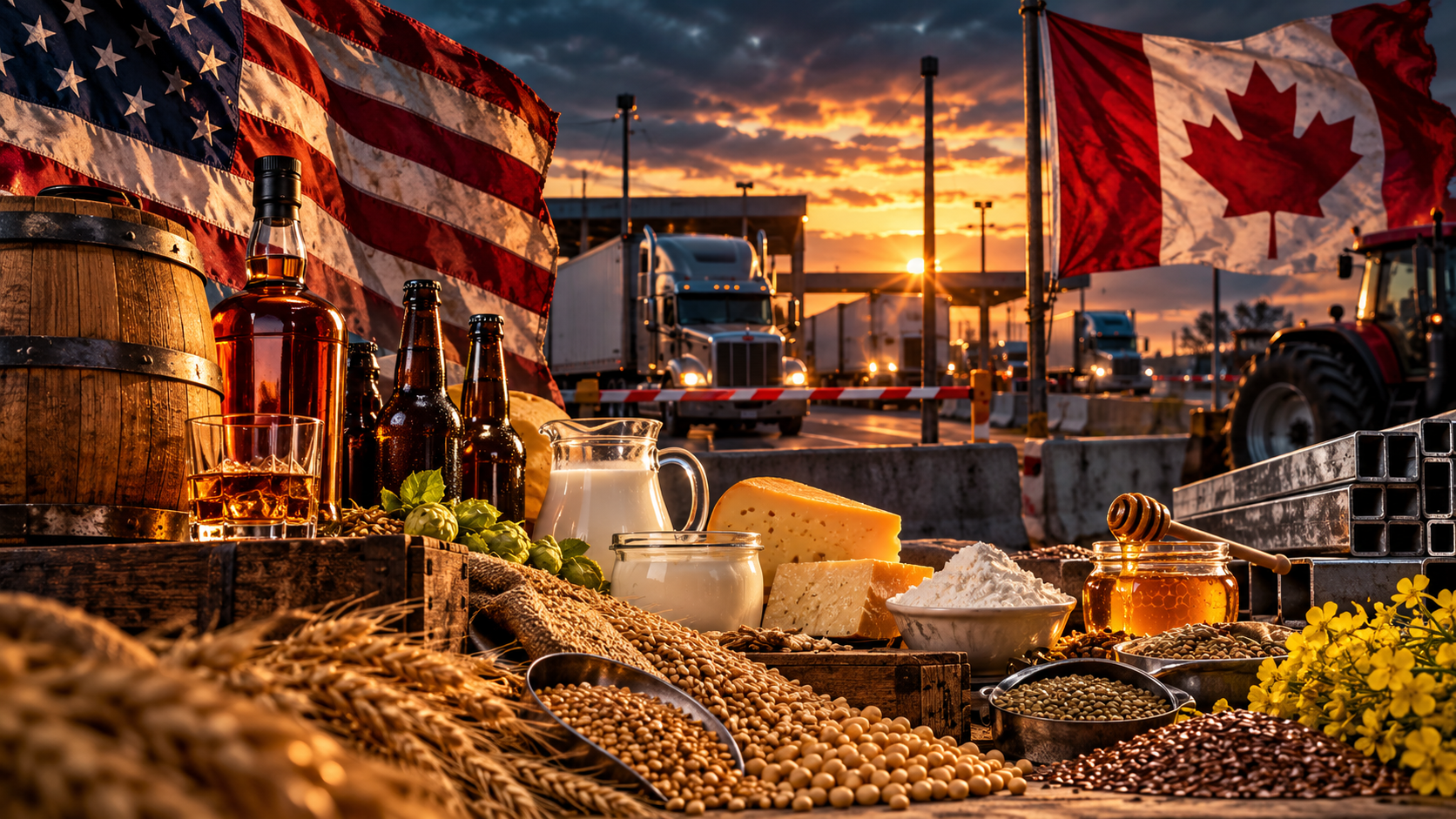
Canada isn't an abstract foregn land. It's the neighbor. We grow a lot of the same things they do: durum, canola, flax, peas, lentils, sunflowers, soybeans, corn, cattle. So when the trade fight blew up again this summer, my first question wasn't what groceries would cost. It was who gets hurt on the producing end.
The tariffs weren't picked to protect anybody. They were picked to hurt.
What's actually on the lists
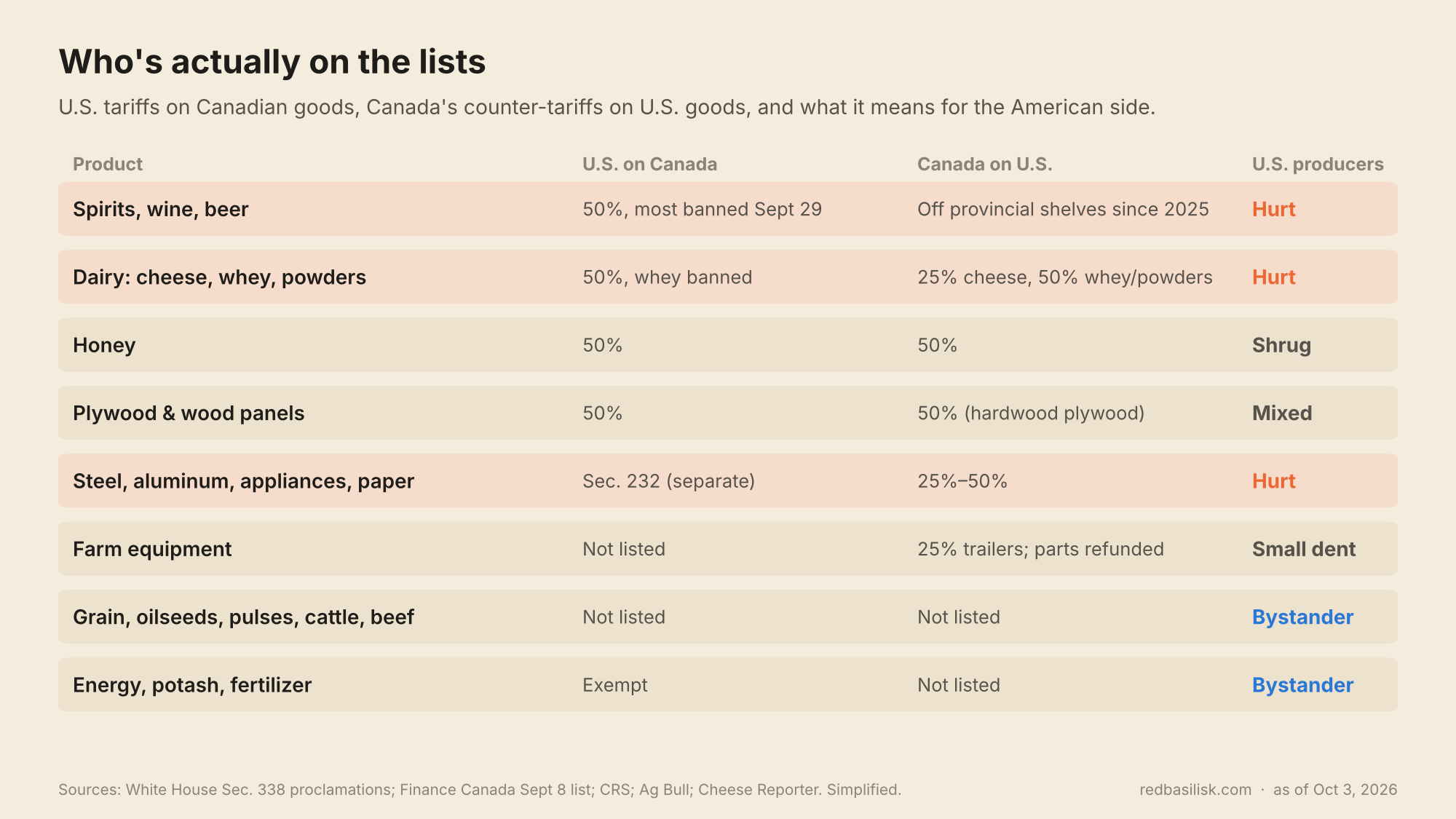
Here's the short version of the summer.
- July 20: President Trump signed three proclamations under Section 338 of the Tariff Act of 1930, a law no president had ever expressly cited to impose tariffs. They put a 50% tariff on a list of Canadian goods worth roughly $18 to $20 billion a year: alcohol, dairy, and a long "motor vehicles" list that also sweeps in honey, plywood, hockey gear, and more. Unlike earlier rounds, goods that qualify under the USMCA trade deal are not exempt.
- August 22: Talks had collapsed the night before, and the tariffs took effect. Prime Minister Carney, who had suspended negotiations, promised to match the U.S. "dollar for dollar."
- September 8: Canada's counter-tariffs started: 15%, 25%, and 50% on C$27.6 billion of U.S. goods. The list leans on steel, aluminum, dairy, appliances, farm equipment, pulp and paper, and electronics.
- September 15 and 29: The U.S. reworked its list, dropping some items like cement and adding others. Then it banned most Canadian alcohol, some dairy products such as whey, and certain motorcycles outright.
Just as important is what's not on either list: wheat and durum, canola, soybeans, corn, pulses, live cattle, and beef. Energy and potash are exempt on the U.S. side, and they don't appear on Canada's list either. Both governments left the big farm commodities alone, at least so far.
So let's go down the list by who makes what.
Hit hardest: the people who make drinks
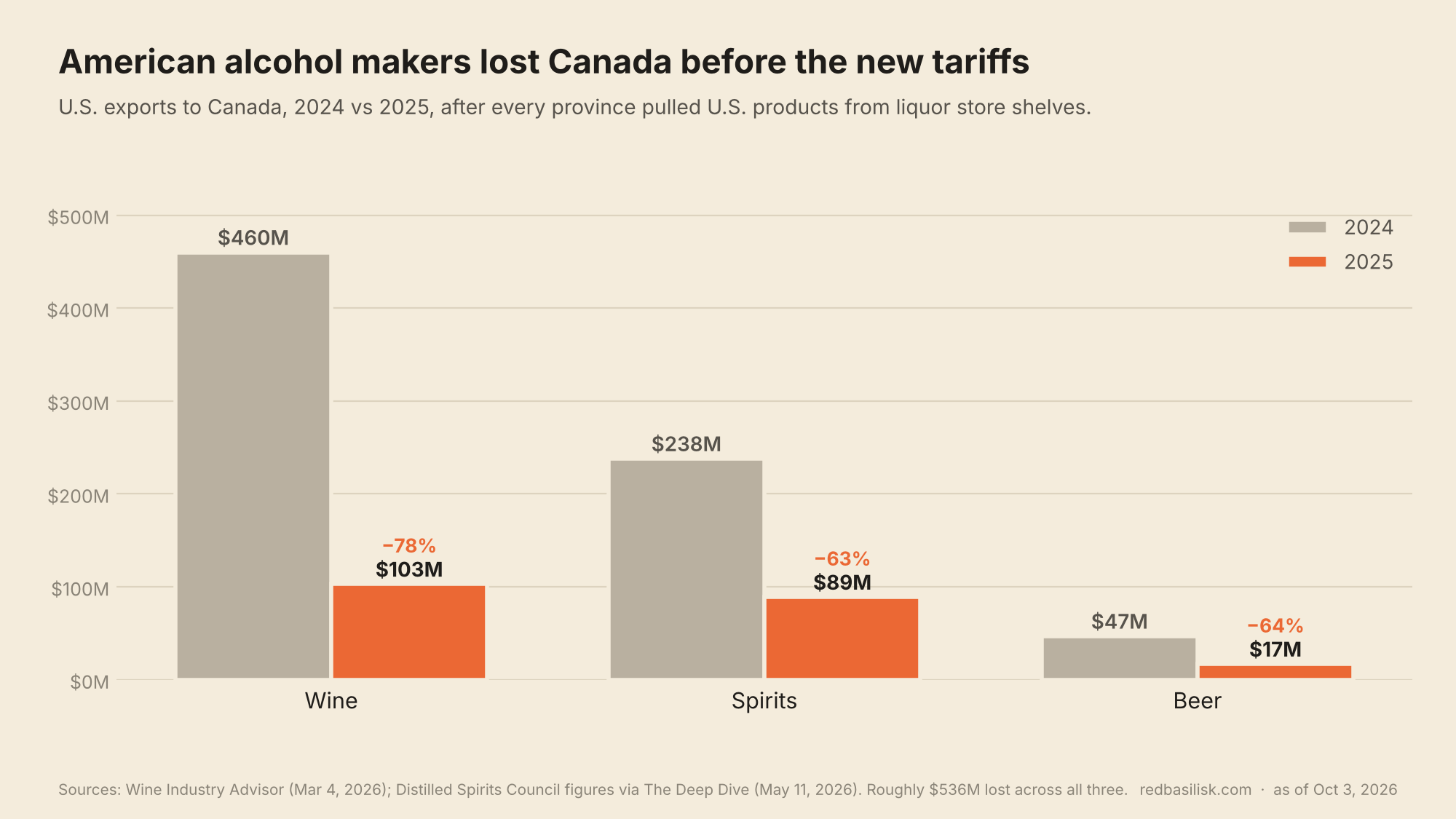
American distillers, winemakers, and brewers were losing Canada long before this summer. In 2025, every Canadian province pulled U.S. alcohol off its liquor store shelves, and some, like Ontario, kept it off. Per the Distilled Spirits Council's numbers, American spirits sales to Canada fell from $238 million to $89 million that year. Beer went from $47 million to $17 million. Wine got hit worst: from $460 million in 2024 to about $103 million in 2025, a drop of nearly four-fifths. That's roughly $536 million in lost sales across all three, per figures compiled by The Deep Dive.
Canada wasn't the only problem. Spirits demand has been slumping at home too. DISCUS says U.S. distilleries shed nearly 1,000 jobs between September 2024 and September 2025, and Jim Beam paused production at its main Kentucky distillery over excess inventory. Brown-Forman's Canadian sales fell more than 60% in the first half of its fiscal year. For a winery or craft distillery, losing your best export market on top of that isn't a price dip. It's a lost customer.
Does the U.S. ban on Canadian booze hand American makers that shelf space back? Maybe a little. But the ban only covers bottles of 4 liters or less. Bulk Canadian whisky can still come in to be bottled here, which is reportedly how Crown Royal stays on American shelves. I couldn't find a single U.S. producer group saying it's coming out ahead.
What about barley? Malt and barley aren't on either list. Barley's real problem is that beer demand is sinking. U.S. growers planted a record-low 2.3 million acres of barley in 2025. That story is real, but it isn't this one.
Dairy: shots fired both ways
Dairy is the oldest grievance in this fight. The White House's stated reason for the dairy tariffs is that Canada's quota rules treat American suppliers worse than European ones, and Canadian dairy is famously walled off by quotas and very high over-quota tariffs. But retaliation runs both ways, and Canada aimed carefully.
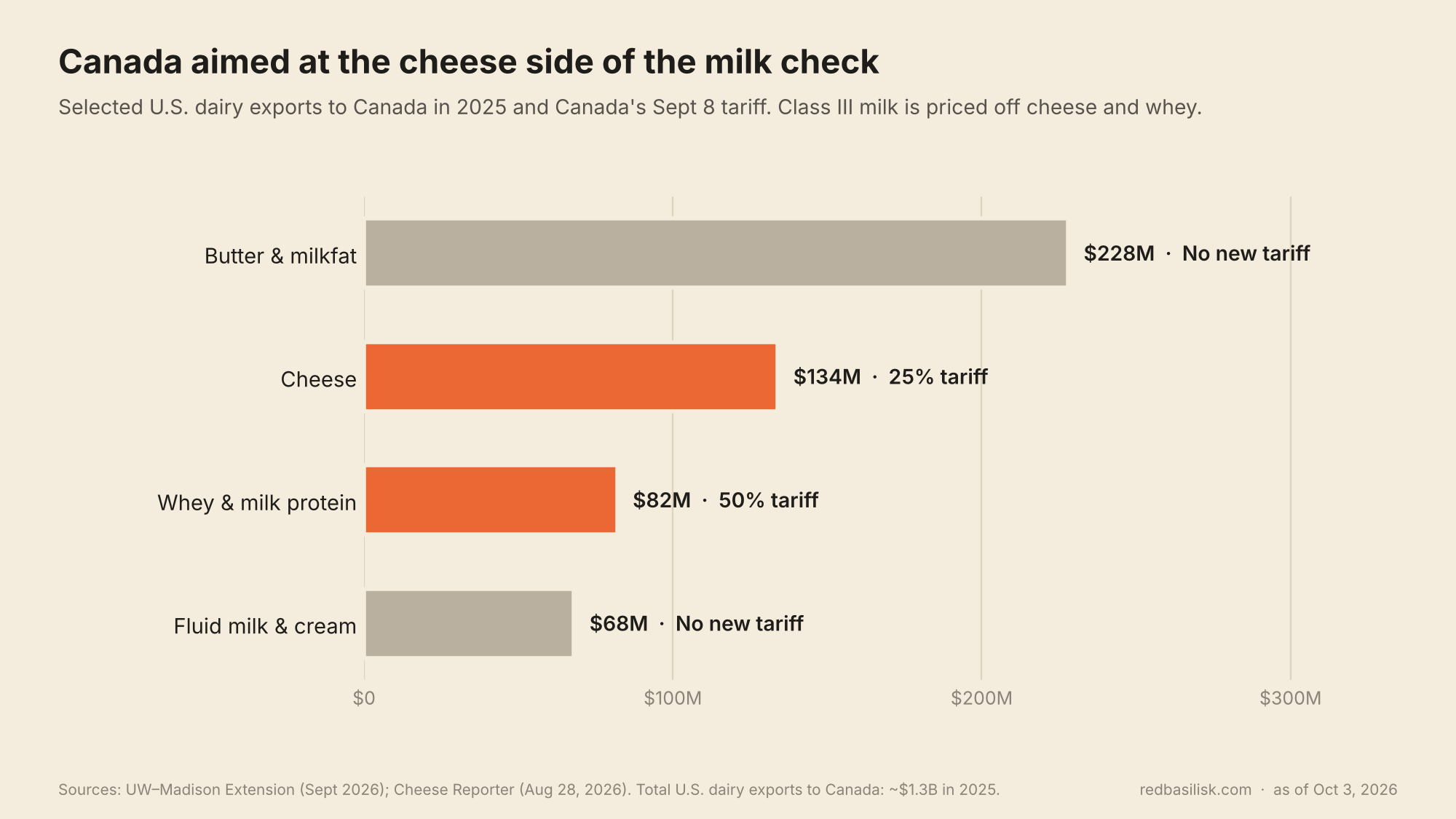
The U.S. shipped about $1.3 billion of dairy to Canada in 2025, around 14% of all U.S. dairy exports. Canada's September 8 list put 25% on American cheese and 50% on whey, milk proteins, and milk powders. Butter, fluid milk, cream, yogurt, and ice cream got no new tariff.
That targeting matters at the farm. Class III milk, the price most cheese-belt dairies live on, is set mainly off cheese and dry whey, the two things Canada hit. University of Wisconsin–Madison Extension estimates the hit at roughly 20 to 35 cents per hundredweight on U.S. milk if the tariffs stick around. For Wisconsin, that's about $65 million to $113 million a year, or roughly $51 to $90 per cow.
Not every dairy group is upset. The National Milk Producers Federation backed the U.S. tariffs, and its president Gregg Doud said Canada's behavior carries "real consequences." The processors at IDFA opposed the whey ban. One dairy trade publication modeled a possible bump in Class III prices from keeping Canadian whey out, but advised farmers to budget zero until whey prices actually move.
Small cheesemakers have been feeling the Canada fight since the 2025 round. Jasper Hill Farm in Greensboro, Vermont lost nearly $1 million in expected Canadian sales, 7 to 8% of its revenue. CEO Mateo Kehler called 2025 "the worst year we've ever had."
Honey: a tariff nobody asked for
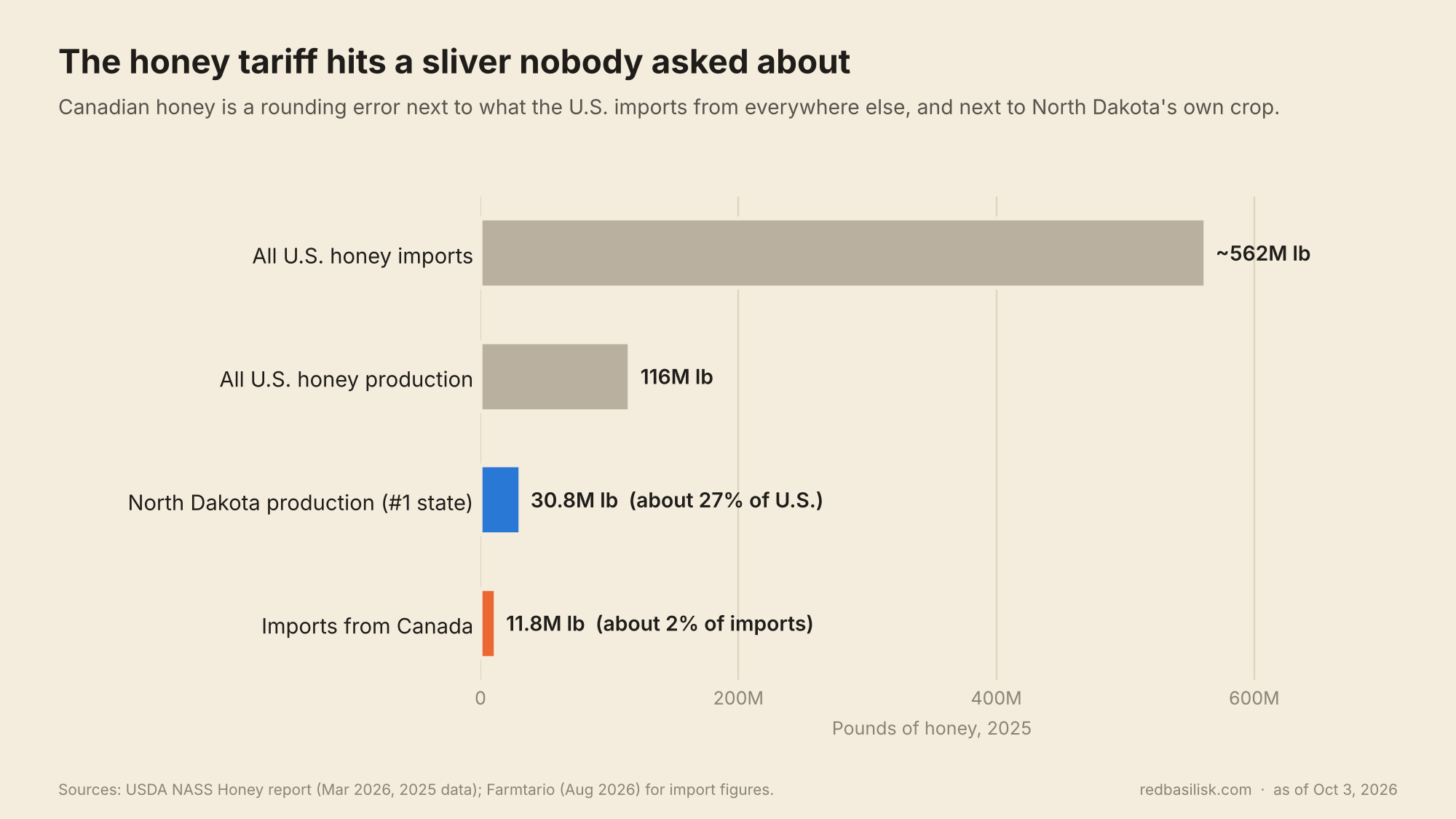
Honey hits close to home. North Dakota is the No. 1 honey state in the country. In 2025, North Dakota beekeepers produced 30.8 million pounds from 460,000 colonies, about 27% of all U.S. honey. A lot of those hives work canola and sunflower fields. Roughly half a million hives are trucked into the state each year, and almost all of them leave to winter somewhere warmer.
You'd think a 50% tariff on Canadian honey would be a gift to those beekeepers. It isn't, because Canadian honey barely registers. The U.S. imported about 11.8 million pounds of it in 2025. That's around 2% of the roughly 562 million pounds of honey America has been importing. Imports make up about three-quarters of America's honey supply, and almost none of it is Canadian.
The beekeepers say they didn't ask for this. Chris Hiatt, a Bowman, North Dakota beekeeper and former president of the American Honey Producers Association, put it simply: "We were not pushing for this." Canada's 11 million pounds, he said, is "like a hiccup." The bigger problem for honey producers this year is the weather. Hiatt said people are talking about 2026 being one of the lowest honey years on record, thanks to heat and drought.
Canada matched with its own 50% tariff on U.S. honey. Simon Lalonde, president of the Saskatchewan Beekeepers Development Commission, says his province's honey sales to the U.S. will be at zero until the tariffs come off. There's one more cross-border tie worth knowing about. Canada has restricted U.S. bee imports since 1987 and still bans package bees, but it has allowed individual queens since 2004. As of 2023, about three-quarters of its imported queens came from the U.S. Live bees aren't on Canada's new list, so that trade keeps moving.
Vermont and maple: not as happy as you'd think
You might figure Vermont's maple producers are cheering a tariff on their Quebec competition.
First, as best I can tell, Canadian maple syrup isn't tariffed at all. One law firm listed maple among the targeted goods. But PwC Canada's breakdown says the covered sugars don't include maple syrup, the White House fact sheet never mentions it, and the International Maple Syrup Institute says there's no U.S. tariff or import ban on it.
Second, Vermont's sugarmakers didn't want it. Vermont makes a little over half of all U.S. maple syrup, about 3.1 million gallons this year. But most U.S. syrup sells in bulk, and it's often blended with Canadian syrup for big retail brands. When tariffs came up in 2025, the Vermont Maple Sugar Makers' Association argued they'd hurt, not help.
Vermont's exposure is really about how much it depends on Canada. Canada takes 31% of Vermont's goods exports. In July, Republican Governor Phil Scott called the tariffs "simply a bad idea."
Wood, steel, and the folks who make machines
The factory side of the ledger is mostly a loss for the U.S. side.
- Steel and aluminum: Canada doubled its tariff on U.S. steel to 50%. That stings, because Canada bought 37% of all U.S. steel exports in 2025.
- Farm equipment: Canada put 15% on parts for harvesting and haying machinery and 25% on farm trailers and wagons. Tractors, combines, planters, tillage tools, and sprayers were left off. Kip Eideberg of the Association of Equipment Manufacturers calls Canada the industry's most important export destination.
- Plywood: The U.S. put 50% on Canadian plywood, about $425 million worth in 2025, and Canada hit U.S. hardwood plywood back at 50%. You'd expect American mills to celebrate. But in a survey of lumber dealers on the newly tariffed Canadian building products, four out of five reported trouble getting product. The dealers' association warned Congress the tariffs risk "creating shortages rather than simply redirecting demand toward U.S. producers," because U.S. mills may not have the spare capacity. Some mills have gained from the broader wood fight. Pleasant River Lumber, a Maine softwood sawmill, added a shift in January, and its co-owner said earlier lumber duties left it feeling "protected, for once."
- Cement: The U.S. dropped Canadian cement from its list on September 15. Builders and lawmakers pushed back that the country doesn't make enough cement to cover its own needs. That's a good reminder that a lot of "Canadian competition" is really an input American producers depend on.
The bystanders: grain, oilseeds, pulses, cattle
For now, the biggest farm commodities are sitting this one out.
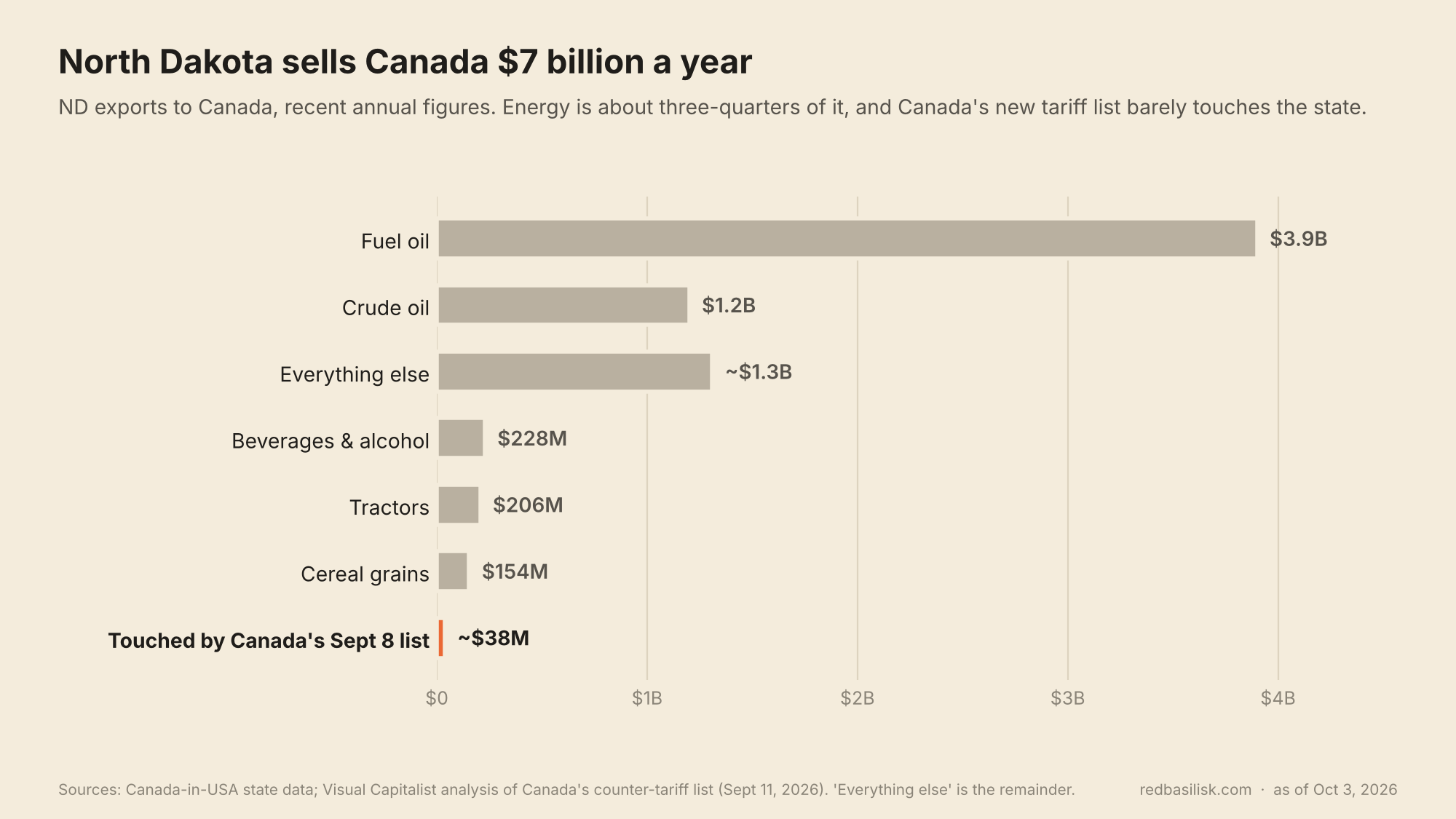
North Dakota sells Canada about $7 billion in goods a year, and Rep. Julie Fedorchak says 80% of the state's exports go to Canada. That sounds terrifying until you see what's in it. About three-quarters is fuel oil and crude, and energy is off both lists. One analysis of Canada's counter-tariff list puts the North Dakota exports it covers at only about $38 million, 44th among the states. North Dakota is exposed because it depends on Canada, not because Canada aimed at it.
So for wheat, durum, canola, soybeans, corn, peas, lentils, flax, sunflowers, and feeder cattle, the price effects from this round are mostly indirect. A drop in confidence, a stronger or weaker dollar, and Canadian product redirected to other markets all reach us. But nobody's levying a duty on a bushel crossing the line.
What could hurt:
- Potash. The U.S. gets nearly 80% of its potash from Canada. Washington exempted it on purpose, and Canada hasn't touched it. If either side changes that, every crop acre in the country feels it.
- Feeder cattle. Canadian feedlots expected to import more than 500,000 head of U.S. feeders this year. If Canada ever tariffed them, northern cow-calf guys would lose a big bidder.
- Canola. The U.S. takes 80 to 90% of Canada's canola oil. A U.S. tariff there would probably help American canola growers' prices, but it would hurt crushers and biodiesel plants on this side who buy Canadian seed and oil.
Flip it: the view from the Canadian side
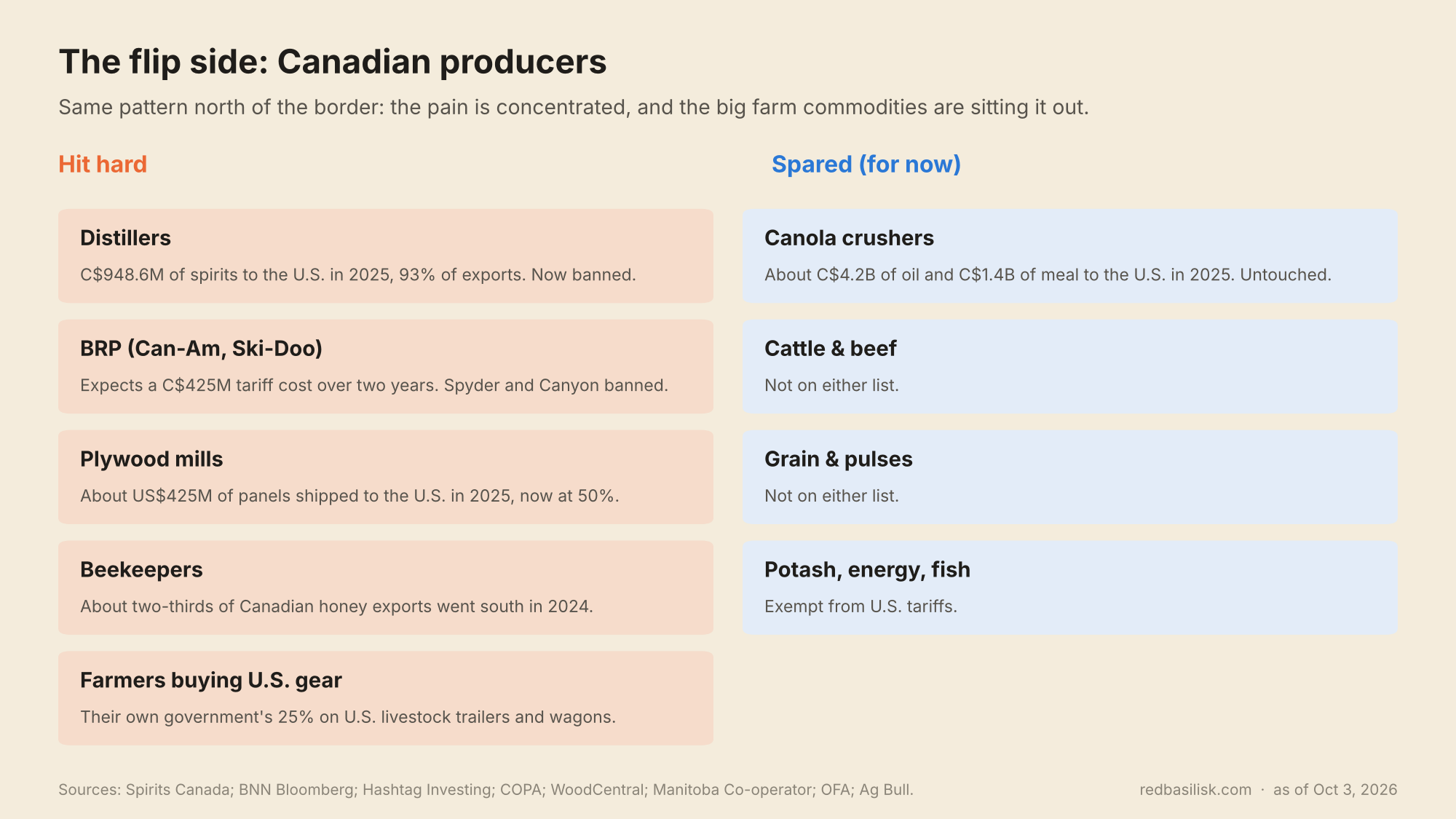
Look across the line and you see the same pattern in reverse.
The hardest-hit Canadian producers are the ones the U.S. aimed at. Canadian distillers shipped C$948.6 million of spirits to the U.S. in 2025, 93% of everything they exported, and most of it is now banned. BRP, the Quebec company behind Can-Am and Ski-Doo, expects a C$425 million tariff cost over two years, and its Can-Am Spyder and Canyon motorcycles are now shut out of the U.S. entirely. Plywood mills, hockey-gear makers like Bauer with plants in Quebec, and beekeepers, who sent about two-thirds of Canada's honey exports south in 2024, are all taking direct hits.
Meanwhile, the Canadian farm commodities that matter most are spared, just like ours. Canola crushers shipped about C$4.2 billion of oil and C$1.4 billion of meal to the U.S. in 2025, and neither is tariffed. Cattle, beef, grain, and pulses aren't on the list. Potash and energy are exempt.
And Canadian farmers are paying for some of their own government's retaliation. They now pay 25% on American livestock trailers and farm wagons. Harvester parts are listed at 15%, but a remission program refunds that so farmers keep getting combine parts duty-free. The Ontario Federation of Agriculture welcomed the relief for machinery and parts, but it's pushing for the same on trailers. The president of the Saskatchewan farm group APAS said machinery and parts "must be protected." Ottawa has set aside C$7.5 billion in support for workers and businesses hit by the fight.
The bottom line
From the producer's end, this trade war is uneven by design. The damage falls hard on a narrow set of makers: distillers and winemakers, cheese-belt dairies, steel mills, and on the Canadian side, distillers, powersports, and plywood. The producers who should have benefited on paper, like American beekeepers and plywood mills, mostly didn't ask for it and mostly aren't getting much out of it. Vermont's sugarmakers, who you'd expect to be cheering, argued against tariffs, and their Quebec competition appears not to be tariffed anyway.
The big stuff, grain and oilseeds and cattle and fertilizer, has been left alone by both governments. I don't think that's an accident. Both sides know that's where the real damage would be.
That's why my import-versus-export rule mostly fails here. These aren't protective tariffs built to help American producers. They're pressure tools, and each side is aiming at the other's most visible exports while leaving its own farmers' biggest markets alone.
What to watch
- Whether talks restart. Formal negotiations hadn't resumed as of October 1, though U.S. Trade Representative Jamieson Greer says technical talks continue. Canada's international trade minister, Maninder Sidhu, spoke with Greer informally at the G20 trade meeting in Milwaukee on September 30.
- Potash. If it shows up on either list, everything changes.
- Cattle and canola getting dragged in.
- Class III milk and whey prices this fall, to see whether the dairy hit, or the promised whey bump, actually shows up.
- The USMCA review. The U.S. declined to renew the agreement as-is in July, which means annual reviews from here on.
My take
I don't actually expect to feel this in my own life. Maybe if your a honey guy thats different, but it is pretty clear this is going to hurt Canada a lot more than it will hurt us. I grew up close to the border, I will be watching this, as well as the developing "wexit" situation. If nothing else, there is a non-zero chance Trump will meet Carney at the Peace Garden to put an end to it, where I went to camp every summer as a kid. That would be neat.
How we dug into this
We ran three research passes at the same time, on alcohol, barley, and honey; on dairy, maple, and wood; and on manufacturers, State's exports, and the Canadian side. They drew on the government lists, law-firm and customs-broker breakdowns of the tariff schedules, USDA data, university extension analysis, and farm and trade press from both sides of the border. A couple of my own assumptions got corrected along the way: the Moorhead malt plant closed before this fight started, and Canadian maple syrup appears not to be tariffed at all. Where sources disagreed, we say so. Figures are a mix of 2025 trade data and 2026 reporting, and the tariff lists are still shifting. Charts were built in Python. As always, a separate AI fact-check pass checked every figure and quote before publishing.
Sources
- [Congressional Research Service: U.S. Tariffs on Canadian Imports — Section 338](
- [Davis Wright Tremaine: Fifty percent Section 338 tariffs on many Canadian goods](
- [Global Trade Alert: Section 338 tariffs raise Canada's average U.S. tariff](
- [Holland & Knight: Canadian imports subject to Section 338 tariffs](
- [White House: Fact sheet on additional tariffs on Canada](
- [GHY: Section 338 tariffs and the Sept 29 import exclusions](
- [Prime Minister of Canada: Remarks on Canada-U.S. trade negotiations (Aug 22, 2026)](
- [Finance Canada: Targeted countermeasures and support package](
- [Finance Canada: Complete list of U.S. products subject to counter tariffs](
- [Ag Bull Trading: Canada's agriculture and food counter-tariff breakout](
- [Fertilizer Daily: U.S. exempts Canadian fertilizers from new 50% tariffs](
- [Wine Industry Advisor: Canadian bans on U.S. wine cost $357 million in 2025](
- [The Deep Dive: Canada's booze bans wiped out $536M in U.S. alcohol exports](
- [Fox News: U.S. whiskey exports to Canada collapse](
- [NPR: Jim Beam to pause production at its main plant in 2026](
- [RyeCentral: U.S. ban on Canadian rye whisky](
- [MPR News: Anheuser-Busch to close Moorhead malting plant](
- [AMBA: Final barley production and stock reports for 2025 crop](
- [Grand Forks Herald: U.S. barley acreage hit lowest level since 1876 as beer demand sinks](
- [GX94: Alcohol tariffs expected to hurt cereal crop demand](
- [UW–Madison Extension via Dairy Business: Canada's 2026 retaliatory dairy tariffs](
- [Cheese Reporter: Canada announces counter-tariffs on U.S. dairy imports](
- [NMPF: Statement on maintaining pressure on Canada over USMCA dairy](
- [Cheese Reporter: Canada's tariffs take effect; U.S. bans Canadian whey](
- [The Bullvine: Canada whey import ban and Class III](
- [Inc.: Canada tariffs cost this cheesemaker $1 million in sales](
- [USDA NASS: Honey report (March 2026)](
- [Farmtario: U.S. honey producers say they did not ask for tariffs](
- [Canadian Honey Council: Tariffs](
- [620 CKRM: Domestic honey demand seen as key price mover](
- [North Dakota Pollinator Plan](
- [CFIA: Decision on honey bee packages from the United States](
- [Manitoba Co-operator: Tariff anxiety hits Canadian honey producers](
- [The Maple News: Canadian syrup not included in U.S. import ban](
- [PwC Canada: U.S. imposes tariffs on dairy, alcohol, vehicles](
- [The Maple News: U.S. crop a near-record 5.9 million gallons](
- [Vermont Maple Sugar Makers' Association: Vermont-Canada trade relations](
- [Fortune: Tariff reaction in Maine, Michigan, Vermont](
- [Office of Gov. Phil Scott: Statement on tariffs](
- [Stateline: Canadian trade war stirs up trouble](
- [Visual Capitalist: The states hit by Canada's counter-tariffs](
- [SteelOrbis: Canada doubles counter-tariff on U.S. steel to 50%](
- [KCHA: Farm equipment caught in trade standoff](
- [Manitoba Canola Growers: Tariff impacts on agriculture equipment](
- [WoodCentral: Canadian plywood tariff](
- [WoodCentral: Canadian building materials tariffs and dealers](
- [Bangor Daily News: Pleasant River Lumber and tariffs](
- [Global Cement: U.S. removes tariffs on cement imported from Canada](
- [Canada-in-USA: North Dakota trade profile](
- [KFYR: 80% of state exports at risk](
- [Manitoba Co-operator: Trade uncertainty weighs on Canadian beef sector](
- [Western Producer via 620 CKRM: Canola oil and beef have escaped Trump's tariffs, for now](
- [Spirits Canada: Statement on U.S. alcohol announcement](
- [BNN Bloomberg: BRP reports second-quarter results](
- [Hashtag Investing: BRP confirms Can-Am Spyder and Canyon shut out of U.S. market](
- [COPA: Canadian oilseed exports and imports](
- [Money.ca: Tariffs and Canadian hockey makers](
- [Global News: B.C. honey producers brace for U.S. tariff](
- [OFA: Statement on Canada-U.S. trade escalation](
- [620 CKRM: Canada to counter-tariff U.S. honey, dairy, some machinery](
- [Fertilizer Daily: US-Canada trade war threatens potash supply](
- [The Globe and Mail: Trade minister meets Greer for first time since August](
- [CP24: Sidhu set to speak with U.S. trade rep at G20 meeting](
- [BNN Bloomberg: Greer says there are difficult issues to resolve with Canada](
- [World Fertilizer: New U.S. tariffs on Canada exclude fertilizers](