




Read
Who's Winning the AI Build-Out
America leads on chips and money. The race is about power.
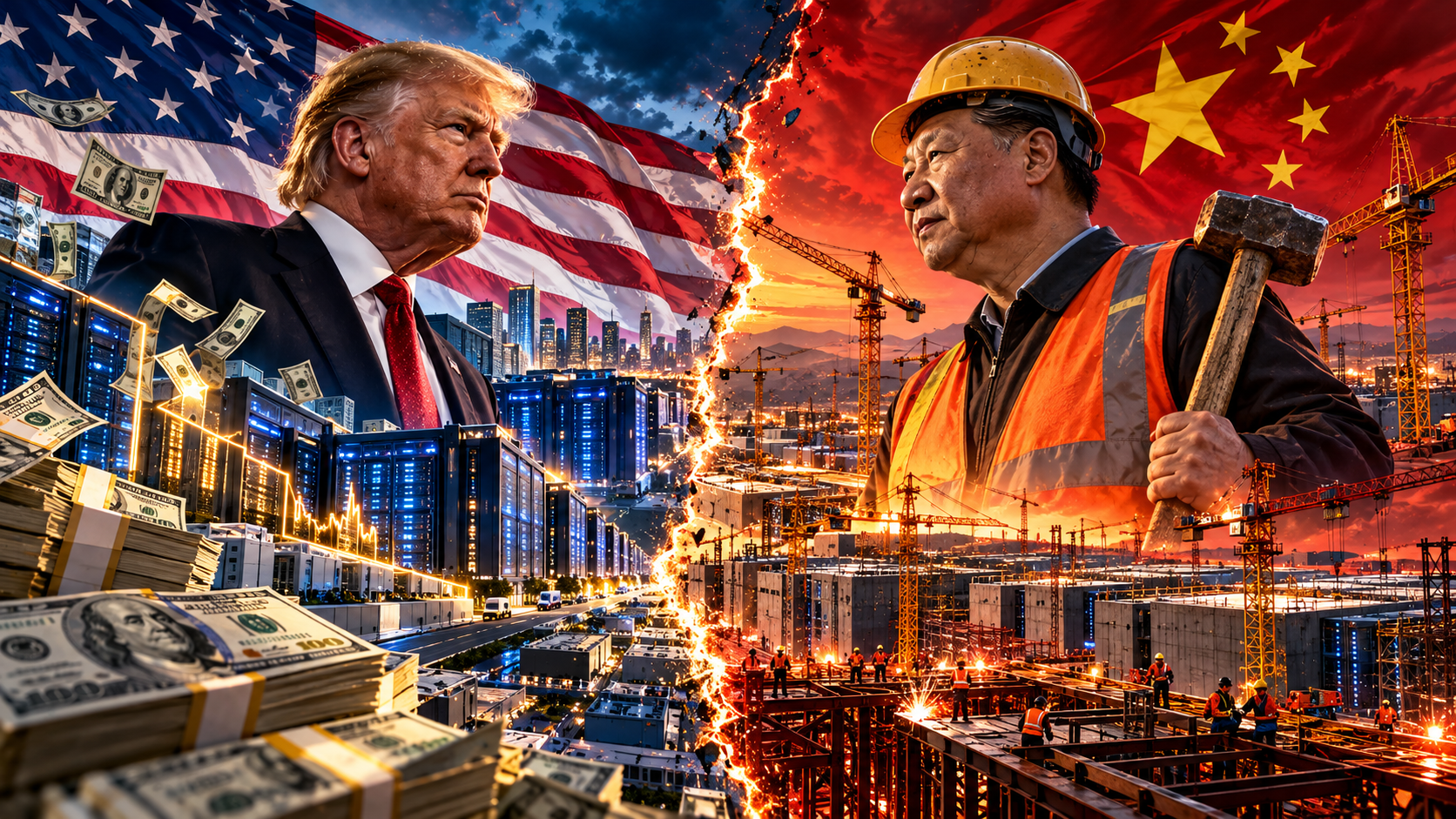
The US holds most of the world's AI computing power and is outspending China several times over. But China added about ten times more generating capacity last year, and power is now the bottleneck. Here's the honest scorecard.
In our last dispatch we looked at what data centers are, where they are, and what they really use. This one asks the bigger question: is America going to win this?
We'll be upfront. We're pulling for the US. We think it matters a great deal whether the most capable AI systems are built here, on American power, by American companies, under American law. But pulling for a team is no reason to lie about the score. If there's a weak spot, we'd rather find it now than be surprised later.
So here's the scorecard, both columns.
Short version: The US is well ahead on the things money can buy: chips, computers and capital. It's behind on the one thing money can't buy quickly: power, and the ability to build it fast. Whether the lead holds depends mostly on that one weakness.
The score today
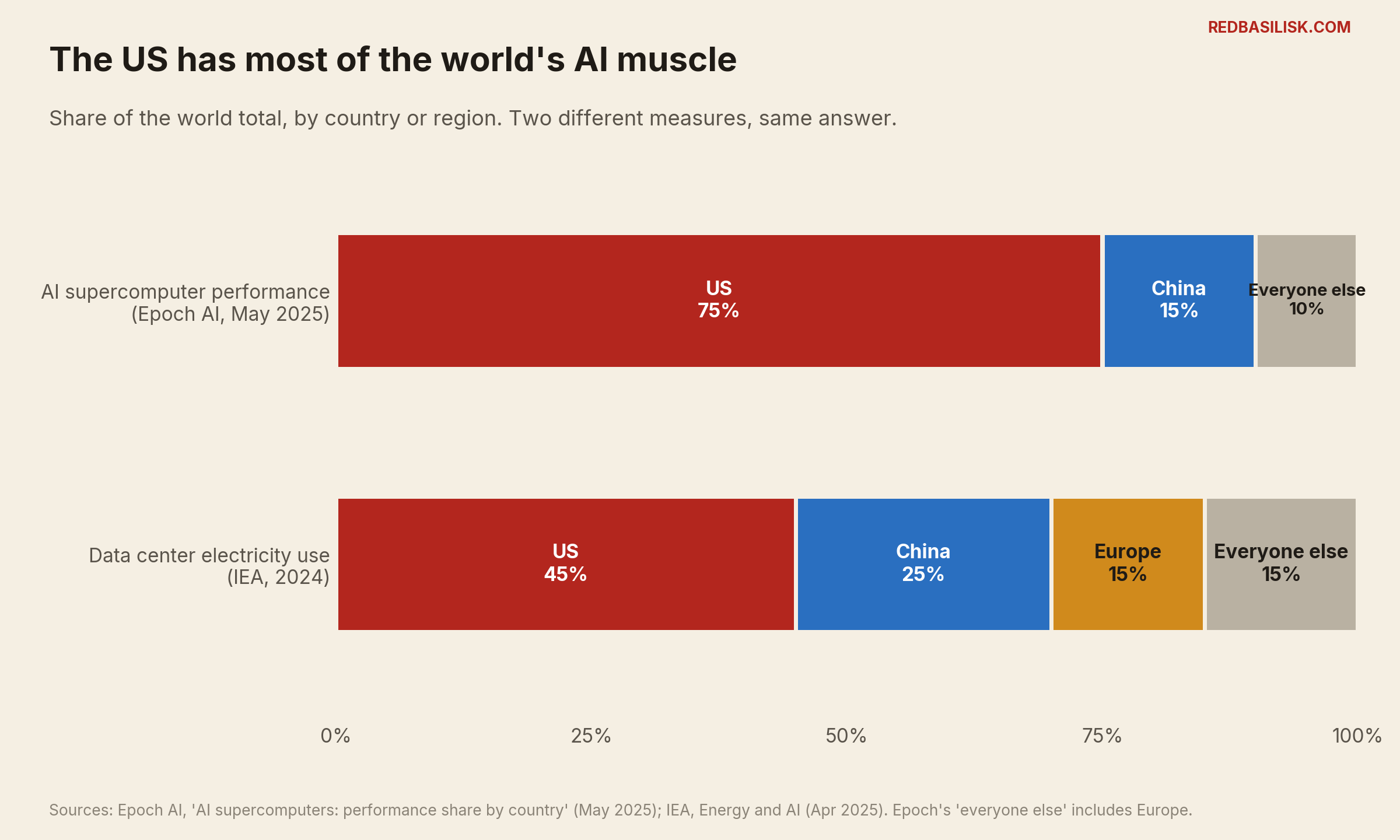
By almost any measure, the US holds most of the world's AI infrastructure right now:
- AI supercomputers: Epoch AI, which tracks the world's large AI computing clusters, estimated that as of May 2025 the US had about 75% of the world's AI supercomputer performance. China had about 15%.
- Data center power: The International Energy Agency estimates the US used 45% of the world's data center electricity in 2024, China 25% and Europe 15%.
- Hyperscale markets: 15 of the world's 20 biggest hyperscale data center markets are in the US, according to Synergy Research. China has three (Beijing, Shanghai and Guangdong), and Europe has one (Dublin).
China's real number is hard to pin down. One careful 2026 estimate put China's AI computing power at about 2.8 million Nvidia H100-equivalents, roughly 12–13% of the world's. It came with a wide range and a striking footnote: the equivalent of about a million are rented remotely in other countries' data centers, and about 450,000 were smuggled.
The money
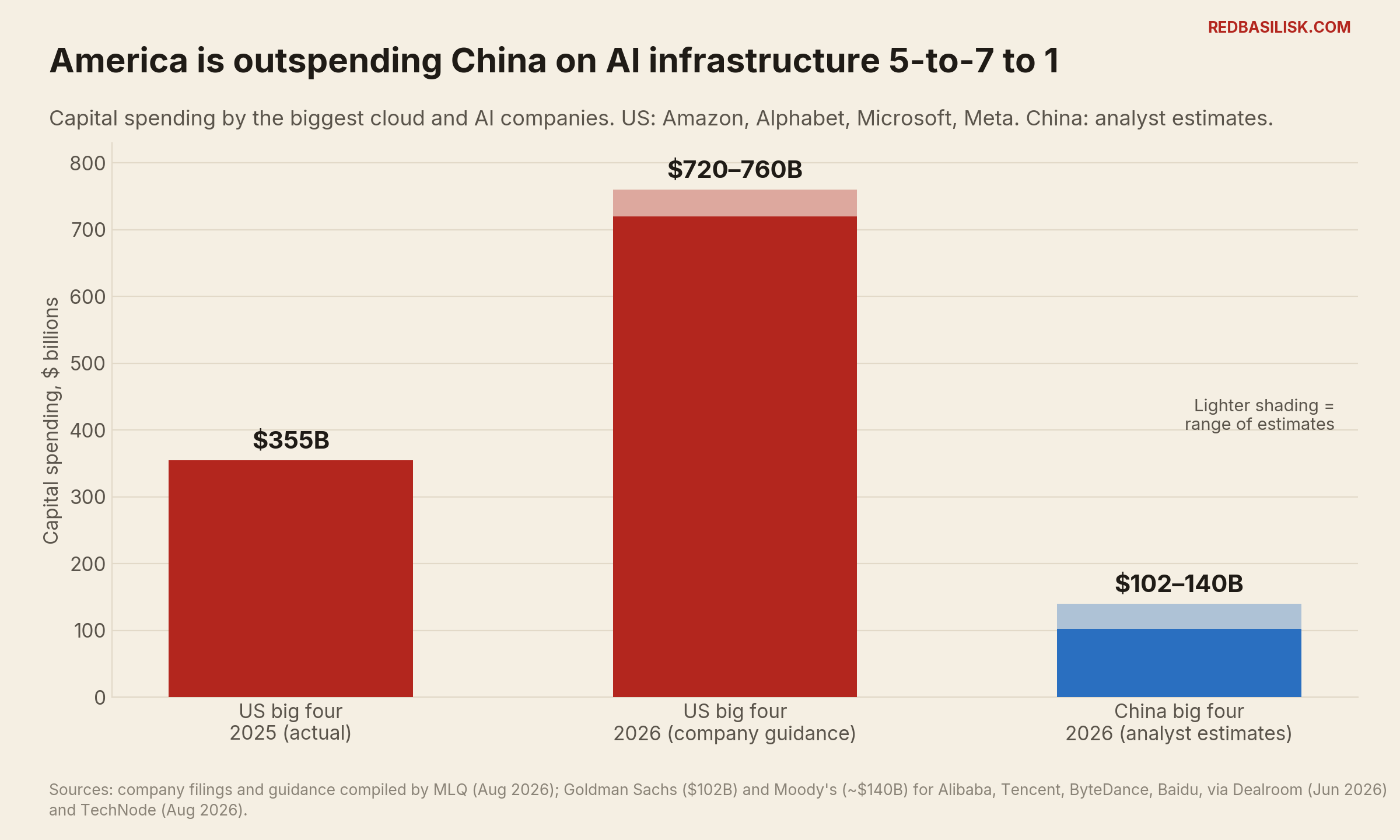
This is where the gap is widest.
The four biggest US cloud companies (Amazon, Alphabet, Microsoft and Meta) spent about $355 billion on capital projects in 2025, mostly data centers and chips. Their guidance for 2026 adds up to roughly $720–760 billion, depending on how you count Microsoft's fiscal year. That's about double. Add Oracle, which is building much of OpenAI's capacity, and it's $800 billion or more.
China's four largest (Alibaba, Tencent, ByteDance, Baidu) are estimated at $102 billion for 2026 by Goldman Sachs, or about $140 billion by Moody's. Either way, the US is spending five to seven times more.
Two cautions:
- Some of it is inflation. Memory and chip prices are up sharply. Microsoft's CFO said about $25 billion of its plan is higher memory and storage costs.
- Big numbers attract big doubts. OpenAI's "Stargate" was announced in January 2025 as a $500 billion program, later described as 10 GW. As of April, Epoch counted seven US sites totaling 9+ GW planned, but only one, in Abilene, Texas, was actually running. Investors have started asking whether the revenue will arrive to justify the spending. That's a fair question, and one for a future dispatch.
What's being built in the US
The pipeline is enormous. The hard part is telling real projects from wishful ones.
- Under construction: real estate firm JLL counts about 66 GW of data center capacity under construction in North America, most of it outside the traditional hubs.
- Utility contracts: Dominion Energy in Virginia has about 54 GW of data center capacity in some form of contract, but only 12 GW of that is in firm service agreements. Southern Company, which serves Georgia, Alabama and Mississippi, has about 17 GW contracted, stretching into the mid-2030s.
- Texas: the state grid operator, ERCOT, has received requests for about 474 GW of new large loads, more than five times its all-time peak demand. Most of it is data centers. In August, Governor Abbott ordered an audit of the queue, and ERCOT put new approvals on hold while it sorts real projects from speculative ones.
Be skeptical of the biggest numbers. Developers file the same project with several utilities to see who can connect them fastest, so queues are full of "phantom" demand. When Ohio started making data centers put money down, as we covered last time, requests fell by more than half.
Washington is pushing hard:
- America's AI Action Plan (July 2025): the White House's roadmap, built on three pillars: innovation, infrastructure, and international diplomacy and security, which includes exporting American AI to allies.
- Faster permits: an executive order the same month speeds federal permits for data centers over 100 MW and opens federal land for them.
- Federal sites: the Department of Energy picked four of its own sites for private data centers: Idaho National Lab, Oak Ridge, Paducah and Savannah River.
- Grid hookup rules: in June, federal regulators ordered six of the major grid operators to justify or change their rules for connecting large loads.
The weak spot: power
Here's the column we'd rather not write.
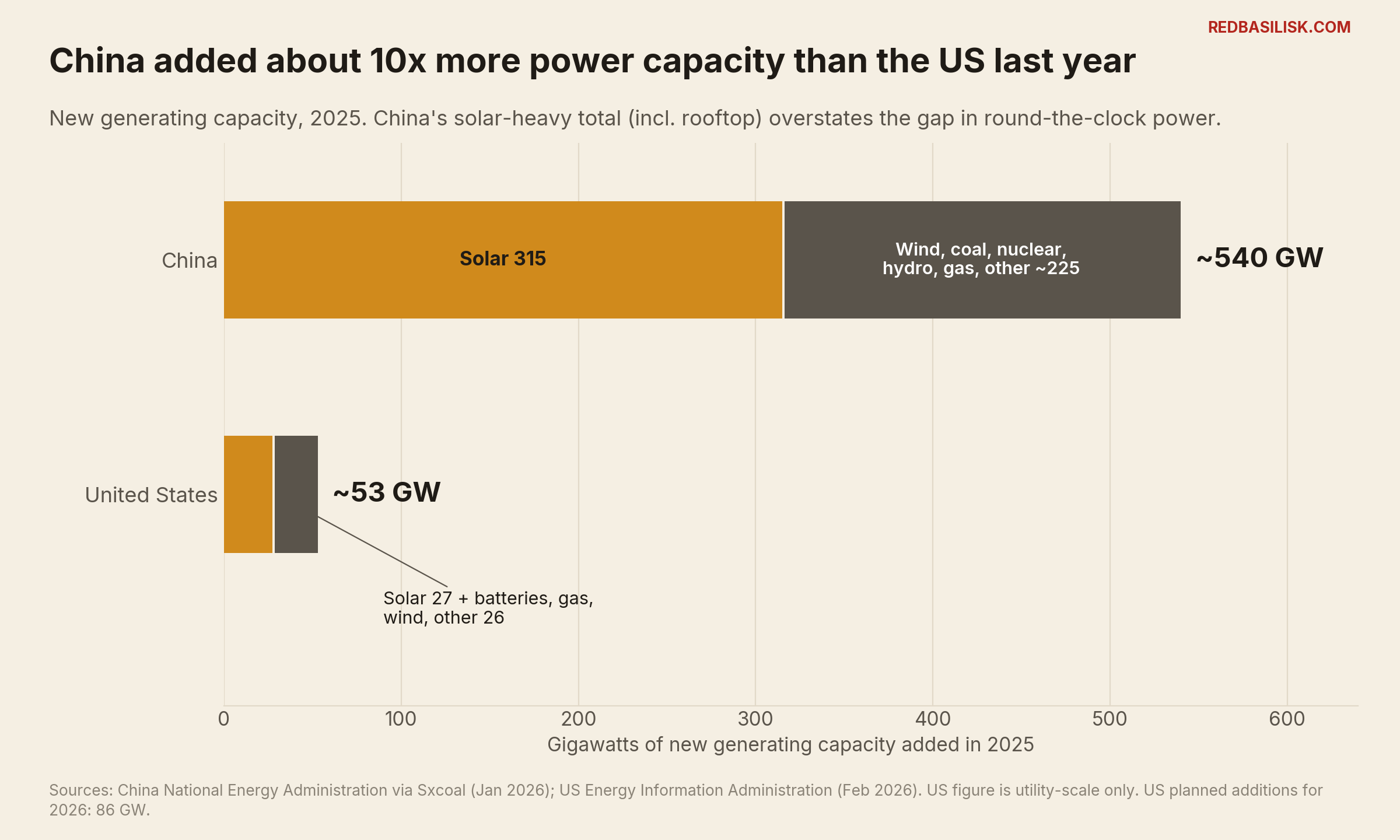
In 2025, China added about 540 GW of new generating capacity. The US added 53 GW. That's roughly ten to one.
The caveats are real. Most of China's additions are solar (including rooftop panels the US figure doesn't count), which only produces during the day, and Chinese power plants actually ran fewer hours on average last year. Measured in round-the-clock power, the gap is smaller than 10x. But it's still very large, and it's been large for years. China isn't building a grid for today's demand. It's building for demand ten years out. The US is speeding up, too: planned additions for 2026 are about 86 GW, most of it solar and batteries.
In the US, the problem is less about money than about waiting in line:
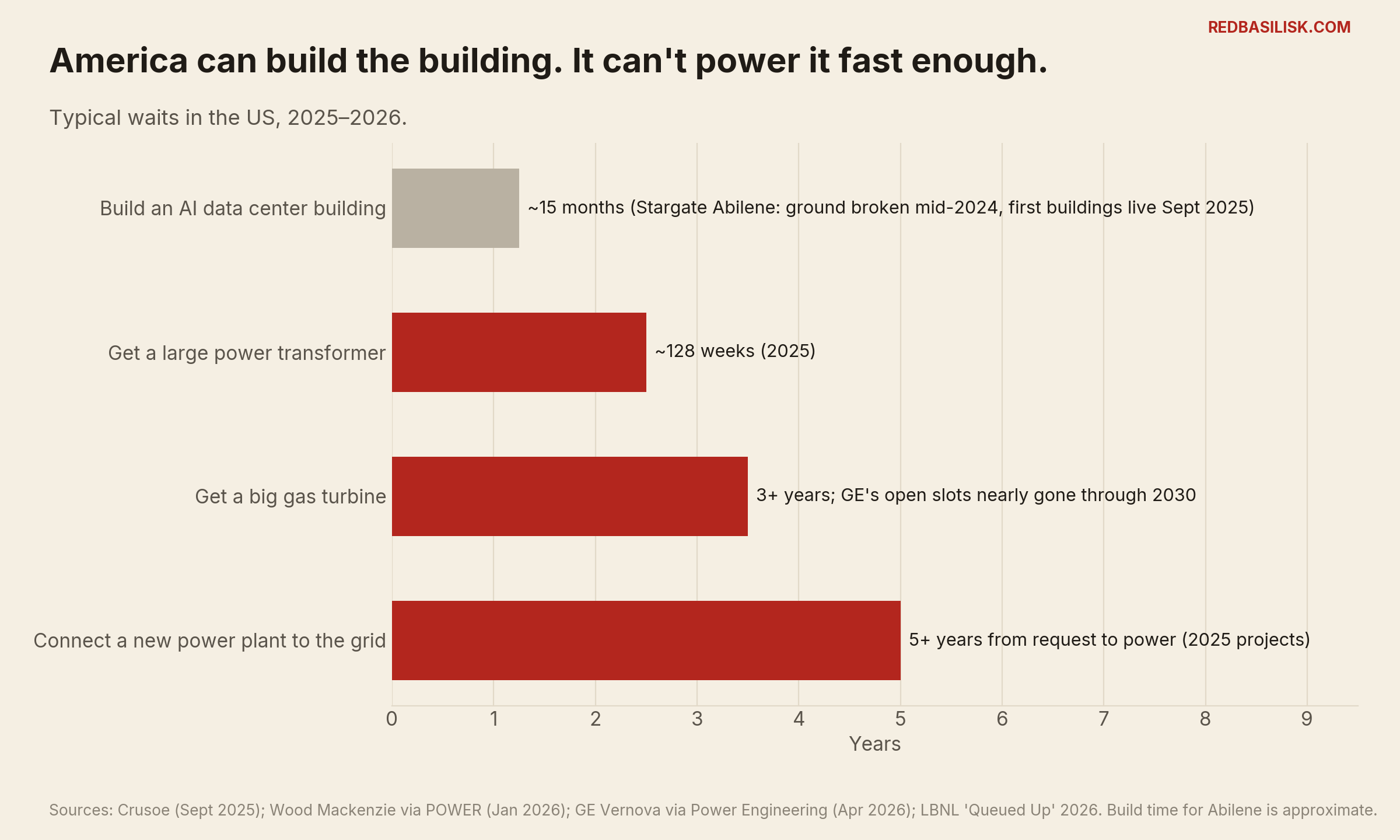
- Grid connections: power projects that came online in the US in 2025 took more than five years from request to operation, according to Berkeley Lab. Historically, only about 13% of projects that enter the queue ever get built.
- Gas turbines: the three big makers (GE Vernova, Siemens Energy and Mitsubishi) are sold out for years. GE's open slots are nearly gone through 2029–30, and turbine prices are heading toward three times 2019 levels.
- Transformers: as of 2025, the big power transformers that step voltage up and down were running about 30% short of demand, with lead times around 128 weeks.
- Workers: the construction industry needs about 349,000 more workers this year, by one trade group's count, and data centers are driving demand for electricians in particular.
That's why so many new AI campuses are building their own gas plants on site. It's the fastest route around the line, but it competes for the same sold-out turbines.
And then there's politics. When local people see their power bill climbing and a giant building going up down the road, they push back. One tracker counted $68 billion of data center projects blocked or delayed by local opposition in a single quarter this year. Power bills are becoming an election issue. A build-out that loses public support will slow down no matter how much money is behind it.
China's weak spots
China has problems of its own, and they're serious.
Chips. This is China's biggest problem. US export controls cut China off from Nvidia's best chips and the machines needed to make advanced chips. Huawei's Ascend chips are China's main alternative. The Council on Foreign Relations estimates Huawei's 2025 output at about 5% of Nvidia's total computing output, falling to about 2% by 2027 as Nvidia pulls ahead. The real limit is high-bandwidth memory, which China struggles to make.
Export policy has wobbled. In December 2025, Washington approved sales of Nvidia's older H200 chip to vetted Chinese buyers. In July, Commerce Under Secretary Jeffrey Kessler told Congress actual shipments had been "trivial." Beijing reportedly told its companies to use H200s only for training and to buy Huawei for everything else. In May, the US closed a loophole that let Chinese-owned subsidiaries buy top-end chips in Malaysia, Singapore and the UAE.
Overbuilding. In 2022 China launched "East Data, West Computing," a plan to build data centers in the cheap-power west to serve the crowded east. Hundreds of projects followed. By 2025, Chinese government estimates put utilization at only 20–30%. More than 100 projects were cancelled, and Beijing is building a state network to resell the idle capacity. Buildings without the right chips inside are just warehouses.
Where China is genuinely winning: open models. Chinese labs release their AI models openly for anyone to download and modify, and it's working. Hugging Face, the main hub for AI models, reports that Alibaba's Qwen family now has about 4.7 times as many derivative models as Meta's Llama. Chinese labs have released the largest open model almost every month of 2026. Developers everywhere are building on Chinese foundations. That's influence, and it doesn't require the biggest data centers.
Everyone else
The rest of the world mostly isn't trying to beat the US. It's picking a side, or trying to stay independent.
| Region | What they're building | What it's for |
|---|---|---|
| UAE | A 5 GW UAE–US AI campus near Abu Dhabi, including the 1 GW Stargate UAE cluster (first 200 MW due this year). License-free access to US chips since July. | Sovereign AI, plus an offshore extension of the US tech stack |
| Saudi Arabia | Humain, targeting 1.9 GW by 2030 and 6+ GW by 2034; now seeking outside investors as the kingdom tightens spending | Sovereign AI, economic diversification |
| European Union | Up to seven "AI gigafactories," each with 100,000+ chips, €30B total; bids close Nov. 2026 | Research, industry, "sovereignty" from both the US and China |
| Ireland | Reopened Dublin to data centers in Dec. 2025, but new ones must bring their own power | Cloud for Europe; data centers already use over a fifth of Irish electricity |
| Malaysia (Johor) | 1.1 GW live, 8.5 GW pipeline; waiting on water | Overflow hub for Singapore and much of Asia |
| India | ~1.6 GW operating, ~3 GW under construction or planned; Google committed $15B | Domestic cloud and AI services |
| Japan | $26B+ in hyperscaler commitments; up to 5–10 year waits for power in Tokyo | Domestic cloud |
| Norway | Stargate Norway at Narvik, 230 MW on hydropower | Europe's green compute |
Europe's problem is price. The IEA estimates the EU's energy-intensive industries paid more than twice US electricity prices in 2025, and nearly 50% more than China. It's hard to run an AI industry on some of the world's most expensive power.
The Gulf's appeal is the opposite: cheap energy, lots of land, lots of money, and governments that can say yes quickly. By tying those projects to American chips and American companies, the US effectively extends its lead abroad. The risk is that chips leak to where they shouldn't go.
What each side is using it for
- US: training the frontier models, the largest and most capable AI systems, plus the cloud services that run AI for businesses and consumers worldwide. The largest single AI data center has been growing about 3x a year. The military is now a major user too: the Pentagon's GenAI.mil system has been used by about 1.7 million personnel and is moving onto classified networks.
- China: open-weight models, and pushing AI into factories, logistics and government. Beijing's "AI+" plan targets 70% adoption of AI agents and smart devices in key sectors by 2027, and 90% by 2030. The PLA has published dozens of procurement notices for tools built on DeepSeek.
- Gulf: sovereign AI, and hosting US companies' overflow.
- Europe: research, regulated industries, and independence.
The scorecard
Where the US leads
- Installed AI computing power, about 75% of the world's
- Money, spending 5–7x more than China
- Chips, through Nvidia and first place in line at TSMC
- Frontier models
- Allies: the Gulf, Norway and Europe build on American chips
- Cheaper power than Europe and Japan
Where the US trails
- Speed of building power: about a tenth of China's new capacity last year
- Grid connections: 5+ years
- Heavy equipment: turbines, transformers, skilled trades
- Open models: Chinese models are winning the developer ecosystem
- Coordination: Beijing can order cheap power and steer chip choices; Washington can't
What could cost the US its lead
- Power delays push the build-out into 2029–31 while chips sit waiting.
- Public backlash over power bills and local impacts.
- Financing strain if AI revenue doesn't arrive as fast as the spending.
- Chip leakage through smuggling, remote rental, and loose export policy.
- Chinese chips catching up. This is the least likely in the near term.
My take
We're winning, and it isn't close yet. America has the chips, the money, the companies and the allies. China's chip problem is real, and it doesn't go away with more spending.
But the lead isn't guaranteed, and the threat isn't coming from Beijing. It's coming from the permit office, the interconnection queue, the transformer backlog and the county commission. The race won't be decided by who designs the best chip. It will be decided by who can build power plants and power lines fastest. Right now, that's not us.
That's good news in a way, because it's fixable. We know how to build power; we did it for a century. It means streamlining permits, making data centers pay their own freight so the public stays on board, and building everything: gas now, nuclear and geothermal next, transmission always.
Out here, we know what energy looks like coming out of the ground. The country that builds the most of it wins this. We'd like that to be us.
How we dug into this
We ran separate AI research passes on the US build-out pipeline, the international comparison, and what each country is using its compute for, then checked the key figures against primary sources.
What we learned about the numbers:
- "Capacity" means different things. Under construction, contracted, requested and "planned" are four very different claims. Queue numbers (hundreds of gigawatts in Texas alone) are mostly wishes. We used construction and contract figures wherever we could.
- China's compute is genuinely uncertain. Estimates depend on smuggling and remote rental that nobody can count precisely. We used ranges and said so.
- Capex figures disagree depending on fiscal years and how leases are counted. We used company guidance totals and showed the range.
- We left out a few claims we couldn't confirm independently, including a report that a Gulf AI company diverted chip technology to China and specific figures on OpenAI scaling back its spending plans.
Sources
- [Epoch AI: AI supercomputers, performance share by country (May 2025)](
- [IEA: Energy and AI (Apr 2025)](
- [Synergy Research: Ranking of hyperscale data center locations (Aug 2026)](
- [ChinaTalk: How many chips does China have? (Apr 2026)](
- [MLQ: Big Tech's 2026 capex range reaches $720B–$745B (Aug 2026)](
- [MLQ: Oracle FY2026 capex and FY2027 guidance (Jun 2026)](
- [Yahoo Finance: Microsoft plans $190 billion capital spending](
- [Dealroom: China's hyperscalers trail US AI capex roughly 8 to 1, Goldman Sachs (Jun 2026)](
- [TechNode: Chinese hyperscalers ramp up AI spending but trail US rivals, Moody's (Aug 2026)](
- [Epoch AI: OpenAI Stargate, where the US sites stand (Apr 2026)](
- [JLL: North America Data Center Report, Midyear 2026](
- [Investing.com: Dominion Q2 2026 slides (Jul 2026)](
- [Data Center Frontier: Southern's 17 GW pipeline (Aug 2026)](
- [Utility Dive: Texas hits pause on data center interconnections (Aug 2026)](
- [White House: America's AI Action Plan (Jul 2025)](
- [White House: Accelerating Federal Permitting of Data Center Infrastructure (Jul 2025)](
- [ANS: Private data center plans advance at Paducah and Savannah River (Jul 2026)](
- [Utility Dive: FERC orders on large-load interconnection (Jun 2026)](
- [Sxcoal/NEA: China's 2025 power capacity additions (Jan 2026)](
- [EIA: US capacity additions in 2025 and plans for 2026 (Feb 2026)](
- [LBNL: Queued Up, 2026 edition (May 2026)](
- [Power Engineering: GE Vernova turbine slots tighten through 2030 (Apr 2026)](
- [Utility Dive: Siemens gas turbine backlog nears 70 GW (Aug 2026)](
- [Utility Dive: Mitsubishi gas turbine backlog (Aug 2026)](
- [POWER: Transformers in 2026 (Jan 2026)](
- [ITIF: Construction industry facing worker shortage driven by data centers (Jan 2026)](
- [Crusoe: Flagship Abilene data center is live (Sept 2025)](
- [IEA: Key Questions on Energy and AI (2026)](
- [Tom's Hardware: Local opposition blocked $68B of projects in Q2 2026 (Sept 2026)](
- [CFR: China's AI chip deficit (Dec 2025)](
- [TechTimes: Nvidia H200 shipments to China called "trivial" (Jul 2026)](
- [MIT Technology Review: China's AI data centers sit unused (Mar 2025)](
- [DCD: China plans data center capacity reseller network (Jul 2025)](
- [Rystad Energy: China's data center capacity (May 2026)](
- [Hugging Face: State of Open Models, Summer 2026](
- [Lawfare: The political limits of China's AI diffusion ambitions](
- [Jamestown Foundation: DeepSeek use in PRC military and public security systems (Oct 2025)](
- [TechTimes: UAE gets license-free Nvidia AI chips (Jul 2026)](
- [Fortune: Saudi Humain turns to outside investment (Sept 2026)](
- [Brussels Signal: Commission opens bidding for AI gigafactories (Jul 2026)](
- [DC Byte: Ireland reopens the grid for data centres](
- [TechRepublic: Johor data center market](
- [SCMP: Johor data centres told to wait for water until mid-2027](
- [Business Standard: Global firms betting billions on India data centres (Jun 2026)](
- [Introl: Japan data center power crisis (2026)](
- [Nscale: Stargate Norway (Jul 2025)](
- [IEA: Electricity 2026, prices](
- [Epoch AI: Largest data center compute (Jun 2026)](
- [DefenseScoop: GenAI.mil and frontier models (Sept 2026)](